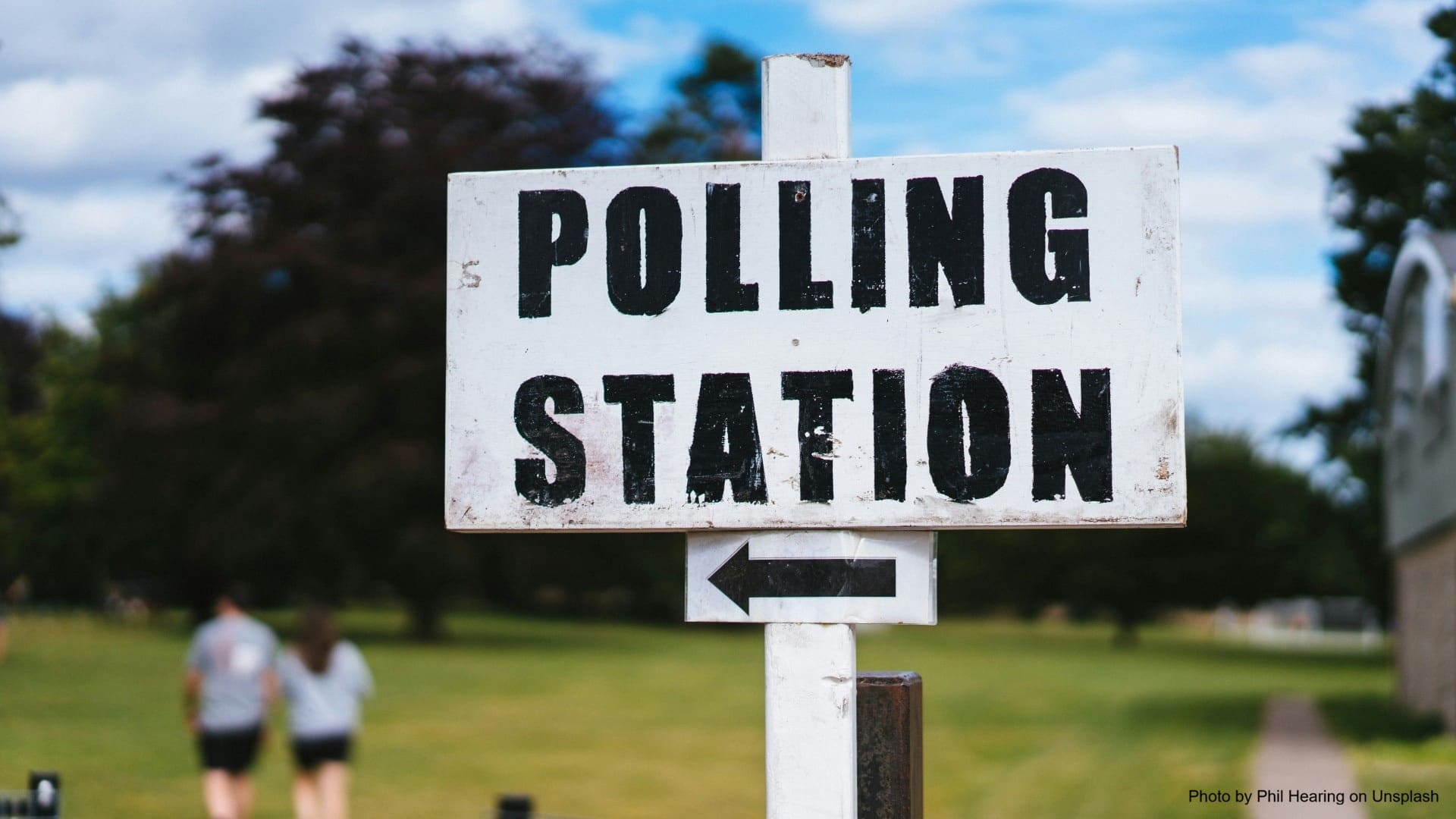
David Klemperer argues that any upcoming national commission on electoral reform should address the question of whether to introduce compulsory voting.
In his speech to Labour Party Conference last month, Andy Burnham announced his intention to establish a National Commission on Electoral Reform, as a first step towards achieving his long-stated ambition of replacing the First-Past-the-Post (FPTP) voting system used for general elections.
This announcement is to be welcomed: although there is a growing consensus amongst both academic analysts and progressive politicians in support of the Prime Minister’s position that FPTP is broken, electoral reform remains a politically fraught subject – and one that must be approached with care. It is essential that any change to the electoral system be carefully considered (to avoid a poorly-designed system producing unintended consequences), and that it be implemented via a non-partisan process (to avoid either a system designed for partisan advantage, or one wrongly perceived as such).
Establishing an independent deliberative body to recommend a new system is thus an astute way of approaching the issue. The All-Party Parliamentary Group for Fair Elections previously published a helpful blueprint for how such a National Commission could work: they envisage a year-long process led by non-partisan commissioners, with both expert-led and deliberative elements designed to enable an informed national conversation.
However, while this blueprint should guide the National Commission’s structure, important political questions remain as to its remit. Many electoral reformers will be urging the Prime Minister to limit this to the voting system alone. Certainly, it is important to keep the National Commission’s remit focused, and not to overload it by asking it to adjudicate on every issue. However, in addition to potential alternatives to FPTP, the National Commission should also be asked to consider the introduction of Australian-style compulsory voting.
First and foremost, this is because when deciding on ‘how we vote’, the parallel question of ‘who votes’ cannot and should not be ignored. Today, UK elections are distorted not only by FPTP, but also by a serious problem of both low and unequal turnout. Not only did barely more than 50% of eligible voters cast a ballot at the last election, but turnout is now consistently much higher amongst the rich than the poor, the old than the young, the white than the racialised, and the secure than the insecure.
Crucially, these disparities in turnout – and the unrepresentative electorate they produce – have a downstream impact on our politics: they warp the electoral incentives facing politicians and governments, and tilt the playing field of British politics against the interests of younger, poorer, and more insecure sections of the public.
In recent years, we have seen governments consistently prioritise the interests of high-turnout demographics, and disregard those of low turnout groups – through austerity that fell hardest on low-income and working-aged people while protecting universal benefits for the elderly, and through macro-economic strategies that prioritised the asset values of homeowners over wage growth for working people. Looking ahead, even when governments do try to prioritise delivering for workers, renters, and young people, low and unequal turnout risks making it difficult for them to win re-election on that basis – potentially locking the UK in a vicious spiral of skewed politics and structural inequality.
By massively driving up turnout, and reducing turnout inequality, compulsory voting can rebalance the political playing field in favour of the demographic groups that have consistently been badly served, and in favour of a politics that is capable of delivering for everyone. While only a new voting system can resolve the political and geographic distortions produced by FPTP, only compulsory voting can resolve the demographic distortions produced by low and unequal turnout.
Secondly, by asking the National Commission to consider the introduction of compulsory voting alongside a new voting system, the government would have an opportunity to potentially maximise the impact of electoral reform. By making the first election held under a new voting system the first in which turnout was near-universal, the simultaneous introduction of compulsory voting would highlight the significance of electoral reform as a moment of democratic reset, and as the foundation of a new relationship between politicians and the public that elects them.
Compulsory voting would also ensure that all voters were familiarised with any new voting system as soon as possible. This would help to embed it in the minds of the public, and prevent a situation from developing in which electoral reform was experienced only by a minority, and so inadvertently reinforced the disconnect between politics and current non-voters by making elections feel more unfamiliar and alien.
Thirdly, compulsory voting is popular with the public. Recent polling has consistently shown compulsory voting commanding either plurality or majority support – a level of support equivalent to that for changing the voting system. If a National Commission on Electoral Reform is intended to be genuinely deliberative, and to take seriously public preferences regarding the electoral system, it would be wrong for compulsory voting to be excluded.
Including compulsory voting in electoral reform discussions may clash with a liberal approach to electoral reform – one which is content to see elections represent only a part of the public, so long as that part’s preferences are represented fairly. But reforming a broken voting system without addressing the problem of low and unequal turnout risks failing to address one of the key ways in which vast swathes of the public are left unrepresented and ignored by our politics.
Ultimately, only by including compulsory voting in the National Commission for Electoral Reform’s remit can the government hope to fulfil the Prime Minister’s own stated ambition to “change the electoral system so that everyone’s vote counts and everyone’s voice is heard.”
By David Klemperer, Research Assistant, Institute for Policy Research, University of Bath.