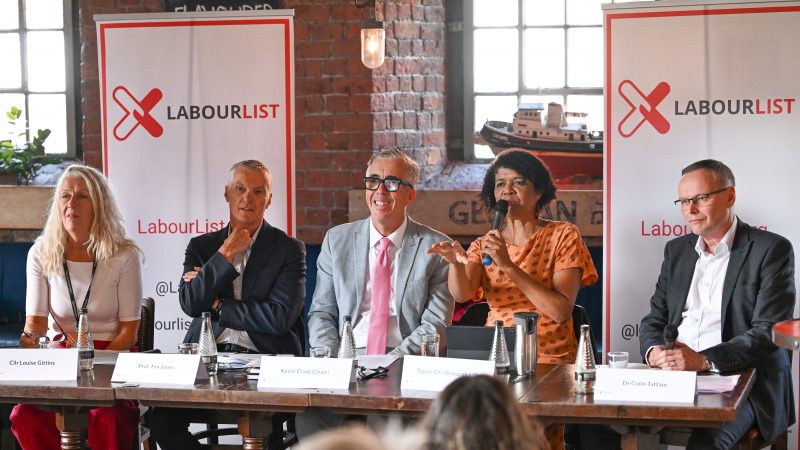

The North’s research strengths will not turn into growth until Whitehall understands the region and investors can be persuaded to look beyond London, Dame Chi Onwurah MP has said.
The Chair of the Science, Innovation and Technology Select Committee said government knowledge of places outside the capital was far weaker than most people assume: “Whatever you think might be the limits of that ignorance, multiply it by 10.” Her committee’s Flying Blind report found that the government lacks basic data on where startups are forming and where growth is happening at a local level.
Onwurah was speaking at a discussion on the North’s economic prospects, hosted by LabourList with the University of Liverpool and the N8 Research Partnership at Labour Party conference on Monday. With the government drawing up its Northern Growth Strategy, the panel, chaired by Kevin Craig, LabourList Board member, discussed why the region’s research excellence has not yet delivered matching investment.
University of Liverpool vice-chancellor Professor Tim Jones said decisions by successive governments had “skewed the research landscape”. He cited the national synchrotron facility, which moved from Daresbury in Cheshire to Harwell in Oxfordshire and helped fuel growth there at the expense of the North West.
For Dr Colin Tattam, Director of the N8 Research Partnership, which brings together the eight most research-intensive universities in the North of England, the difficulty begins once the research is done. The North’s share of UK university spinout investment rose from 2 percent in 2019 to what he called “a measly 8 percent” in the first half of last year.
Much of that gap comes down to capital. Jones said persuading London-based investors to look north remained “very hard”. Onwurah argued that universities should prepare founders to pitch to investors as well as developing their technology. She added that public money invested in the North draws in more private investment per pound than money spent in the Golden Triangle of London, Oxford and Cambridge.
Several panellists highlighted the need for cooperation by northern institutions. Cheshire West and Chester Council Leader Cllr Louise Gittins, who chairs the Cheshire and Warrington Combined Authority, said too much planning still follows administrative lines that residents and businesses ignore. The North should organise around “functional economic geographies” of labour markets, supply chains and investment, she said, and she pointed to the Great North trade mission to India, where mayors, universities and businesses will travel together next month, as a template for cooperation.
Tattam agreed that the region should focus on “the geography of the opportunity rather than the geography of the administration”, and cautioned against treating partnership as a slogan. He said: “Collaboration works best where you’re pulling together around a really clear mission with clear roles, clear direction.” Ambitious groups that succeed, he added, rarely say it was easy, and the North will need to show its “grit” to deliver.