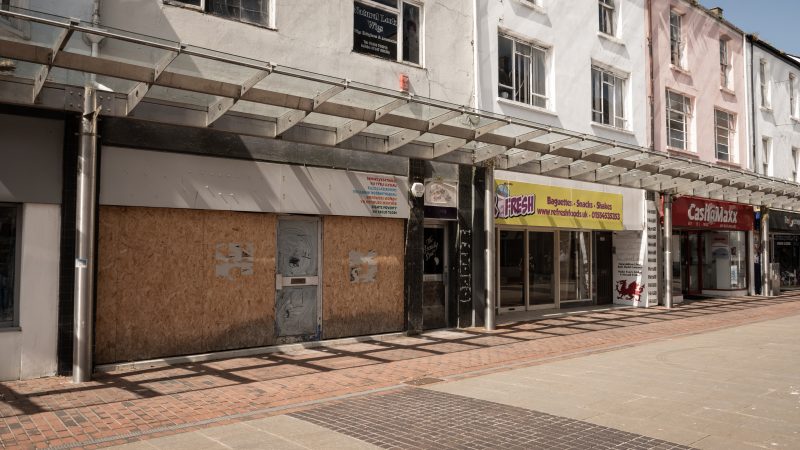

Walk down any high street in Britain today, spark a conversation and you are very likely to hear the same observations. It doesn’t matter if you are standing in former industrial heartlands in the Midlands, rural Wales, a valley in Yorkshire, or inner London. The inventory is functionally identical: empty store units, vape shops, betting parlours, nail bars, and barbers.
When the Good Growth Foundation, in partnership with LabourList, brought together focus groups of voters across the country to explore what’s pulling people to the populists, we heard from voters who backed Labour in 2024 but are now drifting toward Reform UK on one side or the Green Party on the other. The unanimity was striking. These voters may seem to be pulling in opposite, irreconcilable directions, but they are looking at the exact same boarded-up storefronts and feeling the exact same erosion of control over their lives, their freedom to make life choices and security to plan.
The conventional wisdom in Westminster holds that Labour is trapped in an impossible squeeze, caught between a populist right demanding disruption and a progressive left demanding systemic transformation. But our research reveals a very different reality. None of these voters have actually left Labour yet. And their angst comes from similar economic places. Their votes in 2025 were provisional – driven more by a desire to remove the Conservatives than a deep-seated ideological pledge – and they are not asking for a radical change in values or direction.
READ MORE: Labour Party Conference 2026: Full LabourList events programme, revealed
What they are asking for is simple: proof that something actually works.
A loss of control
For millions of people, the defining crisis of modern Britain is not an abstract statistical debate about GDP; it is the total loss of personal agency and tangible progress. A loss of control. Over prices and services. People carry precise, painful receipts of how their lives are being squeezed. They talk unprompted about bus and train fares, heating bills looming like an annual threat, or being forced to hold off on having kids. Crucially, this squeeze has moved beyond discretionary spending. It is now eating into people’s long-term security – forcing them to pause pension contributions or forgo career training, cutting off the very routes that allow them to build a better future.
Underneath these quiet sacrifices lies a profound grievance: the sense that the basic bargain of working life – that effort yields progress – has been broken. That the social contract is broken.
Parents watch their twenty-something children get locked out of entry-level apprenticeships because they lack experience, while workers holding down multiple jobs find themselves running on a relentless treadmill just to stay in place.
When people feel that the rules of the economy no longer offer them a path forward, they become what we have called “populist curious.” They do not necessarily buy into the full agendas of alternative parties; in fact, many are held back by legitimate fears, whether over Reform’s stance on the environment following a summer of wildfires or the Greens’ resistance to crucial infrastructure.
A promise of delivery
What draws them toward these alternatives is not detailed policy, but clarity, posture, and the promise of a system being forced to deliver.
Become a friend of LabourList and join our community. Our friends support our vital non-factional work and get access to exclusive content and events.
If the government is to win these voters back, it must understand that incrementalism dressed up as progress will not cut it. Quick fixes may be welcomed, but voters explicitly describe them as “baby steps”.
Worse, when policies are announced without immediate, visible local impact, they can inadvertently remind people of how much they have been left behind.
Enabling a life worth choosing
To bridge the gap between promises made in Whitehall and real life on the high street, political strategy must focus on two non-negotiable principles: tangible signs the system is getting fixed and people are enabled to make big life choices; where you live, your work and starting a family.
The answer will not be found in sharper spin or smaller promises. It will be found in delivering real, undeniable improvements that people can see when they step out their front door – and giving them back the power to build a life worth choosing.
Only then can Labour keep populists at bay.
First, change must be felt in the physical fabric of daily life. Delivery cannot be an invisible administrative metric; it must be fast, visible, and unmistakable. Whether it is resurrecting derelict high streets, renovating empty homes, filling potholes or restoring public transport and services to working order (yes, think bright yellow buses) people need to see the dial moving in real time to fix what is currently not working. Speed and visibility are what build trust. When people see visible action in their immediate surroundings, hopelessness gives way to patience.
Second, and most importantly, governance must restore agency to ordinary citizens. People do not just want a government that manages decline more compassionately; they want a government that empowers them to shape their own destinies. That means creating an economy where hard work once again offers a reliable ladder up where young people can access real skills and secure jobs; where families can afford to invest in their own futures, and have families in the first place; and where communities have a genuine stake in local regeneration. It also means showing a firm, independent posture on the national and global stage, proving that leadership will stand up for domestic interests and against vested interests – especially in the face of an unreliable America – rather than passively accepting decline.
The voters drifting toward the fringes are not lost. They are waiting.
They are giving the political mainstream one last, cautious look, asking for a reason to stay. We can give it to them with real delivery.
LabourList and Good Growth Foundation will be discussing these ideas on Sunday 27th September from 12.00 – 13.00 at a conference fringe event titled ‘The Big Challenge: How Can Labour Win Back Populist-Curious Voters?’
Location: Good Growth Foundation Pod, Dee Room, Lower ACC Hall
Subscribe here to our daily newsletter roundup of Labour news, analysis and comment– and follow us on TikTok, Facebook. You can also write to our editor to share your thoughts on our stories and share your own. The best letters are published every Sunday.

Praful Nargund is director of the Good Growth Foundation. He was Labour's candidate in Islington North at the 2024 general election.
View all articles by Praful Nargund