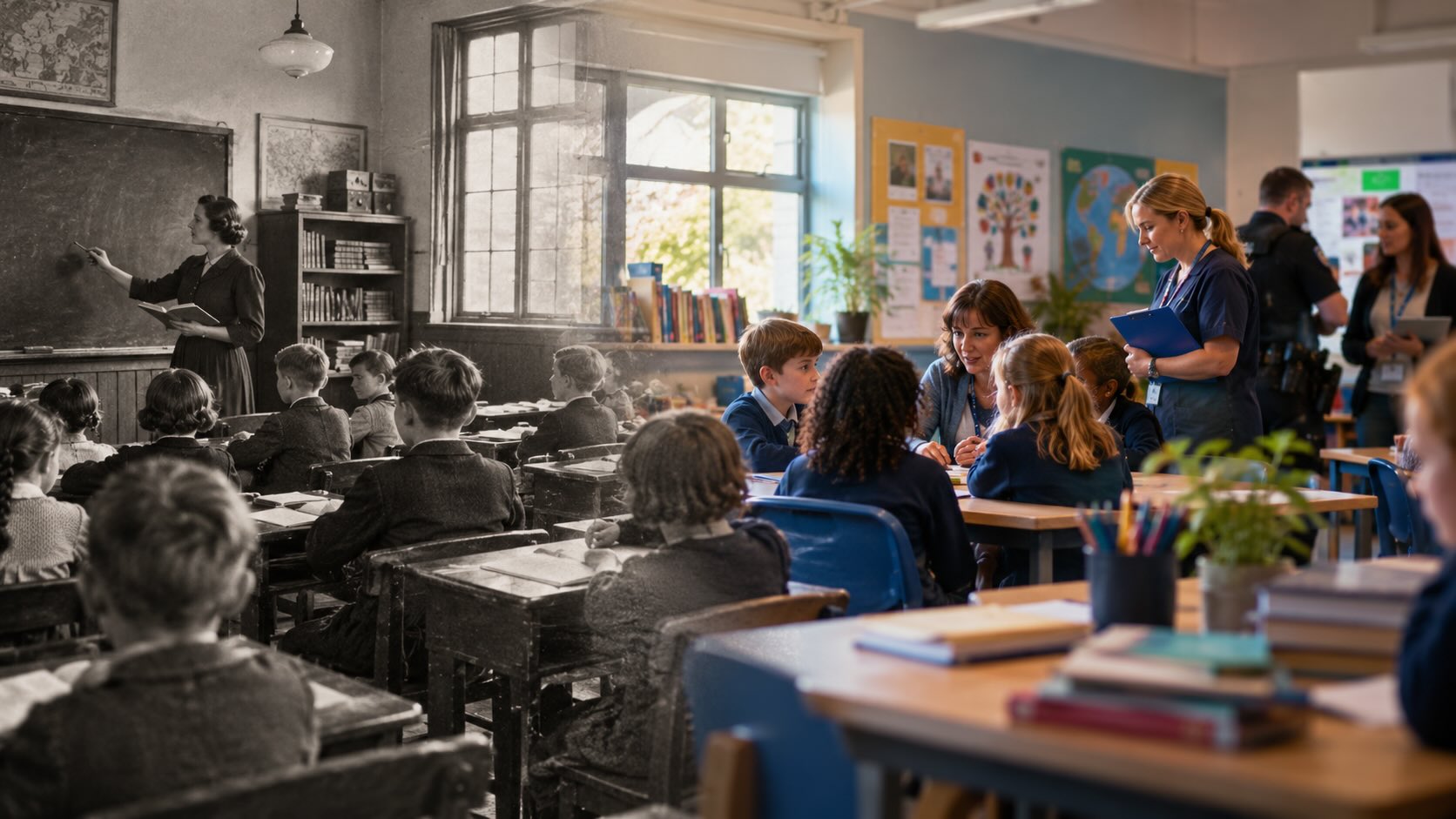
This is Part 1 of a multipart article series by Jennifer Thetford-Kay and Cathy Mudge of Protect and Teach. The series examines how the role of UK schools has changed over the last 20–25 years. The authors challenge UK Government policies and aim to build a counternarrative that could be used in future approaches to UK education. Watch the UK Column interview in which Jennifer and Cathy spoke with Professor Diane Rasmussen about this work.
Schools have never been concerned only with examinations and academic attainment. Teachers have always dealt with illness, family difficulties, behaviour, bullying, and children in distress, while schools have long been expected to contribute to pupils’ development beyond the purely academic.
So what changed? How did schools acquire such a wide role?
Modern schools increasingly sit at the centre of health, safeguarding, wellbeing, family support, and wider social policy. Staff may identify concerns, refer pupils to outside services, work alongside other professionals, and contribute to outcomes far beyond classroom attainment.
There was no single Act of Parliament, ministerial speech, or manifesto in which the UK Government announced that the purpose of school had fundamentally changed. The record shows something more gradual. Ideas developed elsewhere entered government through institutions, advisers, research, lobbying, and funded pilots, and then acquired policy, money, and law.
The story begins much further upstream.
Ideas about educating the ‘whole child’ long predate the modern wellbeing agenda. The intellectual roots stretch back through European thinkers such as Jean-Jacques Rousseau, Johann Pestalozzi, and Friedrich Froebel, whose work helped shift educational thought toward children’s development, experience, and individual needs. Later figures including Maria Montessori, Rachel McMillan, and John Dewey developed different strands of that tradition, with Dewey placing particular emphasis on experience, participation, and the school as a social community.
This was not simply a genealogy constructed later. The 1967 Plowden Report itself named Rousseau, Pestalozzi, Froebel, Alfred North Whitehead, Dewey, Montessori, and McMillan among thinkers whose work encouraged educational change. It suggested that Froebel probably exerted the strongest direct influence, transmitted through the teacher training colleges that bore his name.
Plowden also traced a more liberal English tradition back to Robert Owen, reinforced by Froebel and Montessori. In other words, the idea that schooling should respond to children’s stages of development rather than simply deliver uniform instruction had been circulating long before the language of modern ‘wellbeing’ appeared.
British official thinking had already begun absorbing some of those ideas decades earlier. The 1931 Hadow Report, , argued that primary education should be shaped around the particular needs of childhood. It described the school as simultaneously a physical environment, a place for developing the mind, and a social institution.
Its curriculum recommendations were strikingly modern in tone. Education, it argued, should be conceived in terms of “activity and experience” rather than simply knowledge to be acquired and facts to be stored. The report also considered children’s physical and mental development in detail, and drew directly on specialist expertise, including work by psychologist Cyril Burt.
Psychology then added another layer. Plowden discussed the work of Susan Isaacs, Jerome Bruner, and Jean Piaget, and said Piaget’s thinking had influenced both the 1931 Hadow Report and Plowden itself. The emphasis increasingly fell on how children develop, how they interact with their environment, and how learning occurs through exploration and experience rather than instruction alone.
The Plowden inquiry itself was commissioned in 1963 by Conservative Education Minister Sir Edward Boyle and chaired by Bridget Plowden. Its report, Children and Their Primary Schools, opened the chapter on growth and development with the declaration that “at the heart of the educational process lies the child”.
That was more than a slogan. The report considered emotional development, the home environment, parental participation, the ‘community school’, pre-school provision, and disadvantage. It also devoted an entire chapter to “the health and social services and the school child”.
Many ideas now associated with ‘whole-child’ education were therefore present in official British thinking decades before ‘Every Child Matters’.
Yet something else was developing alongside them. Public health thinking was changing, too. An important earlier landmark was the World Health Organization’s (WHO) 1978 Declaration of Alma-Ata, which promoted primary health care, prevention, community participation, and action across sectors rather than treating health solely as a matter for medical services.
That thinking fed into the WHO’s ‘Health for All’ strategy during the 1980s. WHO now describes that period as the foundation of what became the ‘Healthy Settings’ approach: the idea that health is shaped by the social and institutional environments in which people live their everyday lives. The Ottawa Charter for Health Promotion, agreed on at the first International Conference on Health Promotion in 1986, became a landmark in that shift. More than 200 participants from 38 countries attended, including health professionals, politicians, academics, and representatives of government, voluntary, and community organisations.
Ottawa argued that health was created not only through medical care but through the circumstances of everyday life. Its much-quoted formulation was that health is created where people “learn, work, play and love”. The Charter went further. It called for supportive environments, community action, and the development of personal skills. It said health education and life skills should be facilitated in school, home, work, and community settings, with action involving educational, professional, commercial, and voluntary bodies. Once public health is understood in those terms, schools become difficult to ignore.
Children spend thousands of hours at school, and schools reach almost the entire child population. A school can therefore become not only somewhere health is taught, but somewhere health is promoted through the institution itself. This was part of a wider movement within WHO and European public health. Figures such as Professor Ilona Kickbusch, who worked within WHO Europe during the development of modern health promotion thinking, helped advance the broader settings-based approach. The crucial point, however, is institutional rather than personal: WHO increasingly treated schools, workplaces, cities, and other everyday environments as settings through which health could be shaped.
That approach soon became more specific to education. WHO describes a ‘Health-Promoting School’ as one that strengthens its capacity as a healthy place for “living, learning and working”. Its model includes school policies, the physical and social environment, health services, counselling, mental health promotion, staff health, family involvement, and community links. By the early 1990s, the concept was becoming international infrastructure. WHO says the ‘Health-Promoting Schools’ concept was being articulated with UNESCO and UNICEF by 1992, before later global initiatives encouraged countries to implement the model at scale.
WHO’s Global School Health Initiative, launched in 1995, then sought explicitly to improve the health of pupils, school staff, families, and communities through schools.
This was not yet British education policy. It was an international public health model developing the institutional machinery through which schools themselves could become part of health promotion.
It would be wrong to present this as something invented by Tony Blair’s government. The Education Reform Act 1988, passed under a Conservative government, already required maintained schools to provide a “balanced and broadly based curriculum” promoting pupils’ spiritual, moral, cultural, mental, and physical development alongside preparing them for adult life.
Health and personal development were also being threaded through the new National Curriculum machinery. In April 1988, Education Minister Angela Rumbold told Parliament that personal and social education covered health, careers, political and environmental education, and economic awareness. She said elements would appear as cross-curricular themes in science and elsewhere.
The Health Education Authority was pushing in the same direction. During debate on the Education Reform Bill, Parliament heard that its chairman had warned ministers that health education could not be fully covered through science and that personal and social education risked being diminished. Rumbold replied that the new National Curriculum Council was expected to consider personal and social education at an early stage.
By March 1989, Education Minister John Butcher was describing health education as an “important cross-curricular theme”. He also confirmed that the National Curriculum Council had been asked to advise on the place and content of personal and social education, including health education, across the curriculum. The Council subsequently published Curriculum Guidance 5: Health Education. The direction of travel was becoming clearer; health was no longer simply a topic for the science classroom. By 1992, the link between education and public health was even more explicit.
Health Secretary Virginia Bottomley launched the Conservative Government’s white paper, The Health of the Nation, in July 1992. She described it as a strategy for the UK Government as a whole and said more than 2,100 individuals and organisations had responded to the preceding consultation. Asked how education fitted into that strategy, Bottomley said the departments were already working through the Health Education Authority on smoking, sex education, drug addiction, healthy eating, and the “development of healthy schools”. Here the phrase “healthy schools” was already being used within Conservative government policy before England entered the European network and well before Labour’s national Healthy Schools Initiative.
The domestic strategy was also connected to international public health policy. In 1991, Bottomley confirmed that progress towards the WHO’s ‘Health for All’ targets was being reviewed periodically, while 14 government departments were represented on a ministerial group overseeing development of the national health strategy.
England then formally entered the European Network of Health-Promoting Schools in September 1993.
By June 1995, Health Minister Tom Sackville told the Commons that 16 English pilot schools were working with external agencies and that the Department of Health was contributing approximately £400,000 that year.
The English project also had an identifiable infrastructure. Carol Healy, a project manager at the Health Education Authority, was identified as national coordinator for the European Network of Health-Promoting Schools project in the UK, while the National Foundation for Educational Research evaluated the English work.
Before Labour took office, England therefore already had cross-curricular health education, a national public health strategy referring explicitly to ‘Healthy Schools’, links to WHO’s Health for All agenda, membership of the European network, funded pilots, national coordination, and formal evaluation.
Healthy Schools therefore built on work that was already well under way.
How Does an Idea Get into Government?
Ideas do not legislate for themselves. They move through academics, professional bodies, foundations, public agencies, advisers, and ministers.
Citizenship provides an unusually clear example. Labour’s 1997 White Paper Excellence in Schools pledged to strengthen education for citizenship and democracy. Education Secretary David Blunkett then appointed Professor Bernard Crick to chair an Advisory Group on Citizenship. Its 1998 report was largely adopted, and Citizenship became compulsory in secondary schools from September 2002.
Crick was not a civil servant implementing somebody else’s theory. He was a political thinker whose work on citizenship and political education stretched back decades. The UK Government provided a route through which a longstanding intellectual project became curriculum policy.
Paulo Freire is often invoked in discussions of participatory or critical education. His rejection of the passive ‘banking’ model of teaching certainly resonates with later language about learner agency. The documentary trail, however, does not support presenting Freire as an architect of English citizenship policy. Tristan McCowan’s comparison of Freire and Crick described Freire’s influence on UK citizenship education as “marginal” and Crick as “perhaps the single greatest influence on citizenship education in England”. Similarity of ideas is not proof of influence.
Government was not the only route either. In 1997, the Calouste Gulbenkian Foundation, with support from the Department for Education and Employment, commissioned PASSPORT to raise the status and quality of personal and social education. Its framework brought together health, citizenship, sex and relationships, drugs, parenthood, financial capability, safety, sustainability, careers, skills, attitudes, and values. Its authors, Jane Lees and Sue Plant, were also prominent within national PSE and PSHE structures.
The pattern is worth noting. A foundation commissions work. The government supports it. Specialists develop the framework. Those specialists also participate in national professional and advisory networks. When Blunkett told the Commons about the Crick group in February 1998, he added that the Minister for School Standards would bring forward proposals “in consultation with the Department of Health” so that personal and social education was supported by health education. The line between ideas originating ‘inside’ and ‘outside’ government became much less tidy.
Labour then scaled up what had been a mixture of health education, European networking, and pilots. On 14 May 1998, Public Health Minister Tessa Jowell and the Minister for School Standards launched the cross-government Healthy Schools Initiative. Jowell told the Commons that it carried £2 million in its first year, half from health and half from education. Eight health-education partnerships received £150,000 each. “It is our intention”, she said, “that every school should become a healthy school”.
These were not simply awareness campaigns. Within a year, Education Minister Charles Clarke said the initiative would address ‘emotional health and well being’ and described prevention of emotional, behavioural, and mental health problems as “a key element of our policy”. The National Healthy School Standard followed in October 1999. By April 2000, Schools Minister Jacqui Smith was confirming that ‘emotional health and wellbeing’ was one of its themes, backed by £5.7 million a year for local partnerships. Most importantly, a joint government memorandum to the Commons Health Committee described a ‘whole school’ approach resting on “the involvement of everyone — pupils, staff, parents, governors and partner agencies”. It said the programme “has taken account of” lessons from the WHO Health-Promoting Schools scheme.
The programme kept growing. Schools Minister Lord Adonis told the Lords in October 2006 that 48% of schools had achieved the ‘Healthy School’ standard, with investment above £12 million that year. Two years later, he quoted guidance stating that a healthy school “involves professionals from appropriate external agencies”, including school nurses and drug education advisers.
The school was no longer only teaching children how to make healthy choices. It was becoming part of the intervention.
A different policy strand was developing at the same time. Section 175 of the Education Act 2002 required local education authorities and maintained-school governing bodies to make arrangements so that their functions were exercised “with a view to safeguarding and promoting the welfare of children”. Section 176, in force in England from September 2003, required them to have regard to official guidance on consulting pupils about decisions affecting them.
Then came the aftermath of Victoria Climbié’s tragic death. Lord Laming’s inquiry, published in January 2003, exposed serious failures of communication, practice, and interagency child protection. The UK Government responded in September with a green paper called . The response went far beyond tightening child protection procedures. It organised policy for all children around five outcomes: Being Healthy, Staying Safe, Enjoying and Achieving, Making a Positive Contribution, and Economic Well-being.
It also gave schools a new place. “The Government wants to integrate education, health and social care services around the needs of children,” it said. “To achieve this, we want all schools to become extended schools — acting as the hub for services for children, families and other members of the community”, offering services “that go beyond their core educational function.” The Children Act 2004 subsequently created a statutory framework for cooperation around children’s wellbeing, while the Education and Inspections Act 2006 brought the language of wellbeing directly into maintained-school governance.
The different streams were now visibly converging: education, public health, child protection, wellbeing, and wider children’s services increasingly met around the same institution and the same child.