, the business secretary, has not contested reports saying that, in the budget tomorrow, John Healey, the chancellor, will pause the process of equalising the lower national minimum wage paid to people under the age of 21 with the more generous national living wage that applies to older workers.
In an interview on the BBC this morning, Reynolds was asked to respond to a story suggesting the equalisation process has been put on hold because of concerns about youth unemployment.
In a story for the Times, and report:
John Healey will announce plans to increase the minimum wage by nearly 4% but slow the rise for young people after warnings that they are being priced out of jobs.
The Times has been told that the national living wage, which applies to those aged 21 and over, is expected to rise from £12.71 to around £13.20 – an increase of 3.9%.
However, Healey has decided not to repeat the big rises of the past two budgets in the national minimum wage, which applies to those aged 18 to 21. It will rise broadly in line with the rate for older workers – from £10.85 to around £11.27, an increase of 3.9%.
In its manifesto, Labour said it would raise the level of the national minimum wage to the level of the national living wage to "so all adults are entitled to the same minimum wage, delivering a pay rise to hundreds of thousands of workers across the UK". The manifesto implied this would happen during this parliament, but in May Torsten Bell, the pensions minister, said implementation of this commitment could be delayed until after the general election – implying the government is worried equalisation now could increase youth unemployment.
Asked about the Times story on the Today programme, insisted the new national living wage and national minimum wage rates would be announced tomorrow.
But he went on:
The manifesto pledge on equalisation still applies, but it was always clear it would happen over time and we would take into account, as the minimum wage uprating each year always does, the relative strength of the labour market and other pressures …
Of course, you want not just good wages, but good work. And the way this has always been done – it is a balance of making sure the pressures on the labour market are taken into account. That is the approach you will see confirmed [in the budget].
The Green party has accused Labour of breaking a manifesto promise. Responding to the Times' story, and Reynolds' comments in effect confirming it, , the Greens' co-deputy leader, said:
Anyone doing a day's work, needs to be paid the same rate for the same job. A young person's rent and food bill is no less because they are young, so they need to receive the same wage.
Healey and Burnham are now breaking a manifesto pledge to young people that even Starmer managed to keep. Labour have no respect for young people, who appear to just be there for cheap labour for the wealthy and their corporate donors.
Ali said the Greens would introduce a £15 minimum wage for workers of all ages.
Nigel Farage is desperately trying to drag politics further and further into the gutter. It seems there is no low he won't stoop to – he is completely unfit for public office.
Failing to call out blatant racism against the leader of His Majesty's Opposition despite being given at least ten opportunities to do so and then giving his activists the green light to support Tommy Robinson shows just who he really is.
For a full list of all the stories covered on the blog today, do scroll through the list of key event headlines near the top of the blog.
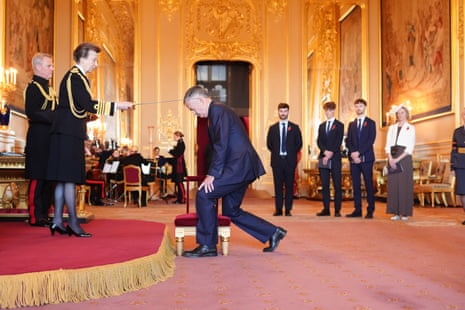
A National School of Government and Public Services has opened, the has announced. Mark Ferguson, a Cabinet Office minister, formally opened it today. The government says:
Regional hubs will be developed across the country, with the first opened in York this week, alongside digital access routes to give civil servants access to modern learning facilities close to where they live and work.
It will provide civil servants and public sector leaders with the world-class learning and development they need to meet the challenges of the future.
The school will build a curriculum around the skills all servants need, including training on devolution, national security, leadership and innovation. Training will also be offered in AI, covering the full range of skills needed now and in the future, from implementing practical solutions at the frontline to cut clerical workloads to cloud engineering courses to develop and deploy the latest technology across government, the School will equip Civil Servants with the tools to build a world-class Civil Service.
Last week the government launched a Be Ready campaign to publicise advice saying people should stockpile water, food and other supplies in the event of an emergency. The announcement attracted a lot of attention, although many Britons probably sided with Angela Rayner, the housing secretary, who signalled that she was not going to get too alarmed by it all by joking about how she would include a bottle of sauvignon blanc and mascara alongside her government-mandated survival supplies.
, the security minister, gave a statement about the advice to MPs this afternoon. In his opening comments, he did not pass judgment on the usefulness or otherwise of a bottle of wine, but he did have some points to add.
-
Jarvis dismissed claims that the advice was an "overreaction". Anyone who did think that should have been with him when he met victims of Storm Goretti earlier this year, he said. He said 50,000 homes, schools and businesses were left without power, communities were cut off because of blocked roads and families experienced having "the basic necessities of everyday life", like power, water and the internet, taken away from them.
This figure is far lower than our European neighbours. The very same research showed that 84% of people in the UK want the government to share more information about the steps they can take to increase their preparedness.
-
He said the last government launched a website giving preparedness guidance, but there was no proper publicity campaign and "not enough people noticed [the advice], and those who did found the guidance hard to follow".
The two main actions are ensuring that you have three days of water and non-perishable food, and signing up to the Priority Services Register if you or someone in your household is eligible for extra support in a utility outage.
-
He joked about how, before he was in the Parachute regiment, he was a Boy Scout where the motto was "Be Prepared".
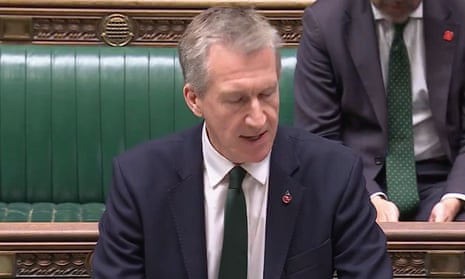
, the chancellor, will give £15m to a dedicated fund to tackle misogyny in workplaces, schools and public places amid concerns in government about the rise of "manosphere" influencers, reports.
has said that he wants to be a prime minister who brings to an end "a decade of division".
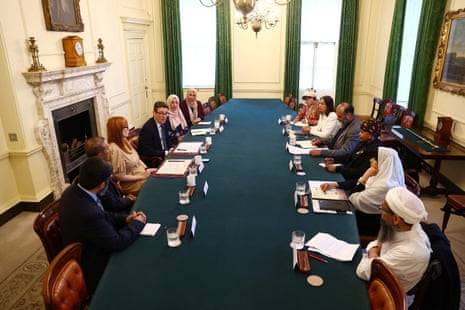
He made the remark at a meeting with Muslim leaders in Downing Street this morning, where he said British Muslims were particularly likely to be victims of hate.
Without giving examples, he also said some of the language used by opposition parties about Muslims was "completely unacceptable".
Speaking at the opening of the meeting, Burnham said
Where I want to start is just to talk a little bit about the style I'm trying to bring into my role.
I'm really clear in saying that we cannot have another decade of division like the one we've lived through.
It's easier said than done, of course. But I did try on the steps outside Downing Street to talk very directly about that, drawing a line on it and building a more positive, hopeful feeling within the country. I'm going to stick to that path and try and move the country beyond some of what we've all lived through in the last 10 years.
And I know Muslim communities across different parts of the country have really in many ways lived through some of the worst examples of division and the hatred that people experience.
Burnham said that he wanted to be a PM "alongside the [Muslim] community, visibly so, very much sending that message, particularly to younger Muslims across Britain, that this is their country, this country is behind them, working to support them."
As the Press Association reports, attendees included crossbench peer Lady Gohir, who leads the Muslim Women's Network; Shabir Randeree and Akeela Ahmed, chair and chief executive of the British Muslim Trust; Bibi Khan of the London Islamic Cultural Centre; and Javed Khan, managing director of the Equi thinktank.
Human rights activists and celebrities including the lawyer Helena Kennedy, the actor Harriet Walter and the theatre director Phyllida Lloyd have urged the Home Office to overturn its decision to refuse a visa to a former member of the radical US group the Weather Underground, saying her decades of rehabilitation should count in her favour. has the story.
has posted this on social media about Harry Kane winning the Ballon d'Or.
To be the first Englishman in 25 years to win the Ballon d'Or is an extraordinary achievement.
Thoroughly well deserved.
As reports, Downing Street was dropping strong hints this morning that a knighthood is on the way for Kane.
The SNP is also making a last-minute budget submission to the chancellor. It is calling for VAT on petrol and diesel to be removed.
, the SNP's economy spokesperson at Westminster, said:
In the face of a cost-of-living emergency, Andy Burnham has broken his promise to cut bills and is insulting voters with minuscule announcements that won't scratch the surface. [See 9.07am.]
The fact is every major household bill has risen under Burnham.
He is treating voters like fools by pretending he is delivering 'breathing space' when energy bills will soon be £1,000 higher than the Labour party promised, mortgage rates are up at 6%, and the price of petrol, diesel, food and shopping has gone through the roof on his watch.
At the UK budget on Wednesday, the chancellor must finally deliver meaningful help for the majority of households by cutting energy bills by at least £300 and by removing VAT from petrol and diesel for the remainder of the fuel price crisis.
It could save households in Scotland £500 as prices soar under the Labour government.
(Describing statements like this, and the Lib Dems' (see 2.20pm), as budget 'submissions' is journalistic fiction in some respects, because the budget has already been written. But opposition parties feel it is important to set out their views.)
The government has confirmed that the UK will rejoin the Erasmus+ student exchange scheme from the start of January, the Press Association reports. PA says:
Foreign Office minister said applications would open next month for young people who will be able to study, train or get work experience in the European Union.
Speaking during Foreign Office questions, Falconer emphasised to MPs that the opportunities would be open to "educational institutions of all kinds".
Work on the UK joining the Erasmus programme was announced as part of Keir Starmer's post-Brexit reset deal with Brussels in 2025.
The UK left the scheme under Boris Johnson's Brexit deal in 2020, with the then-prime minister arguing it did not offer value for money.
It was replaced by the Turing Scheme, which was ended when the government announced the new deal over Erasmus plus.
The government has previously said it expects more than 100,000 people to be able to benefit, and that disadvantaged students tend to benefit highly from taking part in the scheme.
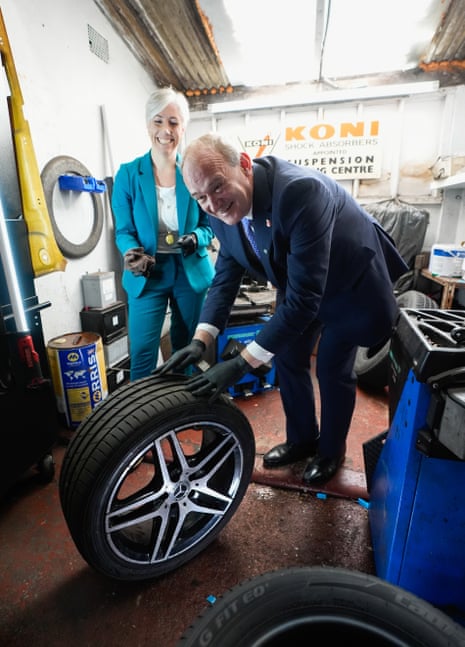
, the Lib Dem leader, and Daisy Cooper, his deputy, visited an MOT garage today – for the sole purpose, it seems, of providing a picture to illustrate his pre-budget soundbite.
In a statement, he said:
Labour has put the handbrake on the economy. Growth is in the slow lane and hardworking business owners like Bob are facing higher costs, a jobs tax, and a broken business rates system.
The economy desperately needs a tune-up. The Liberal Democrats would scrap business rates, replace them with a fairer system, and negotiate a proper growth and defence deal with Europe, so we can turbocharge our economy by joining the EU single market and customs union.
In a briefing on their own budget proposals, the said they would:
and spur investment and job creation across the UK, through a new growth and defence partnership with Europe, including joining the EU Single Market and a customs union.
• Scrap business rates and replace them with a fairer system. The Liberal Democrats would replace business rates with a commercial landowner levy. Firms would no longer be taxed on the value of the building or machinery they use, which penalises investment and hits independent businesses hardest.
• Boost skills and tackle the Neet crisis. The party would guarantee every young person 100 hours of work experience and professional enrichment before they turn 18 to tackle the Neets pipeline before young people fall out of education and work. This would also help tackle the growing number of young people not in education, employment or training (Neets), by making it cheaper for small employers to offer first jobs. According to latest ONS figures, there were an estimated 981,000 young people aged 16 to 24 years in the UK who were Neet in April to June 2026.
-Deliver a £14bn emergency cost of living package to give people breathing space.
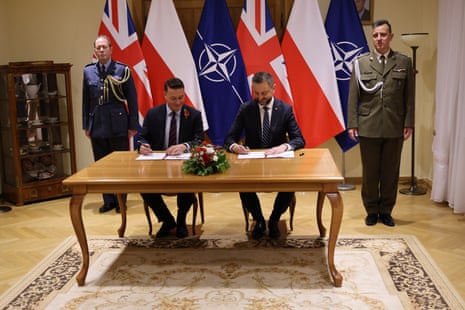
Britain and Poland have agreed to work together to build a new generation of air defence missiles, as the west gears up its defence efforts against Russia, the Press Association reports. PA says:
A new agreement, the Warsaw Defence Plan, will also see the two nations work together to build new drones and anti-drone measures, as well as collaborate closely on more traditional land, sea and air defence.
Defence secretary signed the pact in Warsaw today, where he met his Polish counterpart Władysław Kosiniak-Kamysz.
Streeting said: "Poland is one of the UK's closest allies – from flying together in the Battle of Britain, to breaking the Enigma code, they have been a vital partner for our defence for nearly a century.
"The new Warsaw Defence Plan honours this cooperation and sets out how we will continue to work together today, building a stronger Europe in a stronger Nato.
"From collaborating on Nato exercises that deter our adversaries to working together to support Ukraine in its fight for freedom, we are committed to standing together for European security whilst boosting our economies with stronger defence industries."
Under the pact, the two nations will share their experiences of developing new warships. Britain's Type 31 frigate and Poland's Miecznik are based on a common design.
The allies have also agreed to increase shared patrols in the Baltic Sea, to protect vital communications cables on the seabed.
The agreement comes ahead of a major coalition of the willing exercise next month, which will see British, French and German forces join Warsaw's soldiers in Poland for training to prepare for a peacekeeping mission in Ukraine once the war is over.
, the business secretary, said this morning that British government officials would be talking to their EU counterparts about possible changes to the UK-EU relationship. Possible options include the UK joining the single market, and so free movement would be part of that discussion.
The government seems to be nervous about suggestions it is already in talks about the UK signing up for free movement rules and, at the Downing Street lobby briefing this morning, a insisted free movement was not part of the current talks with the EU.
Those talks are "focused solely on next month's summit, and the practical agreements that we hope to make there that will add billions to the economy and cut the red tape that holds back British business," the spokesperson said.
She added:
Any future relationship depends on practical arrangements, on what is realistic for both sides, and, crucially, on what the British public supports. And the prime minister will set out the next steps when it comes to our longer term relationship around the time of the summit.
The summit will take place in Brussels on Friday 20 November.