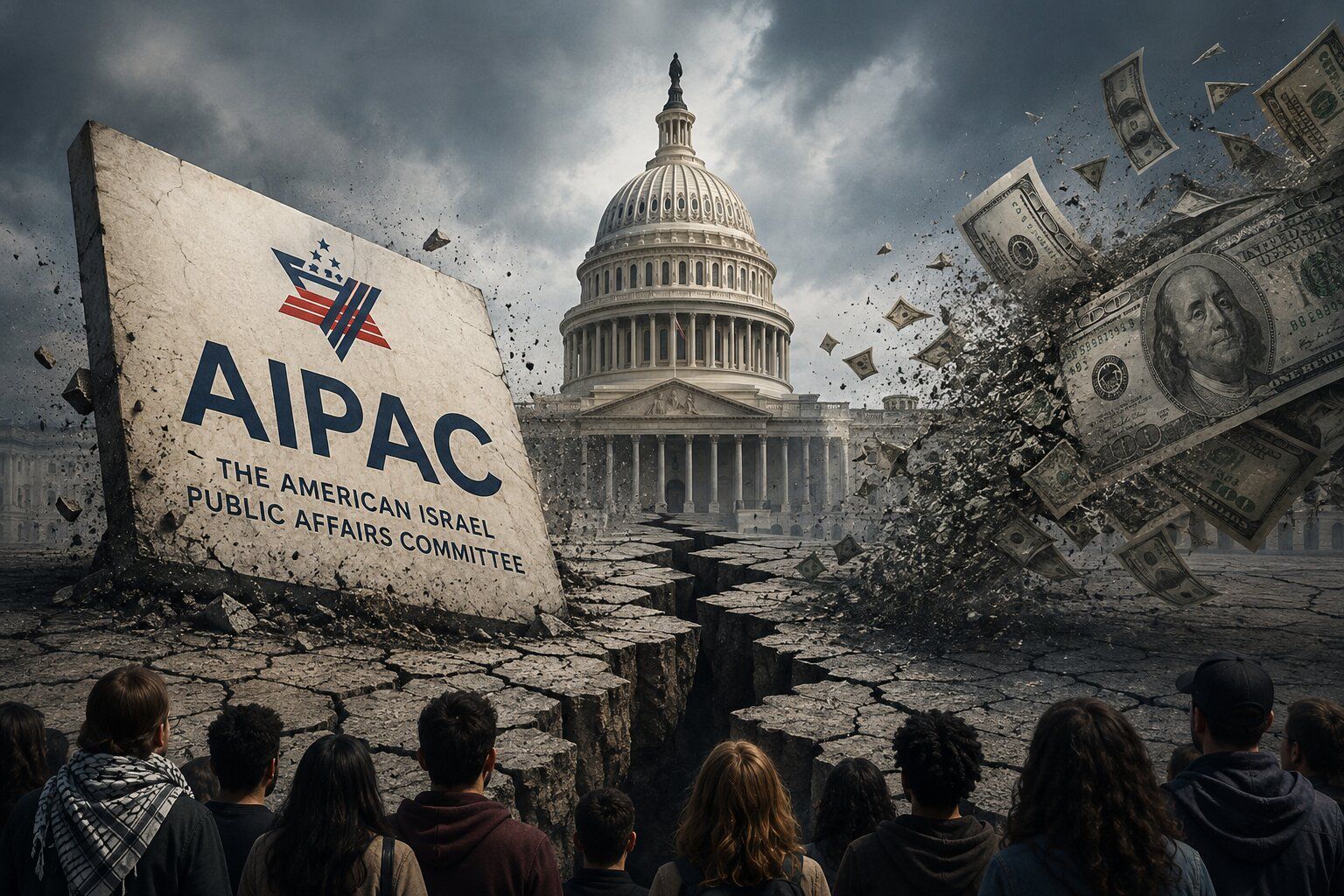
From having enjoyed a bipartisan monopoly in US politics for decades, the American Israel Public Affairs Committee (AIPAC) has begun to lose the aura that once distinguished it from other Washington power brokers, even as it remains an influential one.
The shift could prove tectonic.
The question facing future candidates in US elections is no longer: Must I make friends with AIPAC, or it will make sure my opponents win?
It is becoming: Do I dare take AIPAC money, or will that damage my political profile in the public's eye?
AIPAC may have more money at its disposal than ever, yet it appears to buy less and less of what made the organisation so formidable in the first place: .
recently summarised the changing perception in Washington: “AIPAC has rapidly become the most toxic brand on Capitol Hill”.
On 5 August, in the State of Michigan, Abdul El-Sayed — a Muslim physician who was born and raised in Michigan to Egyptian immigrant parents — defeated fellow Democrat Haley Stevens for an open US Senate seat. Stevens is a three-term congresswoman from Rochester Hills, Michigan, and a former Obama Administration official who has been a prominent supporter of Israel.
The pro-Israel camp poured more than $30 million into the race, hoping to decide who would face Republican Mike Rogers on 3 November for the Senate seat being vacated by retiring Democrat Gary Peters.
El-Sayed won, and quipped: “That is the pro quo that comes with the quid of $30 million spent by AIPAC”.
The outcome demonstrated that a politician can survive an enormous financial assault from AIPAC, openly challenge the deeply embedded conventional Democratic position on Israel, and still emerge victoriously.
Coincidentally, $30 million was the amount South Korea allocated to humanitarian assistance in Gaza in 2025. According to UNICEF, this funding helped provide food assistance to approximately 500,000 severely food-insecure people, healthcare to 150,000 displaced people, and improved access to water and sanitation for another 200,000 people.
For roughly $28 million, NASA's successful ST-5 mission sent three spacecraft into orbit in 2006, testing new technologies in the harsh environment of Earth's magnetosphere.
In the US, a super PAC can raise and use unlimited money, unlike standard political action committees (PACs). On 21 August, AIPAC's super PAC, United Democracy Project, spent roughly $2.5 million in the final two weeks of a campaign, trying to defeat Aisha Wahab, a State of California senator and an Afghan-American Muslim, in a special election run-off for a northern California House of Representatives seat. United Democracy Project lost. Wahab had been on track for a double-digit win before the AIPAC money arrived.
AIPAC, it seems, is no longer automatically perceived as an asset and a source of protection, but a potential liability that needs to be managed.
A Generational Shift
Behind these electoral contests lies a larger transformation in American public opinion: a ground shift to which the Democratic Party appears far more attuned than the Republican Party.