Hundreds of protesters spent the day blocking the route of a hugely contentious parade in Northern Ireland after a court gave late-night clearance for the Orange Order to march on a historically significant road for the first time in nearly 30 years.
The loyalist Drumcree parade along the mainly nationalist Garvaghy Road in Portadown was given the go-ahead by the Parades Commission for the first time since 1998, a decision denounced by Sinn Féin as "madness".
It led to a weekend of intense legal wrangling which concluded at 2.15am on Sunday when the court of appeal said it could not interfere with the commission's decision.

In driving rain on a cold Sunday morning, hundreds of nationalist protesters gathered to block the route. Many linked arms and sang songs as announcements were made over loudspeaker that they were liable to arrest and prosecution.
The Orangemen spent the day ensconced a mile away in a church, the proposed start of the march, and said they would wait until police told them the road was clear.
Among the protesters was the Sinn Féin president, Mary Lou McDonald, who said the decision to allow the parade was "madness" and "primitive treatment of any community in the year 2026. It is intolerable, and it will not be tolerated."
She added: "The mood here has been peaceful. It has been united and orderly. This is a dignified and united community and they are absolutely determined that they and we will not be drawn back into the past."
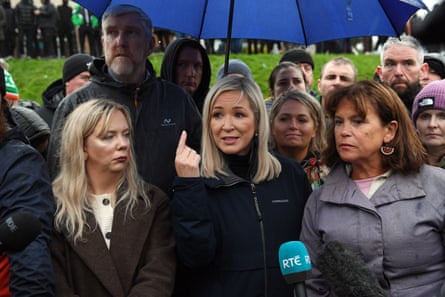
Michelle O'Neill, the Sinn Féin vice-president and Northern Ireland first minister, was also there and said reigniting the dispute brought "into question how this whole peace process works".
She told reporters: "We're meeting families who feel collectively traumatised, who feel individually traumatised. Does anybody think that this is a good idea?
"No right-minded person would make this decision. I still do not know the answer to this question – why, after 28 years of a determination to block a march down this road, the Parades Commission thought that this was the right idea today to bring this mess back on to this community."
The local Democratic Unionist party (DUP) MP, Carla Lockhart, accused O'Neill of "whipping up hysteria" at an "unlawful" protest.
"It is unreal that we have a first minister behaving the way she is behaving," she said. "If I did it, or if any of my colleagues did it, I would be in the back of a Land Rover."
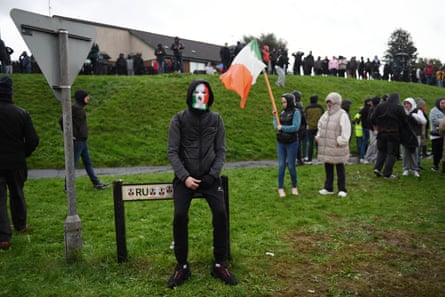
Gavin Robinson, the DUP leader, said: "We now have lawmakers acting as law breakers," and he accused O'Neill of "giving two fingers to the courts, the police, the rule of law".
The Northern Ireland secretary, Chris Bryant, cut short his attendance at the Labour party conference in Liverpool to travel to Belfast, but said he did not have the powers to call the march off unless police formally requested him to do so. He said the nationalist protest was unlawful and called on politicians to "calm things down".
Bryant said: "It is incumbent on everybody in political office to take this moment very, very seriously and to take the temperature down, to think twice before … inflating any argument and to think about what somebody else who doesn't share your opinion might think about the way you've put your case."
The tense standoff also drew in the prime minister, Andy Burnham, who appealed for "calm on all sides".
The Irish taoiseach, Mícheál Martin, echoed that but described the Parades Commission decision as "incomprehensible and wrong".
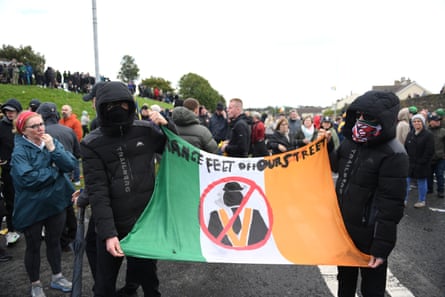
He called for the situation to be mediated sensibly in a way "that protects the gains that have been made and the peace and harmony that has prevailed for so long".
The Drumcree parade on the Garvaghy Road – a Catholic enclave in a largely Protestant town – sparked some of the most serious and violent disorder in Northern Ireland's history.
On Friday, the Parades Commission granted permission subject to restrictions, including a limit of 35 participants, an 8am start time instead of 1pm, and that it should be held in silence.
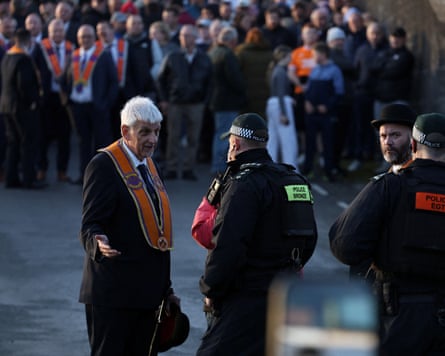
The decision was challenged and blocked on Saturday by a judge, Justice Patricia Smyth, who said the "long-running dispute has the potential to escalate" across Northern Ireland.
That decision was then challenged by the Orange Order, leading to two further hearings on Saturday night and Sunday morning.
The final, time-limited sitting, which began at 20 minutes past midnight on Sunday, was heard before Mr Justice Humphreys, who acknowledged the "unusual if not unprecedented circumstances … with a parade scheduled to begin in just over six hours' time".
Outlining his decision, Humphreys cited case law that as a public body the courts must respect the commission's judgment and "their decisions will not be lightly interfered with".