has hinted that the donations to Reform UK worth £72m might not be legal under the legislation to tighten elections law currently going through parliament.
He made the apparent concession in an interview with the BBC in which he strongly objected to the government's plan to make a new law banning Britons who live abroad, or who have recently relocated to the UK, from giving more than £100,000 a year to political parties retrospective.
replied:
Both these donations are 100% compliant with the law today. Of that there is no question whatsoever.
pointed out that Farage was saying "today" and he asked if Delo and Harborne were both resident in the UK on 25 March – after which the retrospective restrictions on donations by new arrivals will kick in when the representation of the people bill becomes law.
replied:
I'm not going to go into their particular details. All I'm going to say is, with the law of the land as it stands, they are both compliant.
Now there is talk, and Angela Rayner was talking about this yesterday, there is talk of them retrospectively declaring donations illegally.
Well, that simply cannot be. If a government was allowed to do this, you know what would happen? There'd be a response the other way. We or the Conservatives would say, right, if you're going to stop legitimate donors like this, we will then say to the trade unions, you can't give money. And if you do that, you have collapsed the whole political system.
In fact, there has not just been "talk" of making the cap retrospective. The bill legislating for this has gone through the Commons, and MPs debated amendments creating these exact laws on Wednesday 2 September.
While laws applying retrospectively are rare, they are not unprecedented. Reform UK wants to pass retrospective legislation itself. For example, it plans to abolish indefinite leave to remain as an immigration status, including for people who already have it.
Farage's position is different from the one adopted by his party over the weekend when , the Treasury spokesperson, said that Reform UK was confident the Delo and Harborne donations were "entirely in line with the law as it is and, as far as we know, the law as it's going to be in the future".
For a full list of all the stories covered on the blog today, do scroll through the list of key event headlines near the top of the blog.
is former permanent secretary who carried out the government review on the infuence of foreign money on British politics that led to the government deciding to impose a cap on the amount that can be donated by Britons living abroad, and a moratorium on donations in the form of cryptocurrency.
Wider reforms of the donation rules were outside his remit. But, in interviews today, he has said there should be a cap on the amount any person can donate.
He told Times Radio:
It is absolutely true that political parties are essential for the democratic process and they need to raise money from private sources until we get to a point which is, I think a very long way off, when we have significant state funding.
So how do you square the circle? In my view the way you could do that is to have donation caps but to set them at least initially at a really quite a high level, for the sake of argument £1m a year from any individual, corporation or indeed trade union and that would allow the parties still to function without requiring state funding.
Rycroft also that if the government reduced spending limits during election periods, and impose spending limits outside election periods, that would also help because it would "so parties don't need to raise so much money".
The Labour MP has written to the Electoral Commission asking it to investigate if the donations given to Reform UK by Ben Delo and Christopher Harborne worth a total of £72m are legitimate, HuffPost UK is reporting.
One of Britain's steelworks is to come into public ownership after the government said it would take over Yorkshire-based Speciality Steel UK (SSUK). has the story.
, a former counter-terrorism police commander in London, has been chosen by Reform UK to be its candidate in the upcoming Holborn and St Pancras byelection.
The former police officer has appeared recently in social media posts published by the party's London mayoral candidate, Laila Cunningham, as it seeks to place crime and policing at the heart of its search for votes in the city.
Newman said:
As a former police detective, it depresses me to see the state of crime and policing in our capital. Residents no longer feel safe and our police officers are struggling to cope.
Police stations are closing left, right and centre, yet Labour don't care and our Mayor continues to gaslight Londoners over their safety.
I'm standing to ensure that people in Holborn and St Pancras feel safe on their own streets again.
Reform said that Newman was a senior police detective between 2004-2009 at the Met working across London on crime reduction, public safety and counter terrorism security.
In the wake of the 7/7 bombings, he was said to have been charged with leading the response to the aftermath of the attack, specifically leading the Met in Westminster.
Since retiring from the Met, Reform said Newman has worked as a security and investigative consultant, providing advice and investigative services to businesses.
It has also been announced today that , a Liberal Democrat councillor for West Hampstead and outgoing chairman of Camden Lib Dems, will be the Lib Dem candidate in the byelection. And , a former Camden councillor and local political campaigner, will be the Conservative representative.
None of these three candidates are seen as having much chance because the byelection is primarily seen as a contest between Labour's , the leader of Camden Council, and , the Green party's leader.
In the Lords debate, , a former Lib Dem chief executive, said that part of the problem with political donations went back to a decision taken by Tony Blair's government.
In an attempt to end the "party spending arms race", Labour imposed a £20m limit on what parties can spend in the 12 months before an election. But that was bigger than necessary – and later increased to £36m by the Tories before the 2024 election, he said.
Rennard said these rules introduced the concept of national spending which could still be targeted at individual constituencies.
He went on:
This destroyed the concept of the level playing field in constituency campaigning that had applied since Gladstone's government introduced the Corrupt and Illegal Practices Prevention Act of 1883.
As an example, Rennard said the £72m given to Reform UK "could legally be spent in 72 target constituencies over two years, providing for £1m on national spending in each of them".
Back in the House of Lords, , the former Conservative PM, has said that she particularly welcomes the proposals in the representation of the people bill that will impose a moratorium on parties accepting donations in the form of cryptocurrency.
She said the Bank of England described cryptoassets as "a way of storing value electronically outside of centralised systems and away from regulators".
She said she had always been sceptical of cryptoassets, and when she served as home secretary she first came across them as "the currency of choice for criminal gangs". They were also the currency of choice for hostile state actors, she said.
She went on:
It is absolutely right, I think, that the government is moving to find ways to ensure that cryptoassets cannot be used as donations to political parties, but I simply say this to the government … There are loopholes in what the government is doing because donors are banned from using cryptoassets for donations to political parties, but not to candidates.
I would urge the government to look at this in particular because cryptoassets are used by people who want to avoid anybody knowing what they are doing. And in terms of our democracy and donations to parties or candidates, we actually want the transparency of knowing who is doing that donation, who is making those donations.
Commenting on the revelation about the size of Chris Wormald's pay-off (see 4.43pm), , the deputy Tory leader and shadow Cabinet Office minister, said:
Chris Wormald was just one of many civil servants and advisers fired by Keir Starmer as he tried to save his own skin.
This payout is another appalling waste of taxpayers' money by Labour.
Whether it's big payouts for fall guys, or gimmicky giveaways, this government is always happy to spend our money if it thinks it will benefit the Labour party.
received a pay-off worth almost £860,000 after he was sacked by Keir Starmer as cabinet secretary, the government has revealed.
The figure was first revealed in a story in the Financial Times, and has today been published in the Cabinet Office's annual report.
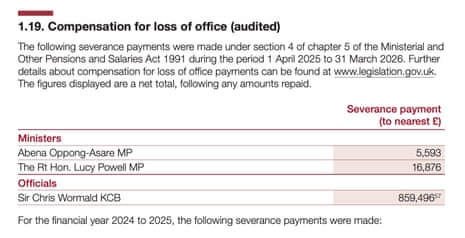
Explaining why the award was so high, the report says:
The total is made up of contractual compensation of £332,897 and additional severance of £526,598. The former cabinet secretary elected to take early payment of his pension. The majority of the total severance payment was used to ensure he could access the full value of his pension that would have been due at normal retirement age, rather than it being reduced for early payment.
Wormald was appointed by Starmer – but also sacked by him 14 months later, after Starmer concluded that a more dynamic cabinet secretary would improve the performance of his government. Wormald was replaced by Antonia Romeo.
As the FT reports, the payment to Wormald was signed off by , who was then Cabinet Office permanent secretary. She needed a "ministerial direction" to agree the move because it did not comply with normal value-for-money rules.
Describing the decision, she said:
The proposed award is greater than what Sir Chris Wormald would be contractually entitled to. However, I am informed that a settlement of this level is necessary given that this is a departure from a high-profile, unique role that has been agreed at very short notice.
The has lauded Andy Burnham's history of campaigning to raise the profile of dementia in a statement following the death of his father Roy, who had Alzheimer's disease.
Michelle Dyson, the charity's chief executive, said:
We are deeply saddened by the news that Roy Burnham – the prime minister's father – has died. Kenneth Roy Burnham had been living with Alzheimer's disease.
The loss of a parent leaves an immeasurable gap in our lives. While every family's experience is unique, many of us understand the long and often challenging journey that Alzheimer's disease can bring, not only for the person living with the condition but for those who love them.
The prime minister has been a longstanding advocate for improving the lives of people affected by dementia, often drawing on his father's experiences. As mayor of Greater Manchester, he supported dementia-focused initiatives delivered with us, including the expansion of our Singing for the Brain programme and ran alongside thousands at the Great North Run for Alzheimer's Society in 2024.
Most importantly, he has consistently used his voice to highlight the urgent need for social care and dementia care reforms.
We send our heartfelt condolences to his family and to anyone else who has experienced the heartache of losing someone to dementia.
In the Lords, , a shadow local government minister, quoted Winston Churchill saying changes to electoral rules should be implemented by agreeement in her speech on behalf of the Conservative party at the start of the elections bill debate.
She said some of the measures in the bill were deeply troubling because they were partisan.
In a reference to the restriction on donations from Britons living abroad, or only recently returned, she said:
Even just the perception of partisan, targeted legislation risks breaking down longstanding political conventions and, crucially, trust in the system.
We will all have heard the reports this weekend of crypto donations to Reform UK. It's our current understanding that these donations would be caught by the overseas contributors cap.
O'Neill asked the minister to clarify exactly who these rules would work, if necessary by letter after the debate.
told peers that the government is thinking of doing more to strengthen the "residency requirements" that limit how much Britons can give to political parties if they are not living in the UK.
In her speech opening the debate (see 4.07pm), she said:
In addition to introducing a robust regime that ensures donors contributing above the £100,000 annual cap must demonstrate a genuine and ongoing connection to the United Kingdom, we are considering how we will strengthen the residency requirements, including ensuring the length of time spent in the UK aligns with broader government policy.
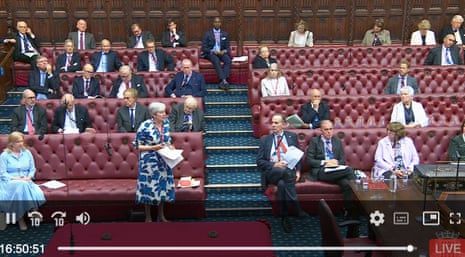
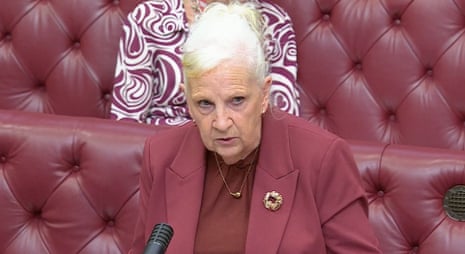
In the Lords, peers have just started the second reading debate on the representation of the people bill. , a local government minister, is opening on behalf of the government.
She starts by saying she wants to make a reference to the "events of recent times".
She recalls catching the train early in the morning with tradespeople, public sector workers and small business owners heading into work early and she goes on:
It's a fundamental principle of our democracy that every one of their votes is exactly equal to the votes of millionaires, crypto bros and industry magnates, and it is that which sits at the front and centre of this bill.
We must put politics back under public control.
We all share concerns about the rise of big money and its ability to dominate public power.
At its heart, this bill is about renewing the foundations of our electoral system so that it remains fair, secure, transparent and accessible in the years ahead.
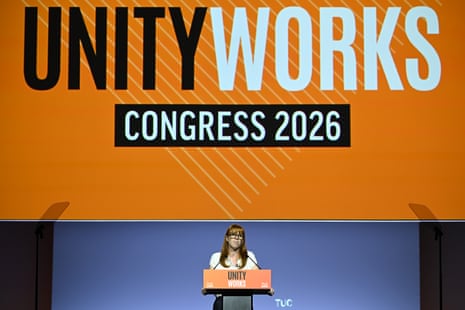
ended her speech at the TUC praising Andy Burnham. She said she was glad to hear him "talk about doing things the Labour way".
And she said, as a former care worker who has campaigned for a better care system, she was particularly pleased about Burnham's commitment to reform adult social care.
As a former care worker myself, I have waited my whole life for a prime minister to speak about social care the way Andy has, understanding what care workers do and the conditions that they face.