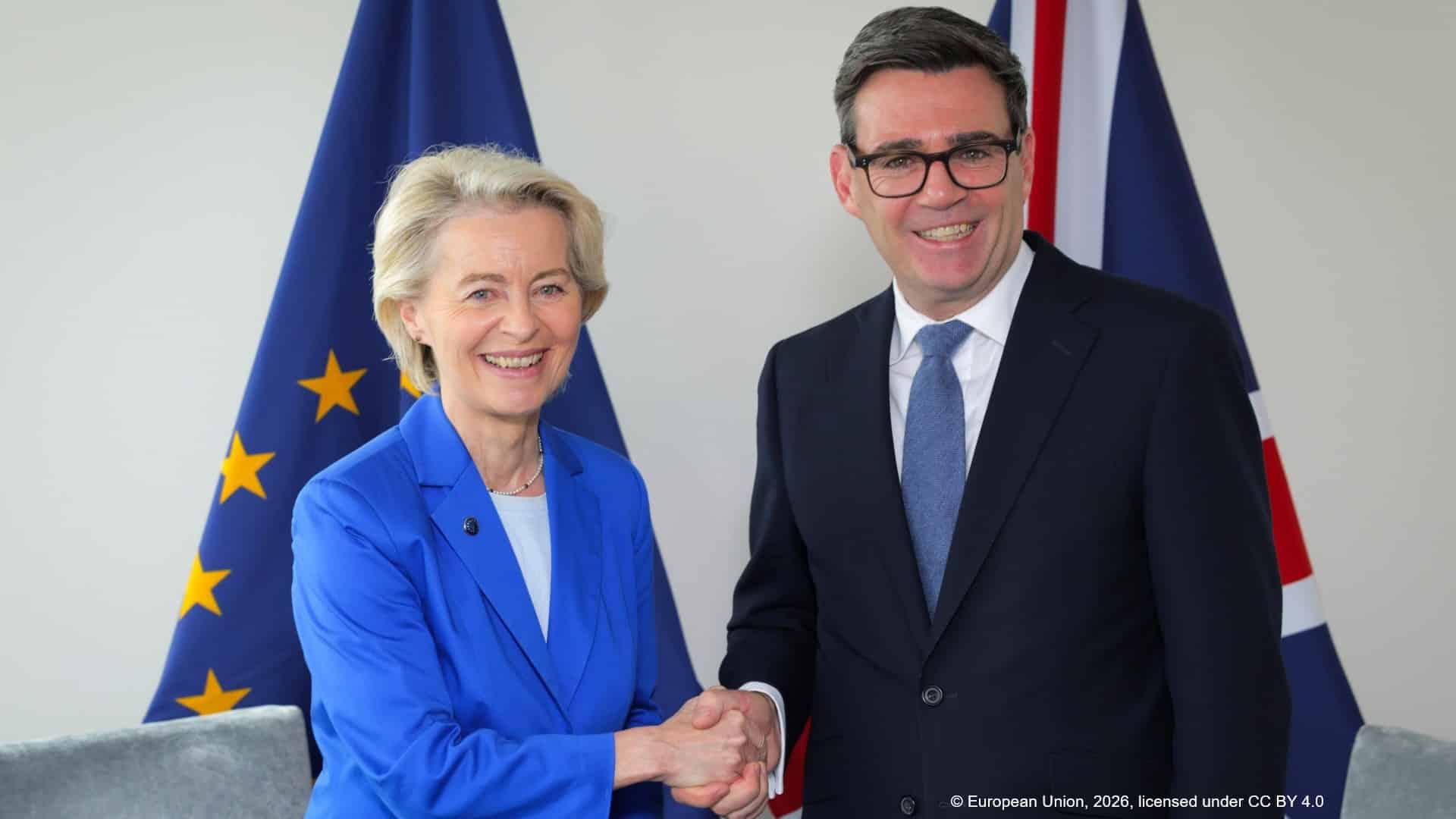
Joël Reland argues that the EU’s increasingly protectionist regulatory model is likely to increase the economic costs of non-membership for the UK, and that this could impact Andy Burnham’s thinking on the type of EU relationship to pursue.
Andy Burnham’s party conference speech marks an important moment in the UK’s post-Brexit story, with the new Prime Minister in effect discarding Keir Starmer’s red lines by announcing that all “different options” for the EU relationship – from a customs union, to the single market, to rejoin – are on the table after the next general election.
Yet this was a speech which mattered as much for what Burnham did not say, as what he did. For one, Burnham very deliberately did not commit to a particular course of action. He seemingly has not yet made up his mind about what to do – and so the ensuing policy debate, as well as the response he receives from Brussels, is likely to matter a lot.
And for another, he omitted mention of what we know has been his biggest EU preoccupation up to now: the EU’s emerging ‘Made in Europe’ industrial policy, under which British carmakers could be cut off from European supply chains because their components will not count as ‘European’. Burnham was reportedly told by diplomats to tone down his criticism of the scheme – which would not have gone down well in Brussels nor suited the wider tone of hope and positivity which he was trying to project.
But Made in Europe is not an issue which can be ignored for long. It matters a lot to the UK car industry. And it also serves as a symbol of an important shift in EU regulatory policy – towards greater protectionism – which should weigh heavily on Burnham’s mind as he considers his options for the future relationship.
The European Commission’s increasing proclivity to actively cut competitors off from its internal market is evidenced by our latest regulatory divergence tracker, published this week. While the UK is seldom the direct target of such interventions – China and the US tend to receive that dubious honour – its high degree of economic dependence on the EU means its risks regularly suffering collateral damage.
The UK steel sector was hit in June by a 60% reduction in EU import quotas and a doubling of non-quota tariffs – a policy concocted to respond to US tariff hikes, but for which British steel has paid a high price. Meanwhile, a new €3 duty is being imposed on ‘low-value’ packages imported by EU customers, designed to curtail the sale of sub-standard goods from low-cost Chinese websites like Shein and Temu. A byproduct is that some British businesses which should normally be able to export their goods tariff-free to EU customers will no longer be able to do so.
Similarly consequential could be the Cloud and AI Development Act – part of the EU’s new ‘Tech Sovereignty Package’ – which proposes restrictions on foreign-owned cloud service providers ability to operate in certain sensitive EU sectors. While this is seemingly aimed at the US, and there are provisions to exempt ‘associated third countries’ (likely including the UK), it sets a potential precedent for excluding UK firms from European tech and telecoms infrastructure projects: especially if the UK is deemed to be too close to American interests.
And a newly-proposed EU Public Procurement Act has been dubbed ‘buy European’ because of the powers it gives the Commission to restrict foreign companies’ access to EU public procurement markets. China is the main apparent target but, again, there is potential for the UK to get caught in the crosshairs. Some lawyers think that recently announced reforms to UK procurement rules could amount to discrimination against EU firms and thus a violation of the UK’s obligations under the UK-EU Trade and Cooperation Agreement. The EU might then respond by using its own bulked-up procurement powers to restrict UK firms’ access to the EU market.
The EU’s philosophy used to be that foreign firms were welcome to access its internal market, as long as they conformed to the necessary regulatory requirements – in turn allowing EU standards to become something akin to global norms. But in a new age of great power politics, those regulatory instincts are turning inwards, to focus on how to keep out potentially hostile actors and protect EU companies from foreign competitors with heavy state backing – especially in key strategic sectors like tech and green industry.
This raises a new policy challenge for the UK. Until recently, there was an obvious way to improve EU trade relations: formally align yourself with a significant proportion of its single market rulebook, as Switzerland or Norway do. The greater the alignment, the greater the market access.
But it is no longer always so easy to align your way out of trouble. Norway and Switzerland are both finding themselves caught out by ‘Made in Europe’ restrictions and EU tariff reprisals aimed at the US or China. For those specific policies, the apparent antidote is a UK-EU customs union – which neither Norway nor Switzerland have.
But, as our ‘staircase’ of options shows, the macroeconomic gains from a customs union are likely to be much lower than a Norway or Switzerland deal, because you’ve still got all the trade frictions that come from being outside the single market. And nor will it necessarily guarantee inclusion in all future ‘Made in Europe’-style schemes. You could choose to form a customs union join the single market – but then you are in the EU in all but name (and without any of the influence of membership).
It is important that, when Burnham comes to appraise the options for the EU relationship, he considers not just the economic impacts of Brexit so far, but also the type of institution which the EU is evolving into. And he might find it hard to escape the conclusion that, for a country on the EU’s doorstep and highly dependent on it as a trade partner, the economic costs of non-membership are becoming ever harder to bear.
By Joël Reland, Senior Research Fellow, UK in a Changing Europe.