Anand Menon reflects on the prospects of another EU referendum and the risks of repeating the low quality of public debate seen last time.
Well, it’s all kicking off. Andy Burnham has set the horses running with his comments about the need to reconsider UK-EU relations. An honest conversation would be welcome, albeit unlikely, not least in the context of what promises to be a rapidly polarising debate.
The Prime Minister wants to know what the options are. Frankly, he could have just looked at our report from last June, which laid them out, along with a lovely graphic to keep things simple.
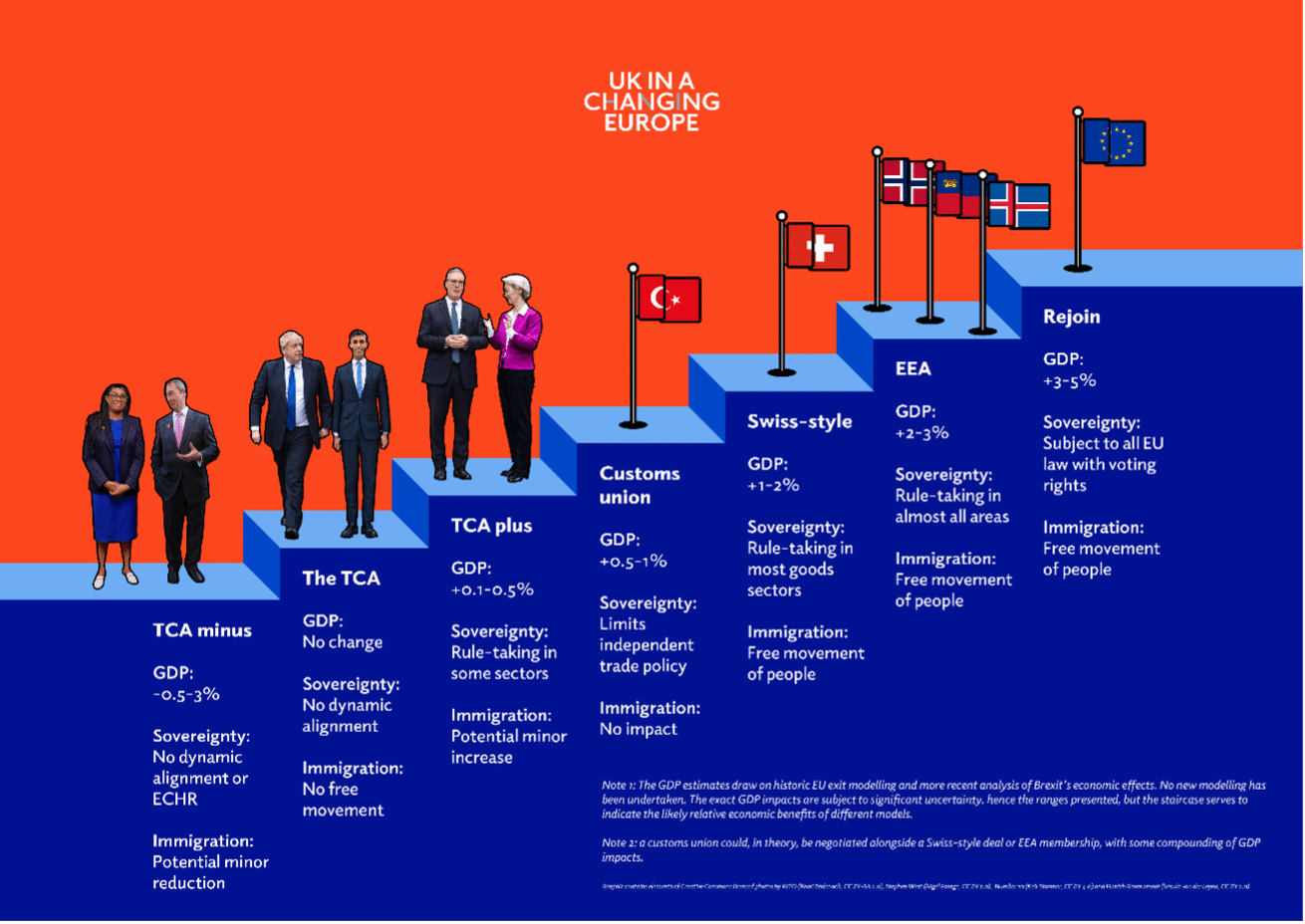
Yet looking at this in the light of the Prime Minister’s comments and considering the nature of the debate here in the UK, it seems quite likely that things will polarise and simplify quite quickly. A customs union is unlikely to have that great an economic impact, and Britain would outsource its defences to the EU in an era of weaponised trade. The European Commission is against a Swiss-style deal. Meanwhile, an EEA-style arrangement whereby the UK has all four freedoms but with no decision-making rights would represent a massive abdication of ‘control.’
We should, of course, know all this already. After all, we spent the best part of four years talking about nothing but Brexit. First time round, however, we didn’t do our homework. This time might be different, and if so, there is every chance that the debate polarises around a familiar choice: Rejoin or Remain out.
The costs of the latter are much clearer than they were when Brexit was a largely abstract concept back in 2016. We now have the data (and the anecdotes) that reveal how Brexit has impacted on trade and investment. There is a greater understanding of the fact that, while Asian countries are growing faster than European ones, we have not yet managed to relocate our island, and so most of our trade is still with Europe.
Nor have the Leave side convincingly made the case that there are Brexit opportunities to be grasped. There are certainly areas of economic activity – in financial services and new technologies for instance – in which industry leaders are happy about divergence from EU rules. Yet the general impression is not one of a brave new world of liberty – which is one reason why Brexiters are now trying to pin the blame for inaction on what they see as an illegitimate establishment.
Yet there are dangers on the other side of the argument too. The remain side did themselves no favours back in 2016 when they warned of a Brexit economic cliff-edge that never materialized. We warned at the time that its economic impacts would play our more like a ‘slow puncture’. And the lack of some sudden shock was exploited by Leave supporters to cast doubt even on the longer-term economic forecasts – most of which have turned out to be pretty accurate.
Now, campaigners will have to avoid the temptation to argue that joining will be easy, and that the EU are desperate to have us back. Neither is true. Acceding to the European Union is a gruelling and intrusive process that is far less a negotiation than a process of complying to demands laid down by the European Commission. And it is one that will spark resistance, as those people whom eurosceptics used to revel in calling ‘unelected Brussels bureaucrats’ issue their instructions. If these reactions aren’t to spark public concern, the public must be warned about what is to come in advance.
And when it comes to the member states, it is certainly the case that many wish we had never left in the first place. Which is totally different to saying they will do whatever needed to get us back. Certainly, the sight of a prodigal son returning will be a PR coup for supporters of European integration. Yet national capitals will be keen to secure the best deal they can – not least in financial terms – from the accession treaty. And, of course, the prospect that some of them at least might hold referendums on any new accession opens us up to the unpredictable vagaries of their domestic politics.
Accession, in other words, will not be easy and it will not necessarily be quick. And any economic benefits that we can expect from rejoining will be relatively slow to materialise.
When we held our referendum about leaving the European Union, there was, it is fair to say, far more heat generated than light. That, after all, is one reason why, ten years on, some people are having second thoughts. If we want to avoid that happening again, it is best to be clear about the trade-offs: what lies ahead and the benefits we can realistically hope to see once the process is over. Think tankers like me were disappointed by the standard of debate last time round. Now, in the Burnham spirit, I am daring to hope.
Anand Menon, Director, UK in a Changing Europe.