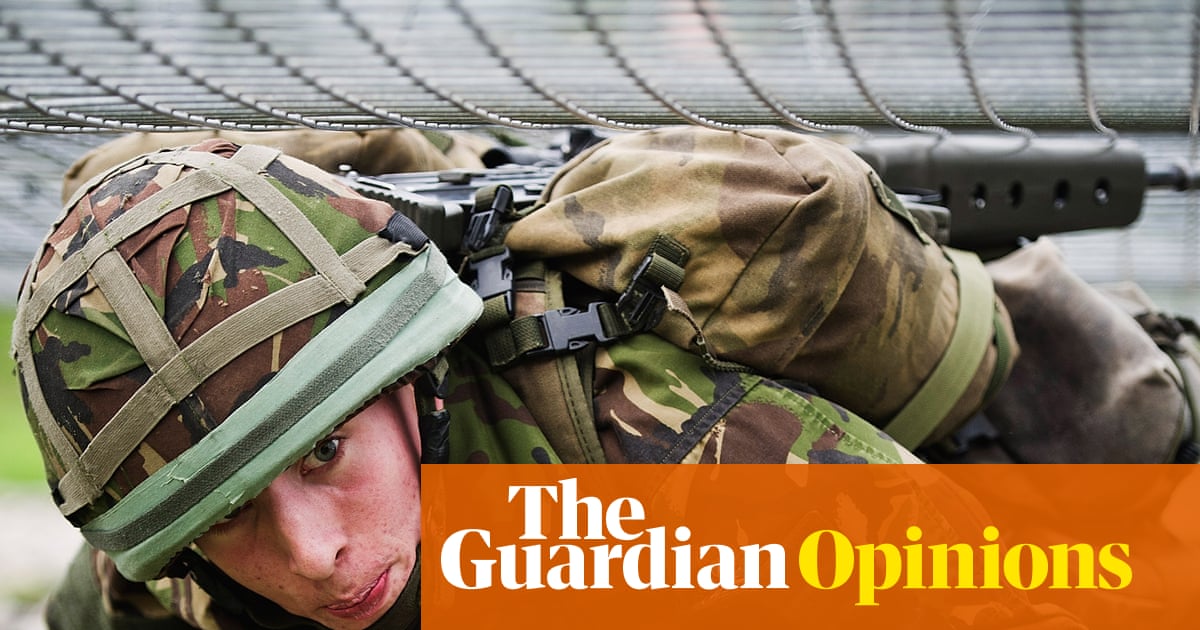
oung people won't go to war for Britain. So claimed numerous headlines last week, responding to findings in the British Social Attitudes survey. Except that the phrasing of the question was whether respondents placed importance on "the willingness to serve [in the military] in a time of need", perhaps forgivably low for people thinking about things of more immediate importance to them such as getting on the housing ladder, getting a pay rise or finding employment at all.
Less than a quarter of under-35s regarded this as of high importance, and so here we are subjected to the same moralising as any vaguely leftwing politician who hesitates on the stock television interview question: would you push the big shiny red nuclear button? "An unbelievable attitude on display!" laments LBC's Tom Swarbrick in response to a 23-year-old caller, Josh, who can't imagine a circumstance where he would ever feel able to kill another person.
That belief that you could not take another person's life is apparently the wrong instinct and an indication of everything that's wrong with young people in the UK. The very worst charge: a lack of love for one's country. Milk-livered zoomer communist pansyism, or whatever. The more generous interpretation has been that young people's lack of commitment to Britain is unsurprising given the broken social contract: that our politicians are excessively deferential to the pensioner class, leaving young people with the bill, and young people don't feel that they've been given a stake in society. According to Sophia Gaston, author of the report, a sense of generational fairness has had an impact on young people's "willingness to put themselves on the line and defend [the] nation".
But who wants war? Who views scenes of chaos and bloodshed and cheerfully imagines placing themselves within them? That simple question has been conspicuously absent from much of the discussion around the survey. What has shaped young people's perceptions of war, and of Britain's participation in it, more than the litany of strategic blunders and postcolonial overreach that have defined the conflicts of the 21st century? Besides, what kind of war should they be willing to serve in? Just any? Or one that will be determined illegal by many politicians and scholars, such as Iraq? Or one as catastrophic as the failed intervention in Libya?
And hang on, isn't war supposed to be a terrible thing that we hope will never have to happen again? On the 100th anniversary of the outbreak of the first world war, my secondary school held a special assembly. The seats in the middle of the hall were arranged in a strange shape, and midway through the ceremony the boys sitting there were told to stand up. "That is how many students [from our school] died in the great war," said my history teacher.
Young people are well aware of growing instability and that the old assumptions about peace in the west may not hold for much longer. Not with Vladimir Putin launching Europe's largest and most destructive armed conflict since the second world war with the invasion of Ukraine – and with very real and credible threats against the UK from Russia, specifically Moscow-driven cyber and information attacks. In September, Nato allies upended a plot by Russian subs training to disable undersea cables , the basic infrastructure of the global internet.
So the question for young people is: what would we do in the case of a Russian invasion? Dover has been breached, there are tanks and troops closing in on Westminster, "good morning" is to be replaced by "доброе утро". This is not a threat to be managed only by a conventional army, but one that requires resilience and belligerence from all of us. My answer to that is: look at what young people have done, in modern times and in history. Look at Ukraine – like anywhere, young people did not want war. When the moment came, they joined territorial defence units in their thousands, helped evacuate citizens and organised humanitarian responses.
Look at the young socialists and members of youth movements who joined the French resistance against Nazi occupation during the second world war, forming intelligence networks and carrying out acts of sabotage. Look at those who formed the Zazou counter-cultural movement, a subculture rebelling against the Vichy regime that was collaborating with the Nazis. These were young people who might not have joined a conventional army, but who nonetheless saw the need to defend their future.
See that quality, too, in Britain's young people today. Many will point to their sacrifices during the Covid-19 pandemic, but I think more of youth-led movements and protests: resistance to immigration raids in defence of our neighbours, climate strikes, days of action protesting at the rising cost of education, even hunger strikes in solidarity with Palestine. These are not the chattering classes' idea of bravery or rising to moments of peril, yet it is that spirit of asserting independence and control over one's future that would need to be harnessed if ever a war were to reach these shores. Yet, like that young LBC caller, they are demonised for not being enthusiastic about going to war for a country that has not gone to war for them.
For all our discussion of patriotism, it is little said that people do not experience a nation through abstract ideas of borders and security, but rather through our communities, friends and families. When those are under threat, away from hypotheticals and chin-stroking debates about nuclear weapons, patriotism is a very different proposition: not about dying under a flag, but standing up for the people around you.