
For just over six years, I led the team in Labour HQ that was responsible for devising and delivering the party’s organisational strategy. I’m grateful to LabourList for allowing me to publish my reflections on how to build the campaign required to win a second term.
Whilst context, techniques, tactics and tools are always changing, there are enduring campaigning principles. Let’s start with the first of those.
Election campaigns are about building winning coalitions
By their very nature, coalitions contain people with different values, outlooks, opinions. Increasingly, what unites a coalition does not endure. The reasons are well aired. A ‘consumerist’ electorate whose ‘traditional’ loyalties have faded away (dealignment), leaving volatility in its wake.
None of this new although all of it was present in the 2024 result. The steep decline in turnout echoed 2001 which was preceded by decades of decline (1992 aside). The height of class alignment was in the mid-60s, with the fragmentation undermining the two-party duopoly continuing its remorseless march following aberrational results in 2017 & 2019. Party identification, whilst still predictive of voter behaviour for those who do identify with a party, is in continual decline.
That said, Labour won – 411 seats, 211 gains. We set out to win a majority and achieved it. That means the Win 24 strategy was a success. Persuasion was central to it.
The slide below was taken from a presentation given to campaigners in target councils in 2023. The first bullet introduces our next principle.
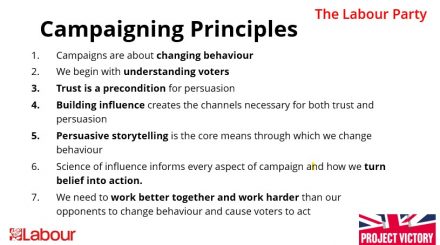
Campaigns are about changing behaviour. Changing behaviour requires persuasion
These same principles underpinned the Win 24 strategy. The approach was to focus all our activity, through every channel, on persuading the voters that would decide the General Election to trust us and ultimately earn their vote. That is not a new concept but in its tactical execution, we made several leaps forward.
We understood that our target voters avoided political news. So, our campaign met them where they were, wherever that was. To do this we abolished the silo between field and digital, ensuring an integrated campaign.
Our entire voter contact model was overhauled with a new script (‘Listen, Change, Win’) that prioritised listening, collecting data that drove a follow up programme called ‘Persuasion Pathways’ and communicating a political message that was determined locally. We ended the arbitrary separation of ‘Get Out the Vote’ activity from the rest of the campaign by shifting to ‘Maximise the Vote’. This fundamental shift acknowledged that persuasion needed to continue to 10pm on polling day. This included a relational ask to Labour voters to contact friends and family which has since been standardised.
None of those decisions were made without extensive research, testing and local pilots, which were then rapidly scaled and rolled out by Labour staff. As ever, there were natural tensions between HQ and the regional offices, but the latter’s expertise and local knowledge were critical to grounding the strategy in the realities of local organisational capacity.
So that’s what we did last time. The question is now is how to win again.
As the adrenaline drained away on Friday 5 July 2024, it was immediately apparent that if Labour faced a unified right next time round, we would need to increase our vote share to win again. Someone (I wonder who) suggested the result was ‘baseline, not a ceiling’. That phrase probably should remain in those heady early days, but the insight underpinning it should be the central driver of any organisational strategy for the next General Election.
The first is what is our aim?
The answer is easy. A re-elected majority Labour government.
The answers to the next five require more thought:
: which seats do we need to win to achieve that?
: what does our winning coalition look like in those seats? Who will be decisive?
: what matters to the voters in these seats? And what are we going to say and do to build the winning coalition in each?
: how are we going to ensure our message reaches our winning coalition?
: what resources do we have to do it?
Notice how these questions start with the voters and then move onto tactics, techniques, tools and operating models. That’s because winning campaigns start and end with the voters. Understanding the voters who make up our (potential) winning coalition and building a relationship with them remains vital. Increasing the number of voters (currently stuck at 30 percent) who are considering voting Labour should be a key focus.
Any strategy needs to flexible enough to understand the different challenges in each seat and provide the solutions to build a winning coalition. But without central guiding principles, it amounts to attempting to run 631 by-elections. That fundamentally misunderstands the dynamics at General Elections. Voters know they are choosing a government, even if their vote is for their local Member of Parliament.
That brings me to my final enduring principle:
There are no organisational solutions to political problems
But that does not mean organisation does not matter. That’s why it should be concentrated in the target seats that will determine the result. Any organisational strategy should begin and end with the voters, rather than discussions about tactics and operating models. The last General Election is a clear example of what happens when the British people are our central focus. And the one before is an example of what happens when they are not.
READ MORE: Labour Party Conference 2026: Full LabourList events programme, revealed
Become a friend of LabourList and join our community. Our friends support our vital non-factional work and get access to exclusive content and events.
Subscribe here to our daily newsletter roundup of Labour news, analysis and comment– and follow us on TikTok, Facebook. You can also write to our editor to share your thoughts on our stories and share your own. The best letters are published every Sunday.

Richard Bennett worked for the Labour Party for 15 years, running election campaigns at a local, regional and national level. He then worked for a consumer insight startup and the Royal British Legion. He now uses the expertise gained to help organisations turn insight into action.
View all articles by Richard Bennett