Dr John N. T. Helferich argues that the recent rapprochement between France and Britain should be used to build wider European coalitions capable of delivering major projects in defence, technology, and industrial capacity.
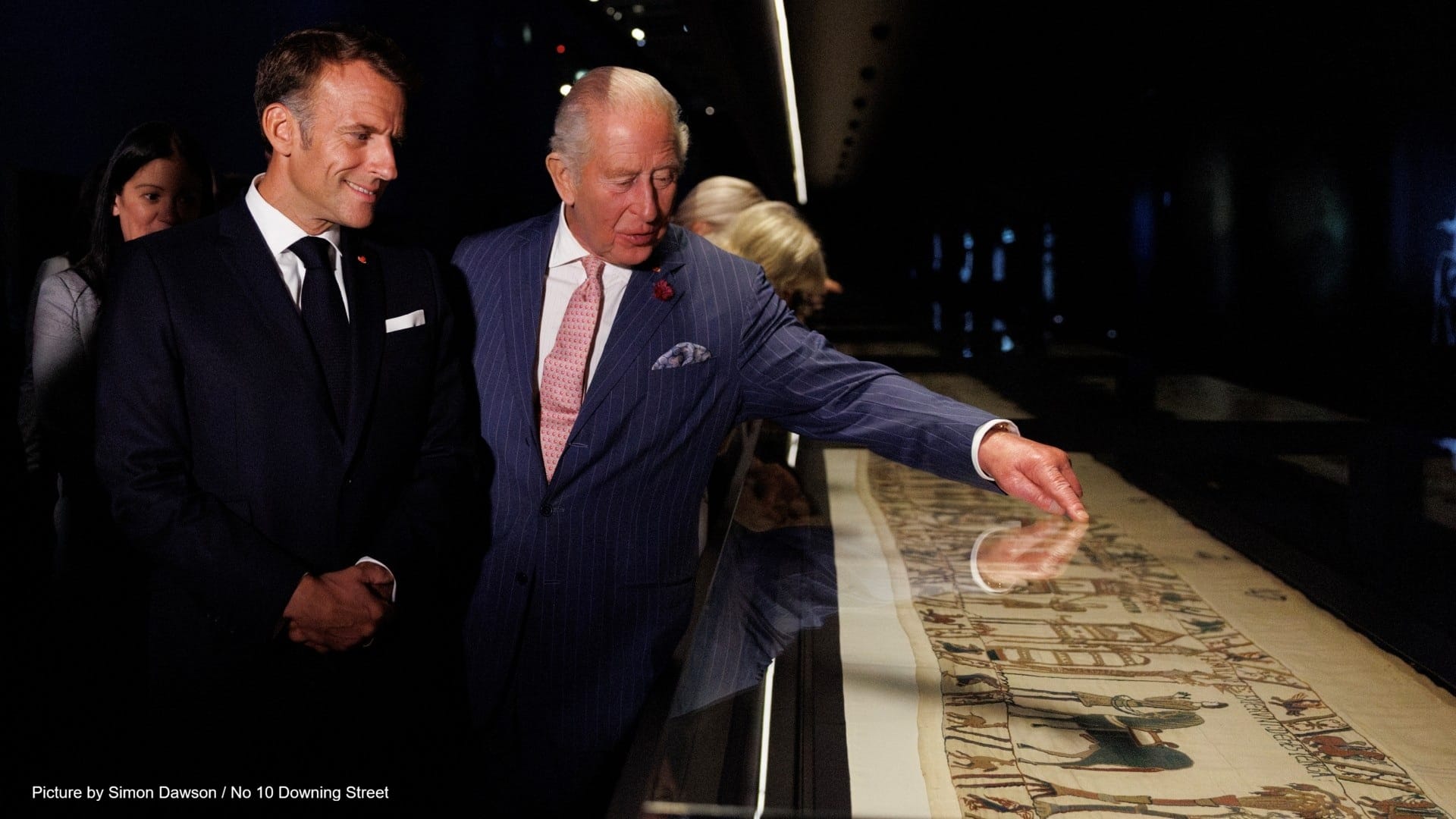
For centuries, 1066 has occupied a special place in British national memory as the last conquest of England. Alongside later episodes such as the Battle of Britain, it contributed to a powerful national narrative about sovereignty and separateness from continental Europe. It is therefore remarkable that the Bayeux Tapestry – the great visual account of the Norman Conquest – is now being displayed in London as a symbol of Britain and France coming together.
Britain first requested the loan in 1931. Almost a century later, Emmanuel Macron has celebrated its arrival as a symbol of a new “Entente Amicale”. Its symbolism is striking and has been compared to the opening of the Channel Tunnel. But whether this new entente amounts to more than another Franco-British rapprochement will depend on whether London and Paris can translate it into wider European leadership.
The timing is more than symbolic. Two conditions that have shaped Britain’s relationship with Europe for decades have changed profoundly. First, Britain’s special relationship with the United States has fractured. Even the Biden administration showed little interest in restoring an especially privileged relationship, while Donald Trump’s return has taken ‘America First’ to new levels, at times openly hostile to Britain. This matters in Paris too. French reservations about closer European integration with Britain have historically been reinforced by fears that Britain would bring American influence in through the back door. A Britain less certain of Washington fundamentally changes that calculation.
Second, Europe has become considerably less politically toxic in Britain. Ten years after the referendum, 57% of Britons now say leaving the EU was wrong, while 59% favour a closer relationship with the EU even without rejoining the Union.
These shifts coincide with a moment when Europe itself is searching for leadership. Germany’s promised a more assertive strategic role, but has struggled to generate the leadership many hoped would follow. Together, these changes have created an unusual opening for France and Britain to emerge as a new strategic leadership partnership in Europe. But if political reality is to catch up with the symbolism surrounding the Bayeux exhibition, the new entente will have to produce a major new European initiative – something sufficiently ambitious to demonstrate that Britain and France, working with Germany and other partners, can translate renewed bilateral ties into a wider European capacity to act.
Andy Burnham faces an interesting historical benchmark. When Tony Blair entered Downing Street in 1997, he quickly pursued high-profile European initiatives and was soon celebrated as the new leader of Europe. The 1998 St Malo declaration with Jacques Chirac demonstrated what Franco-British leadership could achieve: a bilateral initiative that kickstarted the development of an autonomous EU defence capacity.
Keir Starmer also played the European role remarkably effectively. Particularly as uncertainty about American policy increased, he established Britain as a dependable partner on Ukraine while repairing much of the political damage created during the Brexit years. This leaves Burnham with both an opportunity and a problem. The European door is more open than at any point since Brexit, but the political returns from simply declaring another “reset” are diminishing. To establish a European leadership role of his own, he will need to demonstrate not merely that Britain can cooperate with Europe, but that it can organise European responses to common problems.
Macron has equally powerful reasons for looking across the Channel. With the end of his presidency approaching, he has limited time to leave a tangible legacy for the idea of European sovereignty that he has championed since entering the Élysée. Anchoring British power firmly within Europe’s emerging security architecture would be a significant achievement. It would also give Macron’s vision a distinctive legacy: a genuinely European conception of sovereignty that includes Britain, but is considerably more integrationist than the state-centred vision traditionally associated with Gaullism.
There is plenty of medium-hanging fruit, from North Sea energy to removing remaining barriers to trade. But the real prize lies higher up: Europe is searching not only for greater military capacity, but for the technological and industrial structures required to sustain it.
Across the maritime, air and land domains, France and Britain could become catalysts for genuinely European flagship projects. Ideas for a ‘maritime Airbus’, consolidating Europe’s fragmented naval industry into a European champion, have circulated for years without producing a breakthrough. In the air, Europe could pursue a genuinely European sixth-generation combat aircraft rather than competing projects among its core military powers – with the latest German discussions of going it alone representing a step backwards rather than forwards. On land, a new main battle tank could bring together Europe’s armoured vehicle manufacturers at a moment when Chinese competition is already forcing the continent’s automotive industry through a painful restructuring.
The precise project matters less than the principle: Europe needs initiatives large enough to pool markets, industrial capacity and technological expertise across national borders. The failure of previous projects should not mean abandoning this ambition, but rethinking the coalitions and institutions through which they are pursued. Small differences in national capability requirements must not be allowed to derail industrial projects of historic importance.
Nor does the challenge end with conventional defence. In an era of high-tech warfare, the boundary between military capacity and wider technological sovereignty is increasingly difficult to draw. Artificial intelligence, cloud and data centre infrastructure, satellites and secure communications are simultaneously military capabilities and foundations of civilian economic power. European projects in these areas could generate benefits far beyond defence while reducing critical dependencies.
The fiscal constraint is equally important. Much of Europe faces weak growth, strained public finances and difficult choices over financing defence, technological investment and ageing welfare states. China’s extraordinary economic and technological rise has eroded Europe’s relative economic weight, while the United States has proved more successful at sustaining growth and producing new technology champions.
European sovereignty therefore cannot simply mean spending more on defence. It requires rebuilding the industrial and technological capacity on which both prosperity and military power depend. For Britain and France, the challenge is to demonstrate that European cooperation can help deliver it.
By Dr John N. T. Helferich, College Lecturer in Politics, Hertford College, University of Oxford.