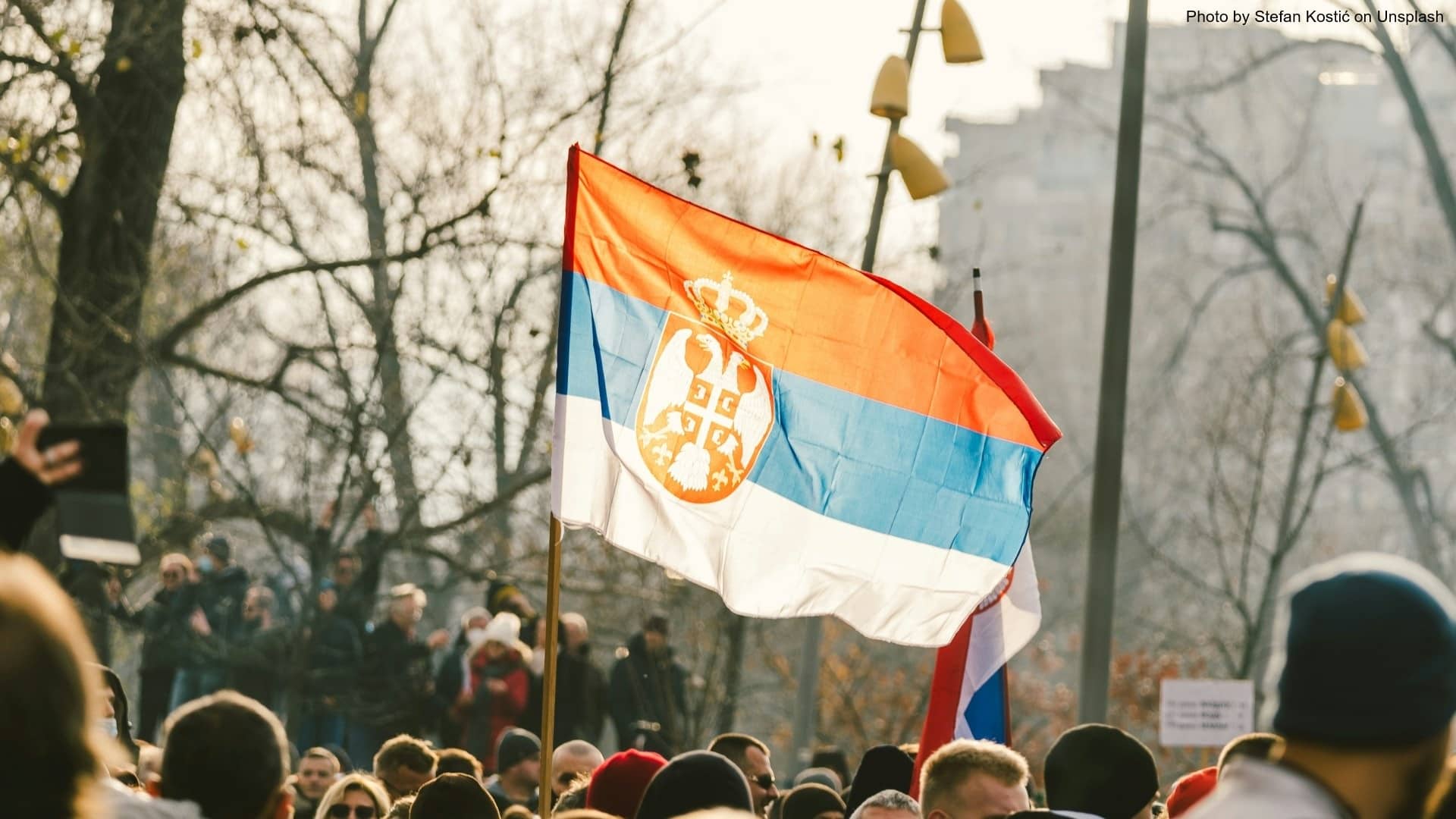
Simon Sweeney and Seb Bytyci explain why the new Serbian government may not significantly deviate from the foreign policy agenda of the right-wing nationalist regime it is replacing.
The defeat of Aleksandar Vučić and his Serbian Progressive Party (SNS) in elections at the weekend has been welcomed not only in Belgrade, but across Europe. Vučić, Prime Minister from 2014-17 and then President for almost a decade, ruled in a manner not unlike his right-wing nationalist contemporary Viktor Orbán in Hungary, who also lost power this year. Vučić pushed Serbia further from the EU and toward autocratic powers including Russia. But it is far from certain that the victorious Student List party, which sprang up out of recent anti-establishment protests, will lead to a significant reverse course.
Vučić cut his reputation as a radical Serb nationalist in the 1990s, but at a Belgrade Security Forum conference in October 2017, the newly elected President of Serbia adopted a constructive and conciliatory tone on relations between his country and its Balkan neighbours, pointing to the need for a Balkans customs union to facilitate investment in the region. Not only has this not happened, but Belgrade’s relations with Kosovo, whose independence Serbia does not yet formally recognise, have not improved in a decade of tension, accusation and counter accusation.
In addition, Vučić has maintained an ambiguous stance towards Bosnia and Herzegovina, voicing support for the integrity of the federal state while also appearing to back the Serb nationalist Milorad Dodik, leader of Republika Srpska, who has long-held separatist ambitions and enjoys support from Vladimir Putin in Moscow.
An especially sour note was the presence of some Serbian government officials at the funeral of the convicted war criminal, Ratko Mladić, earlier this year. Mladić was condemned to life imprisonment for orchestrating the Srebrenica massacre where 8,000 Bosniak men and boys were murdered in July 1995. Vučić did not attend the ceremony, but his son did. Vučić denied it was state backed, asserting that it was a private affair.
In Serbia, Vučić’s tenure proved increasingly autocratic, with ever increasing government control over media, judiciary and state institutions, while civic society organisations faced sustained repression. Vučić’s downfall comes following a student-led campaign against corruption and state-orchestrated cover-ups over the collapse of canopy at a renovated train station in 2024, costing 16 lives.
Relations with EU also stagnated under Vučić. Serbia has been a candidate country for EU accession since 2012, but progress in meeting the conditions for membership has been disappointing, not least because of backsliding on democratic principles, but also geopolitical differences. The foremost concern has been Vučić’s close relationship with Vladimir Putin. Serbia supported EU condemnation of Russia’s illegal annexation of Crimea in 2014 and the full-scale invasion of Ukraine in 2022 but has not backed sanctions on Moscow. It has instead deepened economic ties with Moscow. Vučić also looked to President Xi Jinping of China, which has invested heavily in Serbia, and provides clear strategic competition to the EU in the region.
The EU is far from blameless in a largely stalled Balkan enlargement process. Brussels’ approach is deemed too technocratic and rigid, when a more strategic focus on geopolitical considerations would be more effective in countering competing offers from Beijing and Moscow. At the same time, the Union must uphold its commitment to democratic values, and in this respect the defeat of Vučić offers hope to those in Serbia who aspire to join the bloc.
So how might Serbia’s relations with its neighbours, the EU and others develop under a new government led by the victorious but inexperienced Student List?
Student List’s foreign-policy programme leaves Serbia’s European future uncertain. The EU is presented primarily as an economic partner. There is no explicit commitment to EU membership or a clear strategy for accession. This raises the question of whether European integration is a strategic objective or simply a means of securing investment and financial support.
A refusal to impose sanctions on Russia would reinforce this ambiguity. By pledging to preserve the traditional partnership with Moscow, Student List risks perpetuating Serbia’s misalignment with the EU’s Common Foreign and Security Policy, despite aspiring to closer relations with Brussels. The contradiction is a significant concern for the EU, as Serbia cannot expect to advance towards EU membership while avoiding the geopolitical choices that accession surely entails.
The position on China also deserves scrutiny. Student List propose a comprehensive strategic partnership with Beijing, while promising that future projects will comply with Serbian law, environmental standards and workers’ rights. Although regulatory safeguards are welcome, the programme does not explain how Serbia would reconcile closer cooperation with China with the EU’s concerns about economic dependencies, trade and strategic alignment.
On Kosovo, the Student List government risks reversing progress towards normalisation. Its rejection of previous agreements, opposition to Kosovo’s membership of international organisations and insistence on Serbia’s sovereignty claim over Kosovo run counter to the 2023 Ohrid Agreement, which was endorsed but not signed by both Pristina and Belgrade. Without significant change there seems to be little prospect of resolving long-running disputes. The new government risks deepening the impasse that undermines Serbia’s European integration, while potentially inflaming regional tensions.
Student List cannot be divorced from the nationalist political culture from which it has emerged. Serbia’s 2024–25 student protests featured Eastern Orthodox and nationalist symbols, including “Kosovo is Serbia” and other nationalist slogans, while explicitly pro-EU symbols have sometimes been marginalised. The use by some of the three-finger salute associated with 1990s ethnic cleansing and genocide raises questions about the historical narratives and political values residing within the movement.
Nationalist and derogatory rhetoric at demonstrations illustrates how ethnic hostility and divisive narratives can enter a movement initially mobilised around corruption and accountability. Ethnic stigmatisation has long permeated Serbian political movements, amplified by pro-government tabloids, leading to a normalisation of hostility towards Kosovo Albanians and attitudes towards European integration shaped by nationalist sentiments and anti-Western bias.
Support for EU membership has declined and scepticism has become entrenched. Arguably, Serbia has not made a break with the Milosevic era, except briefly during the early 2000s. Support for the EU stood at 73% in December 2003 but has steadily declined. The European Policy Centre found only 40% support for EU membership, with 34% per cent opposed and around a quarter undecided. The European Commission identifies several areas where Belgrade needs to do much more to advance its accession credentials, both internally and in its external relations.
The challenge for Student List is whether it can break with this political inheritance, rather than reproduce nationalist assumptions under a new, anti-establishment banner.
By Dr Simon Sweeney, Professor of International Political Economy at the University of York and Dr Seb Bytyci, Senior Lecturer at William College.