In September 2026, David Klemperer wrote a chapter for our Policy landscape 2026 report on the state of political debate around and longer-term prospects for electoral reform. The piece was written before Andy Burnham’s promise that Labour will contest the next election on a manifesto commitment to reform the electoral system, but we are re-publishing it in light of that announcement.
The July 2024 general election produced the most disproportionate result in British history: Labour won more than 63% of seats despite winning less than 34% of the vote; Reform UK and the Greens won less than 2% of seats between them despite together winning over 20% of the vote.
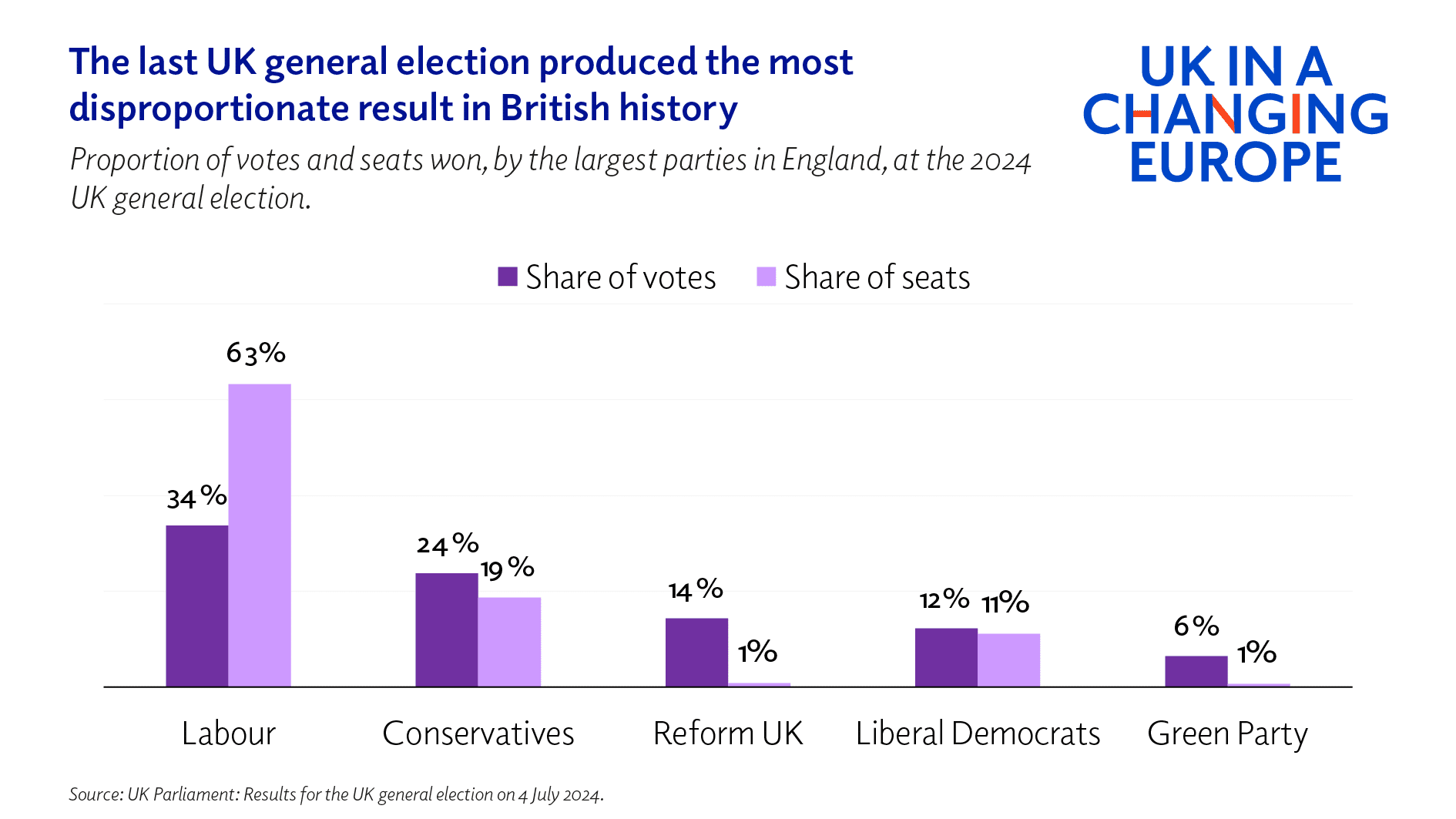
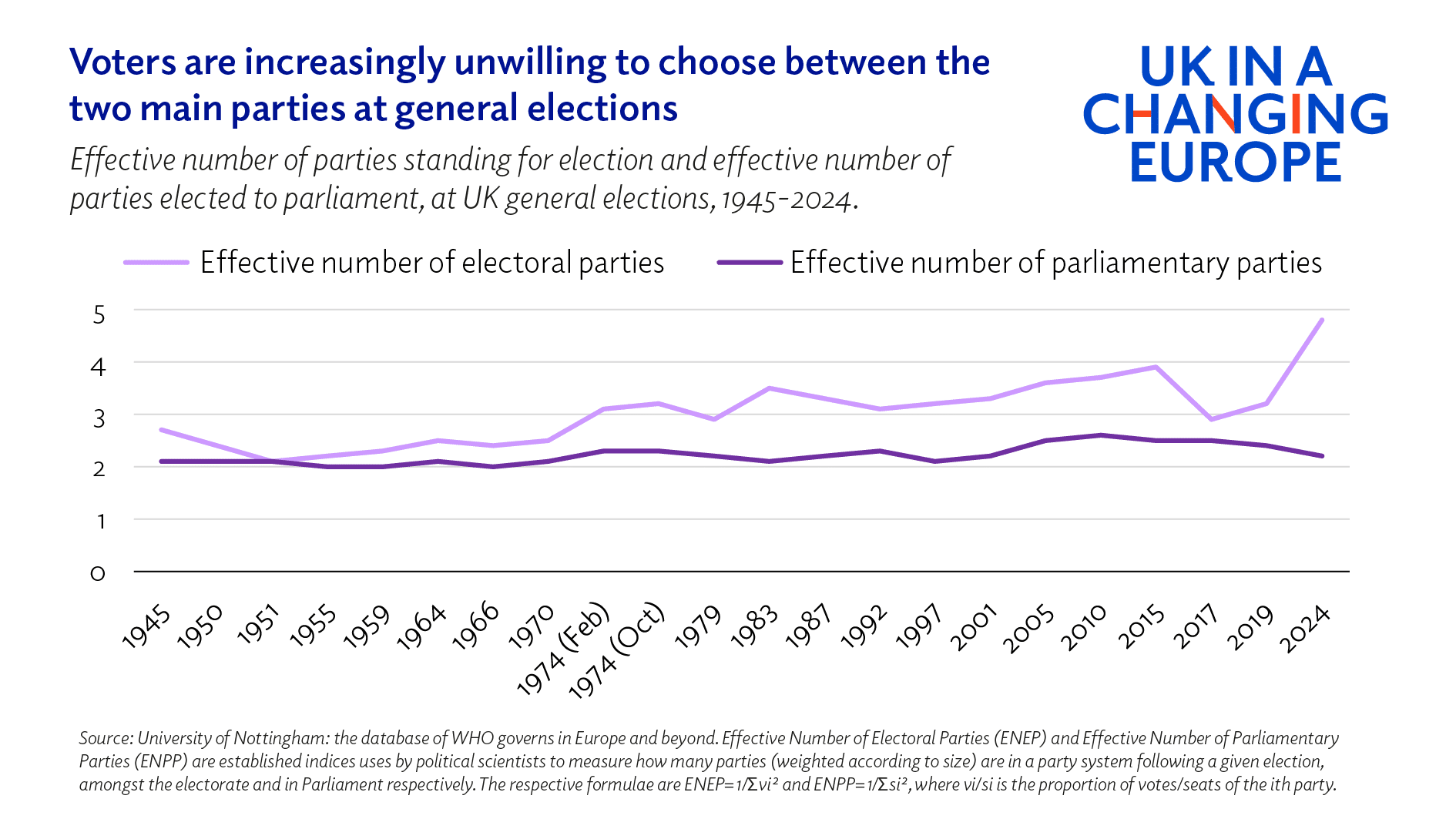
This result was the product of the interaction between the UK’s first-past-the-post (FPTP) electoral system – whose winner-take-all-logic and single-member constituencies disproportionately reward large parties and those with geographically concentrated support – and the electoral reality of increasing political fragmentation, with voters no longer content to confine themselves to choosing between two main parties.
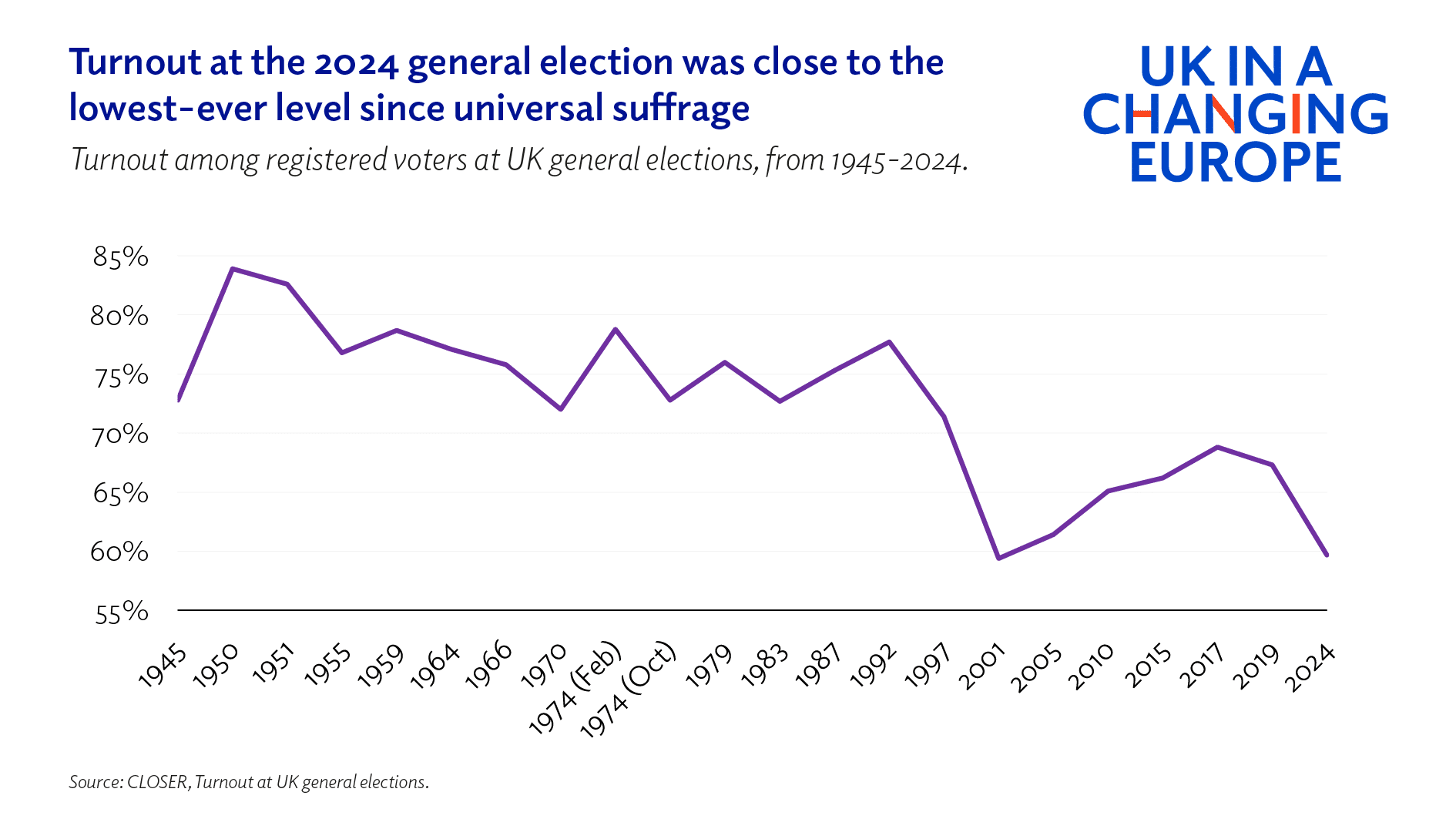
This election also saw turnout – already low by international standards – fall to its second lowest level since universal suffrage was introduced. Less than 60% of registered voters (and barely more than 50% of eligible voters) cast a ballot. Non-voting was particularly concentrated amongst younger, poorer, and more economically insecure demographics.
The combined effect of low turnout, political fragmentation, and FPTP is that election results are increasingly volatile, and governments can be elected on extremely narrow bases of support. Meanwhile, differential turnout rates and FPTP’s premium on geographical concentration of support both distort incentives for political parties – pushing them to focus on some voters more than others. This has all sparked renewed interest in the idea of electoral reform for Westminster elections.
Things already operate differently at the devolved level in Scotland, Wales, and Northern Ireland, where legislatures are elected using voting systems based on the principle of Proportional Representation (PR) – the idea that the share of seats won by each party should roughly match its share of the vote.
Defenders of the current set-up argue that FPTP has historically served to prevent political fragmentation, produce strong single-party governments, and provide clarity and direct accountability for voters at the both the constituency and the national level. In countries which use PR electoral systems, generally no single party wins enough seats to form a government alone, making multi-party coalition governments the norm. For supporters of FPTP, such coalitions undermine accountability and limit the ability of voters to choose between alternative governments.
However, the UK has a long-standing electoral reform movement that campaigns for the replacement of FPTP with a PR system. Electoral reformers present PR as inherently fairer and more democratic, and contest the idea that single-party majority governments are necessarily superior to coalitions. They also argue that whatever advantages FPTP may once have had no longer apply. The rise of five-party politics shows that it is demonstrably failing to prevent political fragmentation: under multi-party conditions it risks creating confusing tactical situations for voters at the constituency level, and producing extreme and even seemingly perverse or random results at the national level.
New campaigns have also emerged aiming to change who votes – by expanding the franchise through granting the vote to all legal UK residents, or by ensuring near-universal turnout through Australian-style compulsory voting. These campaigns argue that who votes is just as important as how we vote, and that a wider and more representative electorate would improve incentives for politicians.
Polling suggests the public is open to electoral reform, with majorities now favouring both replacing FPTP and introducing compulsory voting. Amongst politicians, PR has historically been backed by smaller parties, such as the Liberal Democrats and the Greens, that have been disadvantaged by FPTP (Reform UK were strong proponents until recently, but have become notably quieter on the issue since they began to lead in the polls). Today, it also has increasing support within the Labour Party, whose annual conference voted in favour of PR in September 2022. While Labour has historically benefitted from FPTP, the increasing fragmentation of its vote means it may soon find itself disadvantaged by it.
Although the Elections Bill introduced under Starmer included only very limited measures of electoral reform (such as automatic voter registration and lowering the voting age to 16), there is appetite within the House of Commons for more extensive changes. Multiple amendments have been put down in support of franchise expansion and compulsory voting, while over 200 MPs (including over a quarter of the Parliamentary Labour Party) have backed an amendment to establish a National Commission on Electoral Reform. The new government led by Andy Burnham may be open to such proposals: Burnham himself is a convert to electoral reform, and has repeatedly expressed support for PR.
Should the government choose to pursue electoral reform, the most immediate issues relate to timings and process. Electoral reform would be difficult to implement within a short timeframe, meaning it would likely have to wait until after the next general election. Even then, many would argue that for a change of this magnitude to be legitimate would require more than just an Act of Parliament.
One option would be a referendum. However, the experience of the 2011 referendum on the Alternative Vote (AV – a proposed non-PR alternative to FPTP), which saw electoral reform rejected by over two thirds of voters, and of the 2016 Brexit referendum, is likely to incline many against. An alternative option, which appears to be gaining ground, is for the government to convene an independent National Commission on Electoral Reform, with a deliberative democratic element, to propose a new electoral system for Westminster. This commission could be convened in the near term so as to issue its report before the next election. This would give supportive parties the opportunity to make implementing its recommendations a manifesto promise.
There is also the question of which electoral system would replace FPTP, since there are many different PR systems to choose from: Regional List PR – used for the Welsh Parliament – has voters choose between parties in multi-member constituencies, with candidates then elected from party lists in proportion to each party’s vote share; the Single Transferable Vote (STV) – used for the Northern Ireland Assembly – lets voters choose both within and across parties, by ranking individual candidates in order of preference within multi-member constituencies; the Additional Member System (AMS) – used for the Scottish Parliament – combines local representatives elected in single-member constituencies with regional ‘top-up’ seats designed to ensure overall proportionality.
Each of these systems has its own advantages and drawbacks. The government would need to choose which system it prefers – or alternatively hand the choice to a commission. The government (or a commission) would also have to decide if a new voting system should be accompanied by changes in who votes, through franchise expansion or compulsory voting.
By David Klemperer, Research Assistant, Institute for Policy Research, University of Bath.