Share this article:

Conference, thank you.
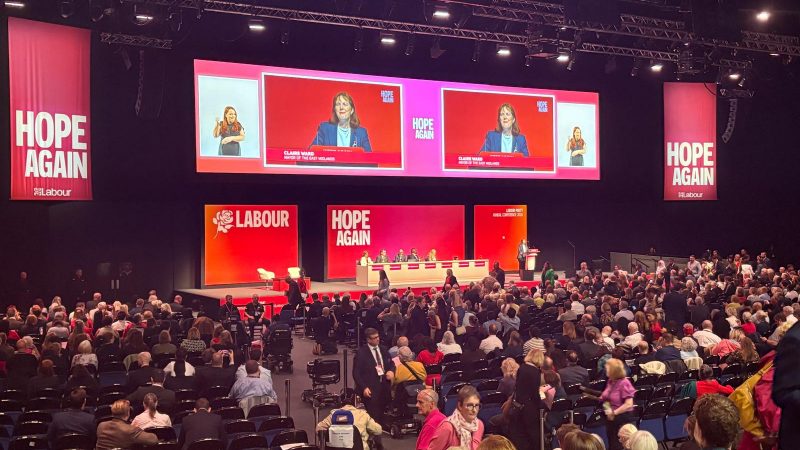
It is a great honour to be able to address you today: not just as Mayor of the East Midlands, and that’s the best job in the world, but as a representative of the ten Labour Mayors we have leading regions across England.
Labour Mayors who have just had an exceptionally busy summer. Because one of our former colleagues, you might know him, got a new job and he’s asked us to help him rewire the state so that his promise to create growth in every postcode and hope in every heart could be delivered.
And honestly conference, the moment that Andy Burnham became our Prime Minister, well, it was like seeing the Shop Steward become the Chief Executive. And he was right to approach us in that first week. As England’s Mayors we are some of the right people to get behind a mission like this.
When I set up my £3 million Community Development Fund, it was focused explicitly on the postcodes in my region that had been overlooked in previous funding rounds. It didn’t trap those places in a rigid funding application process but actively invited them to be creative, to tap into their partnerships and build their strengths.
But I can also find examples closer to where we are today. Take my colleague Steve Rotherham, the Mayor of the Liverpool City Region, a region that has hosted the Labour family with such generosity over the years. And when I look at Everton’s new stadium, just two miles from where we are today, I see rewiring in action.
The Mayoral Development Corporation that Steve has established around that stadium will transform the city at an astonishing scale: 18,000 new homes, 5 million square feet of commercial space, and public spaces for everyone to enjoy. And just for the record, that stadium was built in the East Midlands and shipped up here.
But Conference, Rewiring the State was not just calling mayors to action. Because devolution is not just about mayors. Devolution is not just about empowering the north of England. Devolution is not just about making our great cities greater. It is about no more or less than governing this country at every level like you are an accomplice in the success story of every single person in it.
And I mean an accomplice. Allies, well, they’re nice to have, but they can be passive: accomplices are active. They’re invested. They know the neighbourhood. They’re driving the getaway car. Or maybe even the getaway bus.
If, like Richard Parker, the Mayor of the West Midlands. When National Express walked away from his region’s buses, he didn’t wait for the market to respond. He got his hands dirty and nationalised the buses. He saved 4,800 jobs and kept 750 buses on the road so that the routes that make life work for millions of people could carry on running.
And conference, we know that this quality of sharing the stakes of action with your people is not limited to Mayors. It just looks different in other parts of government. In central government, this manifests through ensuring fairness across all parts of the United Kingdom, including the devolved nations.
And if you want a recent example of central government rewiring the state to do just that, you only need look at the Hillsborough Law. Power protected itself for decades after that disaster, but the families, the survivors, and their community never stopped pushing for a world where the first instinct of the state would be to protect them. And only central government could create the conditions for that: and this Labour Government did.
In local government, it is nimble and agile, designing and delivering public services in a way that is grounded in a place’s context and responsive to the needs of people and communities. And of course, the levers and powers that local government has are critical to everything we want to achieve as a country: planning, licensing, social care, the list goes on.
No tier of government is better or more important than the others, and all need to be reimagined so that we can work well together. We cannot, in our excitement to build strong regions with strong mayoral leadership, forget about what is needed locally and nationally. Our people need accomplices there too.
Conference, when power is in the right place it is easier to build a shared vision for how things could be. But more than that: it is easier to prioritise as your communities would prioritise. Tracy Brabin, Mayor of West Yorkshire, she knows what this feels like.
She is building the Weaver Network, an integrated transport network with an ambition to bring trams into the fabric of the region by the late 2030s. And Tracy isn’t pushing for trams because central Government has told her to , she is pushing for that because that is what her region needs and she will take risks to get it there.
And this is not just about hard infrastructure. Look at Kim McGuinness, Mayor of the North East. As soon as she took office, she established a £29 million child poverty reduction unit. Investment into childcare grants to parents trying to find work, investment into baby boxes across the North East, investment into a programme of grants to pregnant women in poverty. It is as important as any investment into hard infrastructure.
Or Oliver Coppard, Mayor of South Yorkshire. And on the one hand, he is investing into the South Yorkshire People’s Network and on the other, he is setting up the Mayor’s Little Big Book Club – a new reading network for South Yorkshire.
Because he knows, like teachers all over the country, that reading for pleasure is the single greatest determinant of a child’s future success.
So of course, he does not have to choose between investing in transport and investing in children. He does both.
And everyone in this room who has been part of local and regional government will know what it feels like to understand an area’s needs and strengths but be unable to convince central government that it should be a priority.
And this is particularly hard for rural communities, because so much of building an investment case is based on high population densities and footfalls that those communities simply do not have. But when power is in the right place, we can be as committed to rural communities and their economies as we are to urban ones.
David Skaith, Mayor of York and North Yorkshire – the largest Mayoral Strategic Authority by area, even larger than mine. And he’s shown just this through his Natural Health Service pilot, which has trained nearly 150 professionals from across public services to take a new approach to supporting people. By using trained public servants, the natural beauty of North York Moors, and the friendship of people who love being in nature. He is helping to tackle loneliness, supporting people with managing mental health conditions, and drawing on his region’s natural assets to reduce demand for public service.
And I should add that David’s side-hustle as an Instagram lifestyle influencer makes him the perfect mayor to do that work.
So, Conference, devolution is about being bought in. It is generous. This isn’t about resenting our already successful places, devolution supports them too.
Look at the West of England, a place where growth is strong, where Mayor Helen Godwin is investing into five new train stations which will create new focal points for communities, connect people to work, and unlock thousands of homes across the West Innovation Arc and beyond. Or to Greater Manchester, where growth is twice as strong as the country as a whole.
And in that region, our newest Mayor Bev Craig is building on an extraordinary year for the region. I’ll tell you now, Bev is filling those boots.
She has already had a host of major global events, including the Chanel Métiers d’Art, the MTV EMAs, and the BRITs. And next year, the G20. So, no pressure Bev.
If we achieve the Prime Minister’s ambition of growth in every postcode, it means that our most successful places do not endure harms from their success. People in London, our glorious capital city, feel every day the consequences of being the most productive part of an unbalanced UK economy. Their cost of living is higher, their access to affordable housing is constrained, and their roads are busier.
Of course, a few years ago, I would have added and their air quality poorer to that list, but thanks to their Mayor Sadiq Khan, that is increasingly not the case. With a 41 percent decline in Nitrogen Dioxide pollution, and a 40 percent decline in deaths associated with poor air, and lower instances of childhood Asthma – London’s 9 million residents are protected by an ultra-low emissions zone and the political bravery of their Labour mayor.
So, by being accomplices to our people, we are making space for every single person to contribute. Whether that is about transferring wealth, increasing opportunities, or reducing harms.
Conference. I can’t promise you that power shifting to places will feel comfortable. I can’t promise you that it will happen at the same pace in all places. But I can promise you that the discomfort means that we are heading in the right direction, because it means we are sharing these highest of stakes with the people we serve. It means we are accomplices in their success.
You know what this feels like, so let’s do it together.
Thank you.
READ MORE: Labour Party Conference 2026: Full LabourList events programme, revealed
Become a friend of LabourList and join our community. Our friends support our vital non-factional work and get access to exclusive content and events.
Subscribe here to our daily newsletter roundup of Labour news, analysis and comment– and follow us on TikTok, Facebook. You can also write to our editor to share your thoughts on our stories and share your own. The best letters are published every Sunday.