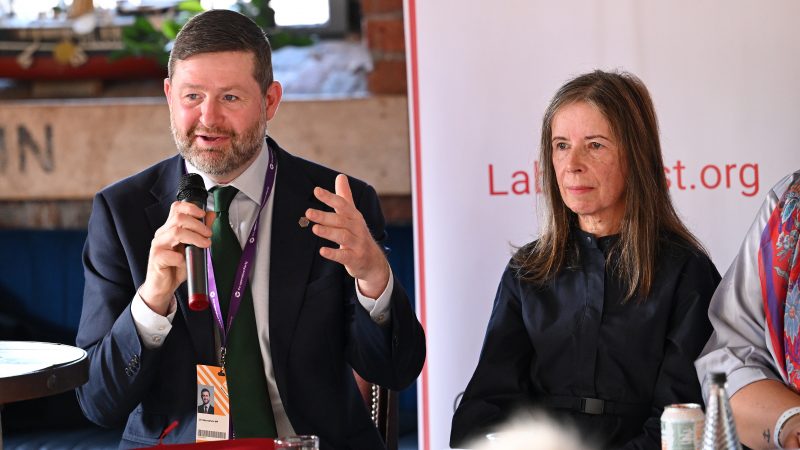

Councils must be put back on a secure financial footing if the next phase of devolution is to work, Local Government, Devolution and Growth Minister Jim McMahon MP has said.
He explained: “There cannot be a mayor without a strategic authority, and there cannot be a strategic authority without the council consenting to it in the first place.” For McMahon, the bigger question is how to rebuild councils so they can cover their bills and restore local services, allowing residents to feel the benefits of devolution on their own streets, as well as at a regional level.
McMahon made the case at a LabourList event on what the rest of Britain can learn from the Liverpool City Region and Greater Manchester, held with the University of Liverpool’s Heseltine Institute at Labour Party conference on Monday. McMahon said that while devolution has moved from the fringes to the mainstream under Burnham as Prime Minister, the task is now to build the accountability around it, including giving combined authority chief executives the duties of an accounting officer. He added: “On almost every turn, from transport to housing to employment support to regeneration, it is proven to be far better delivered locally than nationally.”
The strain on councils was a recurring topic of the discussion. Emma Degg, Chief Executive of the North West Business Leadership Team, said capacity was her members’ biggest worry, and she had a message for businesses “moaning about the slowness of local government”. Councils, she said, are “making the decision between protecting children and looking after vulnerable adults or economic development”, and that choice, she argued, will not go business’s way. Liverpool City Council Leader Cllr Liam Robinson said the council had lost 60 percent of its funding over 14 years. His answer to what he described as Whitehall’s lack of understanding was to send senior council officers to work inside government and learn how the machine operates.
Susan Jarvis, co-director of the Heseltine Institute, said the next stage “really needs to be deeper and more ambitious”, though fiscal devolution “isn’t the magic bullet”. The bigger prize, she suggested, is joining up public services locally to tackle problems such as homelessness that no single agency can solve.
However, Graham Stringer, the MP for Blackley and Middleton South who led Manchester City Council from 1984 to 1996, cautioned against expecting too much of new structures. “Devolution is not an economic strategy,” he said. For him, what matters more is trust, which councils earn partly through the speed of their decisions. Some planning departments seem to revel in saying no, he added: “It’s the wrong attitude.”
Where Stringer emphasised limits, Degg made the case for untapped potential, challenging the habit of talking about northern regions only in terms of what they lack. “If you’re looking at real opportunities for growth, they’re in the North West,” she said. Finding those opportunities often depends on local knowledge, making devolution “not just a matter for MHCLG [the Ministry of Housing, Communities and Local Government]” but for the Treasury too. Her members recently recognised a food supply chain business for its work on AI and digital innovation, which she said no national body would have spotted. “It’s not sexy,” she said. “You’re never going to find a government minister standing next to the stuff that they produce.”
Lancashire, which has a devolution deal but no elected mayor, remains the missing piece of the North’s mayoral map. McMahon was optimistic after meeting its leaders last week, saying that completing Lancashire’s devolution arrangement would give the North a full mayoral footprint. The government should set the vision for issues such as skills, housing and school attainment, he added, but on how that vision is delivered: “It’s got to be localised.”