Paula Surridge argues that the Conservative Party’s attempts to win back former voters who have switched to Reform UK are unlikely to be very successful, and could also alienate many of the party’s remaining supporters.
As the Conservative Party conference gets underway, there is little sign of a substantial recovery in their electoral fortunes. Despite talk of a ‘Keminaissance’, the opinion polls for the most part still have the party in third place. After a brief initial recovery in the second half of 2024, the party’s ratings fell sharply in the first sixmonths of 2025 and have shown little sign of recovery to even the level of the 2024 election.
Despite this, the party – outwardly at least – appears buoyant. And perhaps with some justification. On the face of it, their electoral task is much more straightforward than for many of their rivals – win back previous Conservative voters that have made Reform UK their home.
But is it really that easy? And what are the potential consequences of a strategy that prioritises these (potential) voters over those that still say they will vote Conservative, or who have previously done so but are now undecided?
Using data from the British Election Study Internet Panel, we can look at where those who voted Conservative in 2019 are now in terms of their party preferences. While the most recent data in this study were collected in May 2026, before the change in Prime Minister, it is still informative about how the Conservative vote has broken down since 2019 and what they might do to rebuild it – especially as there is little sign that the ‘Burnham bounce’ has impacted directly on the fortunes of the Conservatives.
The 2019 election is chosen as the starting point, rather than 2024. While potential votes have been lost, particularly to Reform UK, since the 2024 election, to see this as the baseline would only return the Conservatives to a losing position. Instead, we begin from a winning position and look at how that coalition of voters has shifted. To do this, the 2019 Conservative voters are grouped according to their voting preference in 2026.
There are the ‘loyal’ voters who voted for the Conservatives in 2019 and intend to do so again; there are the voters that now intend to vote for Reform UK; those who intend to vote for a ‘left block’ party (Labour, Liberal Democrat, SNP, Plaid Cymru or Green); and those who were at the time undecided. The focus is on those lost to Reform UK and those who are undecided, as together these make up just over half of the 2019 Conservative voters (37% switched to Reform and 14% undecided).
There are some demographic differences between the groups. Those who are undecided are more likely to be female (female voters tend to be more undecided regardless of the party previously supported). They are also a little younger than the loyal Conservatives but, nonetheless, one in three are aged 66 or over. Likewise, those who have switched to Reform UK are less likely to have a degree-level qualification but, one in three still do. The differences in the social composition are not large.
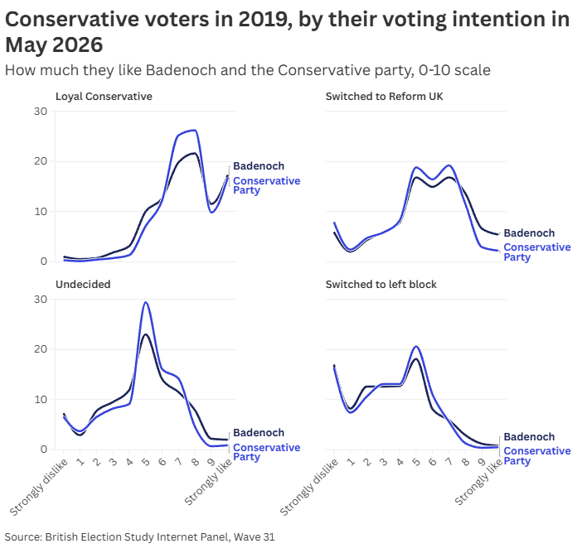
However, their political values and identities do vary. The chart below shows how much each group ‘like’ the party and the leader. As we would expect, the most positive ratings are from those who still intend to vote Conservative. This group like the party itself more than the leader but rate both positively. Those who intended to vote Reform and those currently undecided are much less positive about the party and its leader, though on average are slightly warmer to Badenoch than to the party as a whole. In both cases, though, the ratings are clustered around the middle of the 0-10 scale rather than being clearly positive (or negative).
If we compare how these two groups feel about the Reform UK leader, Nigel Farage, and whether they were happy that Donald Trump was re-elected President, a different picture emerges. Unsurprisingly, those intending to vote for Reform UK are more positive about Farage than the other groups, but the challenge for Badenoch in positioning her party to win those voters back is that the other groups – including those currently intending to vote Conservative – are much more hostile to both Farage and Trump. It seems that her positioning closer to Reform UK and support for the US President have helped to boost her image (a little) among those intending to vote Reform, but her party remains unpopular in this group. Her party is a little more popular among the undecideds and those currently intending to vote Conservative, but Farage and Trump are not.
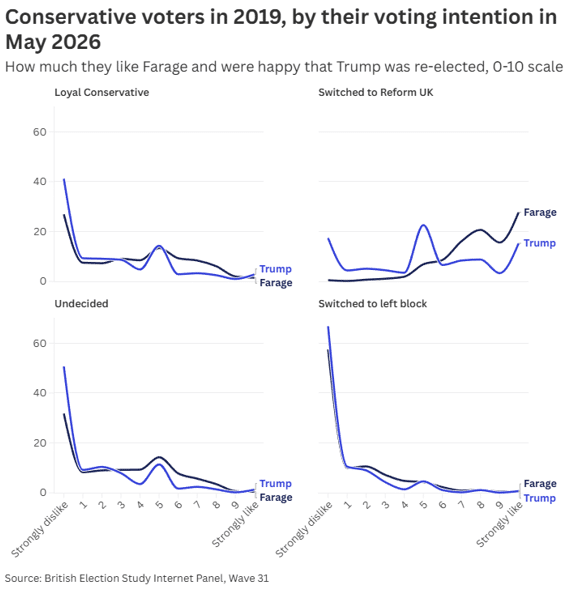
The challenge for the Conservative Party is that the voters that have moved to Reform UK don’t look especially keen to return. Meanwhile, chasing those voters moves the party even further from those who are currently undecided and those who have so far remained ‘loyal’. These voters dislike Reform UK, its leader and the platforms with which it associates. The danger is that the party ends up further alienating voters it might otherwise win while chasing a lost cause (a familiar sounding problem encountered by parties on both the centre-left and centre-right in the UK and elsewhere).
Given the tendency for previous parties to the right of the Conservatives to fall apart, they may think this doesn’t matter too much, and that come the next election the ‘problem’ Reform poses to them might have dealt with itself. But this is no longer 2019, and even if the threat of Reform becomes muted there are now other parties to their right also looking to pick up the pieces.
By Paula Surridge, Professor of Political Sociology, University of Bristol and Senior Fellow, UK in a Changing Europe.