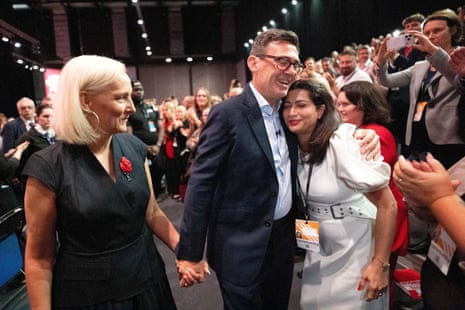
Party conference speeches by a leader are rather weird and antiquated constructions. There is almost no other time in the year when a PM, or an opposition leader, gives a speech uninterrupted for an hour or so. Some are great, some are mediocre, but normally even the better speakers tend to lose the audience halfway through as they rattle through second-order issues included to keep an interest group happy.
Andy Burnham's speech today was a rare exception. Because it was emotionally engaging, because it was laced with anger and it felt like a speech 15 years in the making, because it had a coherent argument, because it was quite colloquial, and perhaps because Burnham was not standing at a lectern, this was much more interesting and watchable than these speeches usually are. Normally, 40 minutes in, you are desperate for it to end. I would have happily listened to Burnham for another half an hour.
On substance, it was strong – but perhaps not quite as bold as Burnham maintains. His ambitions on social care are in the best traditions of "Go Big" (see 8.40am) and Burnham has shown himself to be a politician confident of his ability to turn public opinion on a big, difficult issue (getting rid of the triple lock). It was bold and inspiring. But whether it turns out to be effective remains to be seen, and if Burnham fails to win this argument, he has got time to trim, or back down.
On PR and Europe, he also staked out brave positions that will attract considerable opposition – not just out in the country, but from some in Labour too. But here he was a bit less specific than on social care and pensions. He implied PR would be in the Labour manifesto, but he just said he would fight the election on a proposal "to change the electoral system so that everyone's vote counts", which implied something less ambitious than PR – the alternative vote, perhaps, or PR for an elected Lords? – might end up to be the only option he thinks he can sell to the PLP.
And, on Europe, Burnham implied that he will open a conversation on rejoining. But he was not explicit about that, and then he started talking about "consensus" – which sounded naive because there no subject in British life on which consensus seems less possible than Brexit. One colleague has a theory that Burnham wrote the speech planning to end with a flourish saying rejoining would be an option (like Keir Starmer saying "nobody is ruling out remain" in his 2018 speech) – only to drop the wording at the last minute. There was definitely a bit of a hiatus at the end where the speech had been building up to a big reveal. (See 3.10pm.)
Still, this speech was daring, moving and – potentially – transformational. Burnham has had a good week, and today it got better.
For a full list of all the stories covered on the blog today, do scroll through the list of key event headlines near the top of the blog.
The former Green party leader is a bit more enthusiastic about Andy Burnham's commission on electoral reform than some of her colleagues. (See 5.52pm.) Lucas says:
So pleased to hear this confirmed in the PM's speech. Big congrats to @makevotesmatter.bsky.social and all who've campaigned for it! At last we have a chance to restore trust in our politics with a system where "everyone's views count and everyone's vote matters" 👏👏👏
Now we need to see similar energy behind a commitment to get dirty money out of politics, clamp down on donations, greater transparency over lobbying, Lords reform and an end to the revolving door between politics and lobbying. Only then will we have a politics people can truly trust
Charities have warmly welcomed Andy Burnham's commitment to a National Care Service. Caroline Abrahams, charity director at , said:
We have an ageing population, we've been slow to adapt to this reality and a new deal for pensioners is long overdue so it's great to see a government recognising this – but of course what really matters is what it contains.
The prime minister's commitment to social care reform is hugely welcome, after decades of dither and delay. A modern, progressive social care system, free at the point of use, would be transformational for older and disabled people, and their families too. We're excited about this aspiration at Age UK and we will do everything we can to support Louise Casey's independent Commission in thinking through what it should look like, and politicians on all sides in bringing it about.
, Scotland's first minister and the SNP leader, has said Andy Burnham is making the same mistake with pensioners as Keir Starmer. In a statement on Burnham's speech, he said:
We have provided free personal care for the elderly here in Scotland without punishing pensioners and what the prime minister was doing was repeating the mistakes of Keir Starmer.
The first act of Keir Starmer was to take away winter fuel payments from pensioners, and now the first act of Andy Burnham was to take away the triple lock from pensioners.
It's a strange way to go about trying to build support for significant reforms and I think on the basis of the mistakes made by Keir Starmer, Andy Burnham is going the same way.
And here are two journalists on what happens next in the PR debate.
This is from the Guardian's Patrick Wintour.
Get ready for near permanent coalition government albeit after 2034 since the promise to introduce a form of proportional representation in the general election will be included in Labour manifesto for circa 2029 election. Burnham slightly implied the Commission on electoral reform he intends to establish will report before the coming election. But there is a case for delay so Labour is not tied to a single preferred system at the next election. The timetable gives a lot - a very lot - of time to build consensus. The key arguments are already in the Jenkins Commission which reported in September 1998. We don't rush our fences in the UK.
And this is from the Mail's .
What electoral system is Burnham going to push for?
In our briefing just now, his spokesman was keen to emphasise that the PM backs the current constituency link for MPs
So that rules out a completely PR list-style system, such as we used for the EU.
There was a 1998 commission into electoral reform, chaired by Roy Jenkins, which took into account four requirements:
1. Proportionality
2. Need for stable government
3. Extension of voter choice
4. Maintaining constituency links
It recommended a system called AV+. Basically a mix of the AV preferential system (rejected in the 2011 referendum), and the AMS/STV systems used in Wales, Scotland and Northern Ireland.
Around 80% of the Commons would be filled from the AV constituency MPs, 20% from the proportional system.
I wouldn't be remotely surprised if Burnham's new commission ends up repeating this same finding, unless he inexplicably wants Labour to have zero chance of ever having a majority government again.
Electoral reform campaigners are delighted by Andy Burnham's commitment to a commission on changing the voting system.
Darren Hughes, chief executive at the , said:
We welcome the prime minister's committment put electoral reform for Westminster into his party's next manifesto. Andy Burnham has long been a passionate advocate for proportional representation so that everyone's vote counts and everyone's voice is heard. This is an essential step to rebuilding trust in our politics, which is currently at record lows.
, chief executive of Unlock Democracy, said:
The PM is right that first past the post needs replacing. In today's multi-party politics, it is not fit for purpose. It bakes in volatility and robs millions of voters of fair representation. "A year ago this week, Andy Burnham told a conference event that 'PR is an idea whose time has come.' We're delighted that now, as prime minister, he has kickstarted the process to deliver it.
But , the Green party's parliamentary leader, said Burnham should change the voting system now. She said:
The Green party has been making the case for a fairer, more representative electoral system for years: one where every vote counts equally and every voice is heard. So I welcome the prime minister's support for electoral reform today, and as well as his announcement of a national commission on electoral reform and invitation for all political parties to participate.
But there is a glaring contradiction at the heart of what the prime minister said today. Burnham warned that Labour will have 'failed' if they 'open the doors of No 10 to a divisive government with less than 30% of the vote,' yet simultaneously ruled out making changes to the voting system before the next general election – locking the promise of a fairer system behind his party winning another election under the very system he says needs to change.
That is simply not good enough. The PM cannot acknowledge the unfairness of a system capable of handing power to a government with a minority of the vote share, and then say the answer is to let that happen exactly once more before he fixes it.
Here is some reaction to Andy Burnham's speech from journalists and commentors.
From at the New Statesman
"Today we draw a line on a decade of division," Andy Burnham told Labour conference in his first speech as leader on Tuesday. He meant the country, with its succession of seven prime ministers over the last ten years, but the PM might just as well have been talking about the Labour Party. Since 2016, Labour has swung from left to right and now ended up here, with a feel-good conference speech packed full of policy announcements from the soft left middle of the party (proponents call it the "heart" of the party, critics call it the "comfort zone").
From at the Times
Andy Burnham said he would go big, and he did. He went big on policy: a potential path to rejoining the EU, scrapping the triple lock to fund social care for all, repealing the "ideological" ban on the public ownership of water companies, and electoral reform.
But it was also a speech that was big on emotion, at once deeply personal and political, as the prime minister appeared to become overwhelmed as he recalled the recent death of his father.
From from the i
A brave and sometimes emotional speech from Andy Burnham. But he's yet to win the argument about scrapping the triple lock to help fund social care within his own Cabinet and his own party, never mind the country.
I'm often very critical of leaders' speeches at coconferences. But that was superb by Burnham - full of ideas & policy, inspirational & very emotional, honest & risky. Bold on social care, electoral reform & EU. Yet hard to see sums adding up. Memorable & maybe historic.
From from the News Agents podcast
Burnham is the first truly effective political teacher Labour has had since Blair.
From at the Spectator
Strikingly, of all the standing ovations he received, it was the one on electoral reform which most divided the room, with scores of delegates declining to join in the applause. As one MP remarked afterwards, 'All those achievements that Andy listed were done by a Labour majority government.' One suspects plenty will be making their feelings known in private this evening.
From from GB News
I found it interesting that Andy did not mention Nigel Farage in his speech, unlike the leader's speech by Sir Keir Starmer last year (Starmer even called the migrant boats crossing the Channel "Farage boats"). Rather than worry about his opponents he is set out his own plans, which is probably why the members seemed to lap it up so much.
From from the Times
The Labour Party will be talking about that speech for years and years and years.
From from Times Radio
Most powerful conf speech in years. PM @andyburnham first weeks in office characterised by important but relatively small policy announcements. Today dramatic promises on social care, pensions triple lock, electoral reform and rel to EU. The government has its work cut out
From the Substack commentator
Burham is confirming an iron rule of employment - always try and replace someone who's been fired for incompetance as you'll look great in contrast.
We can all argue about Burnham's speech but it meant girl twin asking me what the triple lock was and boy twin asking me what my preferred form of PR is. So it's done its work.
That was a big speech that dared to make sense of what's gone wrong and what's required to put it right.A Burnham has promised the biggest change in 40 years..If he wins the next election he'll deliver it.But evidently he feels he must win an election before the biggest changes.
From , the Rest is Politics podcaster (and former Labour communications chief)
Hard to overstate how significant that speech was in terms of a new policy agenda and political direction for the country. So many big issues on which he has kicked off a national conversation. Also extremely well crafted and well delivered, at times very moving. Apart from the Swinney quote and a ref to johnson and Truss I don't think he mentioned any of the other parties. They would be wise to think carefully before rushing to judgement on it.
Basically, Burnham has set out in compelling detail what Labour's 2029 manifesto will look like, but done absolutely nothing to address any of the problems that will arise in the interim (like us running out of money).
Feels weirdly like they're building towards an early election at precisely the time they've ruled one out.
The National Care Service proposed by Andy Burnham will operate like the Scottish care system, reports.
More detail on this: Andy Burnham's new National Care Service will cover personal care costs - as per the Scottish system - but not residential element of staying in a care home.
This addresses one of the concerns raised by Andrew Dilnot, architect of a previous attempt at social care reform that failed, in a Today interview yesterday.
, the Green party leader, has said in his response to Andy Burnham's speech that "some of the pledges are steps in the direction the Greens have been calling for". But overall his response is negative. He says:
Unlike his predecessor, we have a PM who talks like he gets it. But sadly like his predecessor he isn't prepared to break from the powerful and wealthy interests that have created an inequality, affordability and a climate crisis. Hope is not just a slogan, it needs to mean real change. The speech today had no wealth taxes, no rent controls, no water nationalisation and a strong hint of more North Sea drilling.
There is a gap between what the prime minister says, and what he'll actually do.
, the Lib Dem leader, says that getting rid of the triple lock will be like a repeat of the winter fuel payments fiasco. He has made the point in an open letter to Andy Burnham.
In a general statement on Burnham's speech, Davey also accuses him of being too indecisive. He says:
Andy Burnham spent years telling the country what he would do if he were in power. Now that he is sitting in Number 10, what we got was a lot of 'Definitely Maybe' and a total absence of action today …
This prime minister had a historic opportunity to start to fix our broken voting system and rebuild our relationship with Europe, but everything remains a maybe.
This looks too much like Starmerism with a veneer of panache.
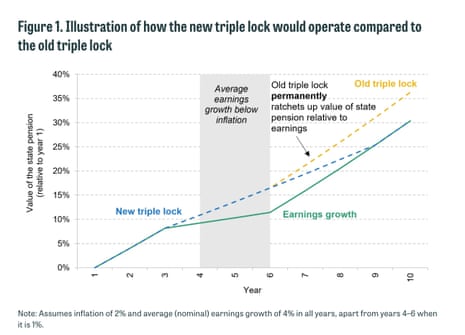
The Institute for Fiscal Studies has welcomed Andy Burnham's announcement about the triple lock. (See 2.48pm) Although it sounds like he is replacing it with a double lock (pensions rising line with prices or by 2.5% every year, whichever is higher), in fact it is still a triple lock. That's because, if the amount needed to ensure pensions have still risen in line with average earnings growth since the introduction of the new policy is higher than prices or 2.5%, they will go up by that amount.
The IFS proposed this change to the system. It explains it like this.
The key change is that the new triple lock removes the most expensive and unjustified part of the triple lock: the fact that it permanently ratchets up state pension spending over time. Under the reformed system, pensions will still rise every year and in line with average earnings in the long run, but less quickly than they otherwise would have, and in a less unpredictable way.
The reform will likely generate small savings to the Exchequer in the next parliament, but they will not be enough to fund universal social care. Over time the new triple lock will prevent the state pension being locked into an ever-increasing level of generosity compared to workers' earnings, thereby generating significant savings in the long run.
In a briefing, the IFS has illustrated this with a rather incomprehensible chart.
, deputy director of the IFS, said:
For years, we at the IFS have been calling for the government to find a better way to increase the state pension than the triple lock. The old triple lock is not a good way to achieve any policy goal. Most importantly, it is both very expensive and very unpredictable. The new, reformed triple lock from 2030–31 is not perfect, but it is a substantial improvement on the status quo. The prime minister should be commended for grasping the nettle and helping to put the state pension system on a more secure and sustainable footing.
Andy Burnham's promise to set out a new vision for the UK's post-Brexit relationship with the EU later this year unleashes the prospects of a dramatic move away from Keir Starmer's red lines of not rejoining the single market or customs union.
All day yesterday in Liverpool, rumours were swirling that Burnham had some big reveal on the EU in his speech.
Although he didn't specify what the new relationship would look like, announcing he wants a consultation on options the Labour party can embrace, will be music to the ears of people like , the head of the Labour Movement for Europe group. After the speech she posted this on social media.
Andy Burnham has spoken the truth that the British people are living every day: Brexit has done more harm than good.
We in @labour4europe warmly welcome the news that the Prime Minister will present to the country the full options for this country's relationship with the EU.
Everything must be on the table. Removing the red lines on Europe is the essential first step to restoring this country's place on the world stage.
We stand with this Prime Minister in making the changes that truly live up to the challenges of 2026, not 2016.
Burnham announced he would be looking at all options for the UK's post Brexit relationship around the next summit with the EU, due to be held at the end of November. (See 3.10pm.)
Although ministers over the weekend, including EU relations minister Hamish Falconer, had insisted Burnham was "ambitious" for his plans with the EU, there were no details of what that looked like. Until today.
Burnham has now raised the prospects that he could blur or even rub out Keir Starmer's red lines, not joining the single market or customs union, or even go into the next election promising another referendum to rejoin the EU.
Only yesterday , a Labour grandee and Tony Blair's former Europe adviser, was telling a panel on the EU in Liverpool that the UK had "got rather stuck" in its negotiations with Brussels.
Keir Starmer, he said, could never really make up his mind about where he wanted the UK to be. He "blew hot and cold" and "the red lines were brought out too often", Liddle said, referring to Starmer's insistence the UK would not rejoin the single market or customs union.
If the UK is serious about growth, Liddle said, "the first thing" it has to look at is "the relationship with the EU".
The government is saying the changes to the triple lock proposed by Andy Burnham would save £15bn by 2040, from Bloomberg reports.
The government is not ruling out tax rises to pay for Andy Burnham's social care policy, in addition to scrapping the pensions triple lock The changes announced today will save £15b by 2040, a government official says. But it's possible taxes will have to rise as well
, the former head of the Institute for Fiscal Studies has posted this on social media.
Replacing triple lock with a system that ensures state pension rises with earnings over time, but never rises by less than inflation, makes a lot of sense. Good. The idea this will pay for free social care any time soon, though, is for the birds. That will mean higher taxes.
This backs up what Kemi Badenoch is saying. See 4.20pm.
has accused Andy Burnham of wanting to take Britain back to the 1970s. In her response to Andy Burnham, she said:
Andy Burnham delivered a speech for the Labour party, not the country.
Burnham wants to take Britain back to the 1970s, a time of more government control, more trade union control and no economic growth. There is a reason our country took a different course after that decade.
Nothing Burnham announced today will do anything to fix Britain's long-term problems. He had no plan to fix our stagnant economy. No plan to fund defence. No plan to sort out the spiralling welfare bill beyond more government schemes.
His proposal to change the triple lock is already falling apart under scrutiny, and it won't generate enough savings to fund a nationalised care system for another two decades, which means more tax rises are inevitable.
Here is the full text of 's speech.
One of the unusual features of Andy Burnham's speech was that he all but ignored his opponents. The only other leader he mentioned was the SNP leader and Scottish first minister John Swinney, and even then he said he did not want to criticise Swinney. Burnham was became Labour leader in part because Labour MPs concluded the prospect of becoming PM was appalling enough to justify an emergency defenestration, but Burnham did not mention him today. Or Kemi Badenoch.
Farage, though, has noticed Burnham's speech. He has issued this response.
By potentially scrapping the triple lock, Andy Burnham will abdicate his responsibility to British pensioners.
Instead of cutting our bloated benefits bill, stopping migrants from accessing benefits, or slashing foreign aid, he's considering launching an offensive against our elderly.
If he is so desperate to pick a fight with pensioners, he should get on with it, call a general election now, and let the public decide.
Reform UK will always protect our pensioners and maintain the triple lock.