, the chancellor, is giving evidence to the Commons Treasury committee. When , a Conservative member of the committee and former Treasury minister, asked him if he was worried that the Office for Budget Responsibility said they could not identify any measures in the budget that would have a significant impact on growth, did not accept this.
He said that Glen was right to say the OBR did not identify any measures that they wanted to include in their growth scorecard.
But he went on:
I'm not terribly worried about that because I believe in the months ahead, and the next year or two, the sort of measures [in the budget] on enterprise I believe, the measures on devolution I believe, the measures on energy and also on AI will start to feed through and we will see that impact on growth.
And in the end, yes, of course, the formal figures matter, the forecasts matter.
But, actually, it's also business confidence [that matters].
The OBR normally only includes growth measures in their scorecard if they will increase growth by at least 0.1% of GDP.
As reports on his business live blog, Healey also told the committee he was "dismayed" by a leak to Bloomberg on the morning of the budget saying the new bank tax would be less onerous than the City assumed.
For a full list of all the stories covered on the blog today, do scroll through the list of key event headlines near the top of the blog.
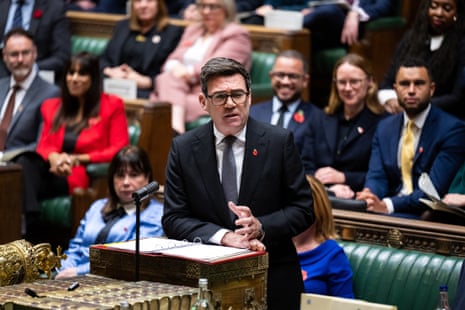
Keir Starmer's former chief of staff, , has called for a rethink of "quasi-judicial" powers given to cabinet ministers such as the energy secretary's ability to approve future oil and gas fields. has the story.
The Restore Britain MP says he has tabled an early day motion saying that "the English, Scottish, Welsh and Northern Irish are historic people with distinct ethnic identities". This is a direct attempt to counter the argument being made by the Lib Dem MP Josh Babarinde, and supported at PMQs today by Andy Burnham (see 12.29pm), about how black English and Asian English should be recognised identities.
led the campaign to keep the UK in the EU in 2016. He resigned as PM after he lost. But he is not in favour of trying to rejoin.
In an interview with Bloomberg's Mishal Husain, Cameron argued that Brexit was not to blame for the most serious economic problems facing Britain.
If you look at the economic problems we have today, I don't really think they've got anything to do with Brexit at all. I mean, our economic problems are we are overspending, over-borrowing, over-taxing, over-regulated, and far too much being spent on working-age welfare. Those are a set of problems that have nothing to do with Brexit.
We need a government that actually gets spending under control, gets taxes down, helps entrepreneurs, deals with our borrowing problem, reforms the welfare, and massively deregulates so we can build houses, build infrastructure. None of those have got anything to do with Europe.
So that's my point. Do we really want to go into another decade-long debate about whether we should be in or out, when actually we should deal with our own problems while making the partnership model work?
Cameron also argued that, if British politicians raised the prospect of rejoining one day, they were less likely to get a good partnership deal now.
If you start endlessly producing this idea that we're actually on a path to rejoining, I think you're in danger of getting a less good partnership deal because of course the EU countries will just think, 'Well, these guys are gonna rejoin anyway, so what's the point in giving them a good partnership deal?'
Labour's asked John Healey at the Treasury committee about his plans to ringfence spending on some programmes deemed preventative. She asked how much spending was likely to be included in this new PDEL (preventative departmental expenditure limits) category, and how departments would decide what counted as PDEL.
replied:
The short answer is that it's premature to be able to give you that sort of detail …
The thinking behind this is really twofold.
One is that we recognise in CDEL [capital DEL] the particular value and importance of long-term investment. And this is a way of recognising the potential long-term value of preventative spending …
The second thing is that it is a recognition that in some of the most complex and intractable social service delivery [areas] – and arguably economic [areas] – [there is] the complexity of having multiple departments with different budget lines that may or may not make a contribution.
I would expect a limited number of areas to try and demonstrate in practice a different way, not just of accounting and allocating budgets, but managing most effectively our ability to tackle some deep-seated problems.
Obvious, potential priorities might be rough sleeping, homelessness, violence against women and girls, where short-term decisions often load extra costs in other parts of the system.
This is a way for government to get beyond some of those sort of barriers.
At the Treasury committee, the Labour MP asked why UK government borrowing costs (or gilt yields) were higher than for comparable countries, even though the debt-to-GDP ratio is lower than in countries like France and Italy.
Healey replied:
I don't really want to labour it, but quite honestly our gilt yields were pretty much in step with European countries until the Liz Truss mini-budget. We've been paying a premium since then …
I think if you look at the upheaval in the bond markets in recent weeks, you'll have seen that Britain can't avoid the storm. But we don't happen to be at the centre of the storm in the way that we have potentially been in the past. That has been difficult for France. And you've seen the relative rise in yields for France in that period of turmoil and uncertainty have outstripped the UK.
At that point Healey invited , the permanent secretary at the Treasury who was giving evidence with him, to comment. Bowler told the committee:
The chancellor is absolutely right about when we diverged from the G7 average …
I think it's probably worth saying that throughout this Middle East conflict, the UK has been very much in line with the G7 average and other countries which, frustratingly, have seen borrowing costs rise. And they're rising predominantly because [the war] means more inflation, via energy, and tougher fiscal situations.
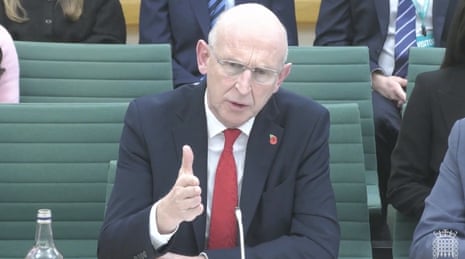
The Reform UK MS (member of the Senedd) has posted on social media a copy of the letter the Senedd llywydd (presiding officer), Huw Irranca-Davies, has sent to MSs asking them not to challenge his Joe Martin ruling on social media. Parry-Jones says it is a "dystopian" attempt to silence people.
In Cardiff some Reform UK Senedd members have held a press conference about their decision to boycott this afternoon's plenary session. (See 2.41pm.) In a post and video clip on social media, describes it as one of the most bizarre press conferences he has attended as a journalist.
Reform UK held a press conference and said they would not be carry out their jobs of sitting the Senedd today to defend the "free speech" of Joe Martin MS.
When challenged about this they walked away.
In response,, the Plaid Cymru leader at Westminster, has posted these on social media.
Running scared of free speech.
Reform drop any pretence of representing constituents as a serious opposition party with today's 'don't you dare hold us to account' boycott.
Reform are boycotting their own debate on remembrance and veterans on Armistice Day.
Nothing says 'standing up for veterans' quite like not bothering to turn up for them.
told the Treasury committee that support for a third runway at Heathrow is government policy.
In response to a question from Labour's , who asked about the third runway, Healey said:
The government is behind a third runway at Heathrow, and I'm part of the government.
Interestingly, that is not the answer Andy Burnham gave when he was asked about this in an interview during Labour conference. Burnham, who is reportedly sceptical about the case for a third runway, said this was a "contested issued" and mainly a matter for Labour MPs. He also claimed it would not be appropriate to comment because a consultation was underway.
, a London MP and a supporter of a third runway, said told Healey she was frustrated how long it was taking.
Our experience in recent decades, is it not, is that successful airports are very often an engine for economic growth in the wider area? That's as true in Manchester as it is true in parts of London and elsewhere.
In terms of the assessment following the consultation period, that's not led by the Treasury. That's led by the Department for Transport, and the government is working through the responses and the further update information we've got from that.
It was a good PMQs today for Guardian stories, my colleague points out.
Full @GdnPolitics domination of PMQs today - EVs, Rosebank, MPs quotes on 10 year plan and census stories all getting namechecked by MPs.
At the committee, was also asked about a comment from Helen Miller, head of the Institute for Fiscal Studies, criticising one of the measures in his budget, the founder's relief tax cut for entrepreneurs. She said it was "bonkers".
Healey said he had a lot of respect for Miller. "But, to be quite honest, I look more to those who are in the field," he said.
He said the founder's relief policy had been warmly welcomed by the Startup Coalition, which represents tech startups.
, the chancellor, is giving evidence to the Commons Treasury committee. When , a Conservative member of the committee and former Treasury minister, asked him if he was worried that the Office for Budget Responsibility said they could not identify any measures in the budget that would have a significant impact on growth, did not accept this.
He said that Glen was right to say the OBR did not identify any measures that they wanted to include in their growth scorecard.
But he went on:
I'm not terribly worried about that because I believe in the months ahead, and the next year or two, the sort of measures [in the budget] on enterprise I believe, the measures on devolution I believe, the measures on energy and also on AI will start to feed through and we will see that impact on growth.
And in the end, yes, of course, the formal figures matter, the forecasts matter.
But, actually, it's also business confidence [that matters].
The OBR normally only includes growth measures in their scorecard if they will increase growth by at least 0.1% of GDP.
As reports on his business live blog, Healey also told the committee he was "dismayed" by a leak to Bloomberg on the morning of the budget saying the new bank tax would be less onerous than the City assumed.
Reform UK members of the Senedd are boycotting today's plenary session as a protest against a member of their group being told he won't be called to speak until he apologises for comments about immigrants that were deemed offensive. (See 11.04am.)
Explaining their move, the Reform UK leader in Wales, said:
The people of Wales gave Reform a clear mandate to raise their concerns and to be their voice.
It is now clear that the freedom of speech of one of our Senedd members is being curtailed, meaning his constituents are being silenced.
We stand behind Joe [Martin], and we will not attend today's plenary session in protest at his treatment.
Every Reform MS will be in their Senedd office working hard for our constituents.
And said in a statement:
My voters sent me to the Senedd to speak on their behalf.
I am being blocked from doing so, and now it's clear that I have fewer rights than the people who elected me.
That cannot be the situation in a national parliament.
The Reform UK MSs (members of the Senedd) still intend to take part in any votes at the end of the session.
Reform UK's general secretary has left the role as Nigel Farage's party continues to face turmoil over questions about vetting failures and professionalisation.
The departure of comes after Reform UK's leader on Hampshire county council, George Madgwick, was charged with 12 counts of rape and one of distributing indecent images of a child.
Waterhouse, an experienced public affairs executive who previously worked in the Westminster thinktank world and for the Crown Estate, had only been recruited in August last year. Labour described him as Reform's "latest fall-guy" for problems at the party.
A said:
Tom Waterhouse has left his role with Reform UK. The party leader has now appointed an interim general secretary.
However, his departure comes as a blow to Reform's drive towards professionalisation, a project which he had been at the centre of.
He had been involved in a major recruitment push, bankrolled by wealthy donors, as well as the selection of its candidates for a future general election.
Waterhouse had also been involved with Adam Richardson, a long-standing associate of Farage, in the party's internal investigation into two of its senior officials, James Orr and Dan Jukes, which cleared them of breaking laws that ban foreign donations, despite the matter remaining under police investigation.
However, the recent case of Madgwick severely embarrassed the party and once again brought the question of Reform's candidate vetting process into the spotlight.
That process is now run by Paul Nuttall, the party's deputy chair and former Ukip leader, but Waterhouse also reflects continuing organisational turmoil at Reform.
, the Labour chair, said:
As the scandals pile up for Reform, everyone is being forced to take the blame except Nigel Farage. Their general secretary is the latest fall guy, but we all know nobody in Reform makes a decision without Farage's approval.
Farage has recently not concealed his unhappiness at continued failures when it comes to vetting and other matters.
"I wasn't very happy," said the Reform UK leader when asked why Madgwick, who was arrested in January over multiple alleged sexual offences, was still in his role nearly 10 months later.
Farage last month also blamed "staff incompetence" for a poor turnout and a half-empty hall during a Reform UK economic policy launch event in London.
Staff at Reform's Millbank HQ were informed on Wednesday that Waterhouse was leaving. He is one of a number of figures who had been seen as major assets to Reform's push for power who have parted company or been sidelined in recent times.
They include Tim Montgomerie, a high-profile activist who defected from the Conservatives, who was suspended after he criticised Farage's decision not to attend the count when he won the Clacton byelection.
Madgwick, who is scheduled to appear at Portsmouth magistrates court on 25 November, denies any wrongdoing.
Downing Street has defended Ed Miliband amid questions over his past contact with Russell Brand, the Press Association reports.
At the post-PMQs lobby briefing, asked whether Miliband, who did a high-profile and controversial interview with Brand on Brand's YouTube channel during the 2015 election campaign, should address his previous contact with the rapist comedian, the said:
The prime minister was asked about this on Friday in an interview with the BBC. As he said, it's not always the case that people know everything about people in public life, but what is important is where there is wrongdoing, it is exposed.
The PM also praised the bravery of the victims, saying credit to the victims, huge credit for the courage it's taken, but also for the journalists that have exposed this.
The spokesperson also said the Miliband/Brand interview was "long time ago".
is on record as saying she treats PMQs like panto. It is not a ridiculous view; in many respects, it is all about theatre and performance, the jokes matter (often they are all that anyone remembers by the end of the afternoon), and Badenoch started impressing her MPs (and wider audiences) when she abandoned an overly-analytical approach to PMQs, and started playing it for laughs, or Punch and Judy-style aggro, instead.
If you subscribe to the Badenoch thesis, today was one of her best outings against Burnham. She was consistently funny and withering, and delivered an effective put-down about Ed Miliband too. Her MPs seemed to like it, and on Tory social media she is getting predictably good reviews. This matters a bit; it is better than a Tory leader getting bad reviews in the Tory media.
And there are moments when a well-crafted joke can deliver a win at PMQs. When William Hague was in the job Badenoch is doing now, that happened most weeks.
But to convey mastery at PMQs, rather than just making people laugh, the humour has to be linked to a wider argument, and today it wasn't. At least, it wasn't linked to a wider argument that was compelling. Badenoch's main challenge was about the Rosebank oilfield, and the government's failure (yet) to approve it. Burnham could acceptably see this off with a reference to it being subjudice. Beyond that, Badenoch was essentially just running an 'admit you're useless' diatribe. With some PMs, in some circumstances, that's enough. But Burnham is not anywhere close to that point yet and so Badenoch's questions just sounded like knee-jerk negativity – albeit artfully done.
For an alternative (and better) theory of PMQs, do read this thread from , a former Labour No 10 adviser (in the Blair/Brown years) who now runs a thinktank. This is his conclusion:
I worked on 119 PMQs in No10 and I would observe that winning individual PMQs (because you landed a blow or a joke) matters less than establishing an argument over a term (eg. He didn't fix the roof while the sun was shining). That's how you win at PMQs in the long run.
On jokes, Badenoch is winning. But, on most or all of the main arguments, Burnham still has the upper hand. And on personality too he also has an advantage because he sounds fair and reasonable, as he did again today, which isn't always a virtue associated with the opposition leader.