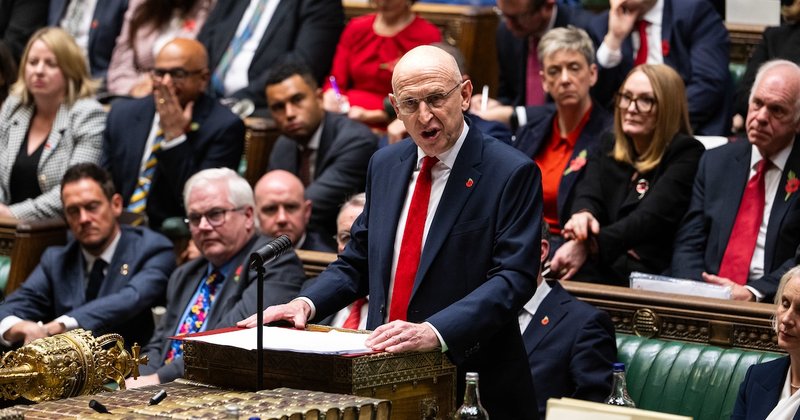
John Healey has delivered Labour’s third Budget since entering government—his first as Chancellor of the Exchequer, and the first since Andy Burnham became Prime Minister.
We’ve been fact checking claims made by both the Chancellor and the Leader of the Opposition, Kemi Badenoch, in her Budget response. (We’ve also partnered with the Independent again this year, so you may also see some of our analysis on its website.)
Here are some of the key announcements and claims we’ve examined so far, but we’ll be continuing to dig into the detail. If you have questions about the Budget or have seen something you’d like us to look into, please let us know.
Join 75,000 newsletter subscribers who trust us to check the facts
Sign up to get weekly updates on politics, immigration, health and more.
Subscribe to weekly email newsletters from Full Fact for updates on politics, immigration, health and more. Our fact checks are free to read but not to produce, so you will also get occasional emails about fundraising and other ways you can help. You can unsubscribe at any time. For more information about how we use your data see our Privacy Policy.
When exactly will people stop paying gas standing charges?
Mr Healey said in his Budget speech: “From next year, through Ofgem, we will remove standing charges from household gas bills.”
This news had already been announced earlier in the day, but Mr Healey’s comments in his speech may have left some unsure about exactly when the change is due to come into effect.
In fact, while Mr Healey said “from next year”, the government’s own press statement and the Budget document itself suggest the change might not take effect until the year after next.
The Budget document says the change is “aiming for delivery by the end of 2027 or as soon as possible after then”. And a Treasury spokesperson told Full Fact: “Our aim is by the end of 2027 or as soon as possible after then (so 2028).”
An Ofgem spokesperson told us: “Our focus will remain on working with government and industry to deliver these changes in a way that works for consumers and supports a fair transition."
The MoneySavingExpert website, whose founder Martin Lewis met Mr Healey to discuss the change early on Wednesday, has reported that it expects the change to come into effect on 1 October 2027 or 1 January 2028.
When did the government take VAT off electricity?
Mr Healey said the government “took VAT off electricity” bills “in the first week of this new government”. He also announced that the cut will be extended through the winter and spring to July.
It’s true that Andy Burnham announced the temporary zero rate for qualifying supplies of electricity in Great Britain in his first week as PM, but this came into force at the start of this month.
Has the Chancellor kept the Labour manifesto promise not to raise tax on working people?
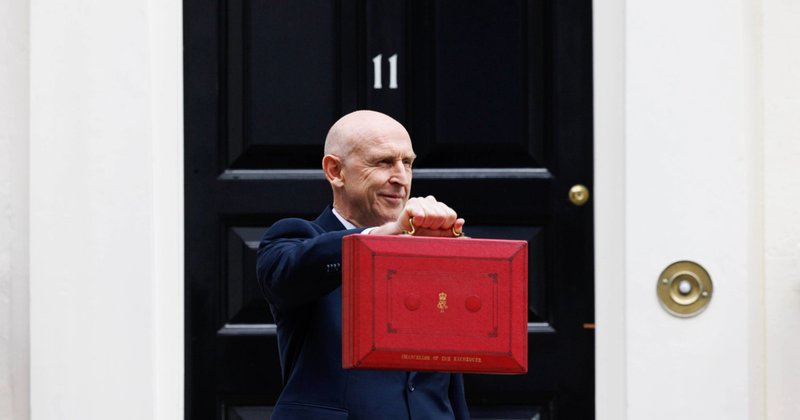
John Healey said his “choices” in this year’s Budget mean he’s “kept the Labour manifesto promise not to raise tax on working people”.
While we’re continuing to go through the detail of the measures he’s announced, ahead of today our Government Tracker was already rating this promise as ‘not kept’ due to decisions made in the 2025 Budget.
Last year, Mr Healey’s predecessor Rachel Reeves extended the freeze on income tax and National Insurance thresholds, until 2031.
Following last year’s Budget, Ms Reeves said “I do recognise that that will mean that working people pay a bit more”, though she also said she did not believe the manifesto commitment had been breached.
How much will adjusting the triple lock save?
The Chancellor said that adjusting the triple lock will “save £15 billion” a year.
This figure refers to how much less the government thinks it will spend in 2039/40 on the state pension. That’s compared to what it would have spent without making any changes to the policy, not to the amount it spends currently.
In addition, as experts have pointed out, the exact amount this policy will “save” depends on what happens in the economy in the coming years.
The Resolution Foundation has described the £15 billion figure as a “reasonable central case”, but depending on what happens in the next ten years or so, the actual value of the policy could be more, or it could be less.
More funding announced, but how does the government measure rough sleeping?
John Healey said the Budget includes “a further £430 million” to offer “everyone sleeping rough a route off the streets” in coming winters.
In July, in his first speech as Prime Minister, Andy Burnham pledged to “end rough sleeping in our country”.
We’re tracking the delivery of that promise via our Government Tracker. For now we’re rating it as ‘wait and see’, as it’s too early to know how levels of rough sleeping have changed since the commitment was made.
Rough sleeping in England is measured by the government in two ways—an annual snapshot survey, which takes place on a single night between 1 October and 30 November, and in monthly figures provided by local authorities.
The latest monthly figures estimate 8,748 people were sleeping rough in England in June 2026, while last year’s autumn snapshot survey estimated 4,793 people were sleeping rough. (Rough sleeping figures are typically impacted by the seasons so fluctuate throughout the year.)
Unemployment’s up - but employment is too
In her response to the Budget, the Conservative leader Kemi Badenoch said: “Unemployment has risen by a quarter of a million people since Labour came in.”
This is correct. However, it’s worth noting that the number of employed people has also risen, by over one million in the same period.
And the rates of unemployment and employment have both increased too.
While this might seem contradictory, both the employment and unemployment rates can rise together when more people move into the economically active population, and so are now working, or unemployed and available to work. The number of economically inactive people has decreased by 327,000 since June 2024.
For more on unemployment, jobs and how things have changed under Labour, see our recently updated explainer.
How does the tax burden compare historically?
Mrs Badenoch claimed that “next year under [Labour] Britain will have the highest tax burden in our country's history. Higher than the 1970s. Higher than in the Second World War. Higher than in the Napoleonic Wars.”
It’s true that the so-called ‘tax burden’, which refers to tax revenue as a percentage of GDP, is forecast to reach 37.9% in 2027/28, according to the Office for Budget Responsibility's report published today—and that would be the highest level on record since comparable records began. But those comparable records only date back to 1948/49.
We’ve asked the Conservatives what Mrs Badenoch’s comparison with the Second World War and the Napoleonic Wars was based on, and will update this article if we hear back. Earlier this year tax expert Dan Neidle said that the number of individual taxes in the UK was the highest since the Napoleonic Wars, but that measure isn’t the same as the amount of revenue being collected as a share of GDP.
Tracking the government’s 1.5 million new homes target
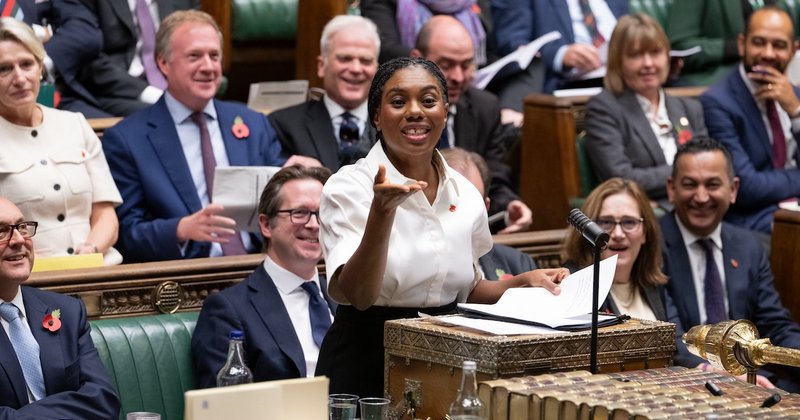
Mrs Badenoch also raised Labour’s promise to build 1.5 million new homes in this Parliament, saying: “I remember when the housing secretary first started and I told her that she'd been stitched up.”
The government has specified the target covers England only, and is measured by counting net additional dwellings, which include new builds and conversions minus demolitions.
However, so far this pledge appears to be off track.
Between 9 July 2024 and 20 September 2026 estimates suggest there was a net addition of 437,900 homes—29% of the total target.
At the current rate of building, Full Fact’s rough calculations suggest from last month it would take over five more years for the 1.5 million target to be met.
In recent months the government has begun referring to this figure as a “stretching target”. Housing minister Matthew Pennycook said in August the target “is looking really tough”, and the following month housing secretary Angela Rayner acknowledged there was a “slim chance” of it being achieved.
Did Mr Healey set a date for 3% defence spending?
Mrs Badenoch also claimed the Chancellor hadn’t set a date for defence spending levels to reach 3% of GDP.
She quoted Mr Healey’s resignation letter from when he stepped down as defence secretary in June, in which he said: “I am certain that a headmark date for 3% of GDP on defence in 2030 is what Britain must set.”
Mrs Badenoch said: “Today is the day he should have set that date. Today. He is the man who failed to set a plan for 3%.”
But earlier Mr Healey did say that 2030 was a “target date” for defence spending to hit 3% of GDP.
He said: “At the Spending Review next year I confirm that I will set out the details of how we will meet our NATO commitment to spend 3.5% of GDP on defence by 2035 with a target date for 3% in 2030.”
However, as the Institute for Fiscal Studies noted in its initial response to the Budget, there was “very little detail” on how the 3% target will be reached.
What does the OBR say about inflation and disposable income?
Ms Badenoch also claimed that the Office for Budget Responsibility’s forecast shows “Inflation up every year until 2030” and “Real Household Disposable Income (RHDI) lower every year.”
This appears to refer to how the forecast published today compares to the one published in March 2026. It doesn’t reflect how inflation and RHDI are actually forecast to change in the coming years compared to what’s happening now.
The Consumer Prices Index (CPI)—the headline measure of inflation—is forecast to peak at 3.4% in 2027, before falling to 2.1% in 2028 and 2029, and 2% in 2030 and 2031. These figures are all higher than they were in the March 2026 forecast, except for the figure for 2030 which is the same.
RHDI per person is forecast to fall in 2026/27, before increasing year-on-year throughout the rest of the forecast period. However the latest forecast shows lower growth in all years than in the forecast published in March 2026.
Overall RHDI meanwhile similarly shows a fall in 2026 before positive growth in subsequent years. However compared to the forecast in March 2026, growth has been upgraded for 2028 and 2030, and remains the same for 2029.
We’ve asked the Conservatives about Mrs Badenoch’s claim, and will update this article if we hear back.