Good morning. The Conservatives start their conference at the weekend and is kicking off proceedings by announcing a significant plan for welfare reform – stopping many under-25s from being able to claim universal credit, the main unemployment benefit.
Instead, they would get a new Get to Work Allowance – which would be subject to conditions from day one intended to help people find work. If after six months they are still out of work, they would go on to a new benefit, a Subsistence Allowance, worth just 70% of their previous claims.
The plans don't relate to disability benefits, because they would only apply to people able to work.
Explaining the plans in an interview with the Spectator, said:
It's unfair to the people who get up and go to work, having others earn more than them for not working. Even families on benefits know that the system is out of control. But no one wants to be the one to get off the treadmill first. We need to force that. Government has to do that.
The Tories are describing this as a "tough love" approach designed to deal with the problem of around one million young people being Neets (not in employment, education or training). , who interviewed Badenoch for the Spectator, has a more colourful description. "This is the nanny state with menaces; Mary Poppins with an umbrella gun," he says.
And here is the Conservative party's explanation of its plans from its news release.
The Conservatives will require all 18-24 year olds who attempt to claim universal credit and who have not previously worked for a continuous period of 6 months to participate in a Get to Work scheme in exchange for welfare. Participants will receive a new 'Get to Work Allowance' which is contingent on their participation in the scheme. To be exempt from these requirements 18-24 year olds will have to demonstrate that they have previously been in continuous employment for a period of 6 months or more, for a minimum of 16 hours a week. Young people on UC who are not subject to work-related requirements, such as for health reasons or due to caring responsibilities, will be exempt.
The programme would last up to six months. Participants could leave earlier if they secure a job, apprenticeship or qualifying education or training place.
For participants in the Get to Work Scheme, the new Get to Work Allowance will replace the universal credit standard allowance. After 6 months, if participants on the scheme have not entered work they will automatically move down to the new Subsistence Allowance announced last week by the Conservatives. This is paid at 70% of the current Standard Allowance and will be pre-loaded onto a Back to Work card that prevents claimants spending on alcohol, cigarettes and gambling. After six months they would continue to be subject to demanding conditions.
We have not heard from Labour yet, and that may be because the party is not sure yet how to respond. Alan Milburn, the former cabinet minister, has finished the final report from his inquiry into Neets and it is due to be published before the budget. He is also expected to propose measures that would impose more conditions on young people getting out-of-work benefits because he also wants to stop people being consigned to a life on benefits. And ministers are expected to adopt his plans. We don't know the details of the Milburn/government scheme, and it will probably involve more carrot than stick than the Tory one. But there may well be quite a lot of overlap too.
I will post more on the plans, and the Badenoch interview, soon.
Parliament is not sitting, and there is not much in the Westminster diary. But Nigel Farage, the Reform UK leader, does have a rally at 2pm this afternoon where he will respond to Andy Burnham's conference speech..
I'm afraid we are no longer able to have comments open below the line every day on this blog. If you want to contact me, please email politics.live@theguardian.com. You can use this email to flag up corrections, comments for publication, questions or complaints.
, the Reform UK leader, has claimed that Labour will lose voters in the "red wall" (traditional Labour areas that voted for Brexit and turned Tory in 2019) because of his call for a debate on a closer relationship with the EU, and even potentially rejoining. Speaking on GB News, Farage said that during the Makerfield byelection Burnham said he respected the Brexit vote and was not proposing rejoining the EU. He went on:
From a prime minister who says he wants to unite the country, I can't think of anything more divisive than going back to the Brexit debate and some of the anger that would provoke.
And it certainly does not honour the promise he made the people of Makerfield when he won that byelection just a few months ago; it doesn't pass the Makerfield test.
It will do Labour a great deal of damage in the red wall, but you can see what he's trying to do. You know, quoting the Liberal Democrats, quoting George Osborne, almost trying to build a new coalition for us to become part of that European Union again.
The Foreign Office has announced new sanctions against Russia. It says the 31 measures include "sanctioning LNG shadow fleet vessels, Kremlin disinformation networks and perpetrators of civilian torture and child indoctrination".
In the news release about the announcement, the says:
Following sham elections in temporarily occupied territories of Ukraine earlier this month, the UK is now taking firm action against people and entities found to have undermined Ukraine's territorial integrity through human rights abuses.
They include eight people involved in the arbitrary detention, torture and ill-treatment of Ukrainian civilians. These abuses are part of a wider system of repression in Russia's occupied territories, where enforced disappearance and denial of justice have also been used against Ukrainian civilians.
A further seven individuals are being targeted for their role in the indoctrination and militarisation of Ukrainian children, including those deported by the Russian authorities. To date, an estimated 6,000 Ukrainian children have been forcibly relocated to a network of heinous so-called "re-education" camps.
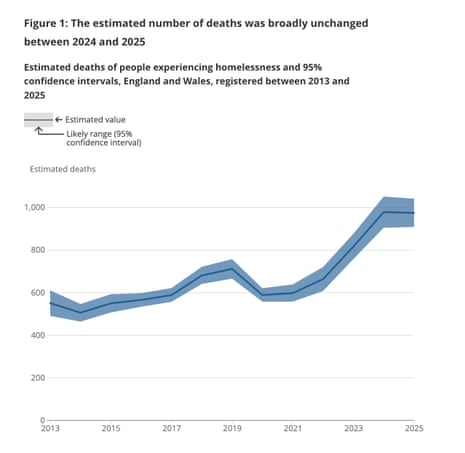
The Office for National Statistics has published a report today saying there were an estimated 974 deaths of people experiencing homelessness in England and Wales last year. That is almost exactly the same as the estimated figure for last year, but 77% higher than the figure for 2013.
Hundreds of prisoners are due to be released early from jail on Thursday amid warnings that many will have nowhere to live and the probation system will struggle to monitor them, reports.
The Conservatives have also hinted that they might cut the benefits available to young people if they are living at home and their parents can support them. They are not giving many details, but this is potentially quite a big change to the way the benefits system works. At the moment young people's eligibility for benefits depends on their own earnings and assets; if their parents can afford to subsidise them, that is not taken into account.
The Conservative party says:
The Get to Work Allowance will also put greater emphasis on family responsibility. We will review the role of family support for young adults living at home. A university student's access to financial support can depend on their parents' circumstances, yet the rules for young adults claiming benefits work differently. So we will look again at how parents' earnings and savings are treated, including where parents themselves claim universal credit. Young people without parental support, including those who are estranged, will continue to have a safety net.
Here are more details from the Conservative party's news release about the conditions that would apply to their proposed Get to Work Allowance. It says:
For the first time ever, work requirements and support will kick in immediately, as soon as a young person makes a benefits claim. Each young person will also be assigned an individual Get to Work Manager whose job it will be to make sure they get into work.
Each young person will need to complete assigned work activities to get their Get to Work Allowance each week. Activities will depend on the young person's qualifications, experience and motivation. For instance:
-Daily attendance at a local job centre, on work experience placements, training/work readiness courses or community work schemes set up with local councils;
-Participation in job search and application workshops, and interview preparation sessions;
-Group sessions to develop the communication skills, teamwork and behaviours that employers tell us are so often missing in young job applicants.
Those who complete the Get to Work programme successfully will receive a 'Ready for Work' Award recording the skills they have demonstrated. After six months on Get to Work, young people still seeking to claim universal credit but not working will drop down to the Subsistence Allowance, worth 70% of their previous claim, in line with the policies announced by the Conservatives last week. This will incentivise young people to take work when they are offered it.
The party's news release does not say what the Get to Work Allowance would be worth, or anything about the potential costs or savings from the scheme.
Good morning. The Conservatives start their conference at the weekend and is kicking off proceedings by announcing a significant plan for welfare reform – stopping many under-25s from being able to claim universal credit, the main unemployment benefit.
Instead, they would get a new Get to Work Allowance – which would be subject to conditions from day one intended to help people find work. If after six months they are still out of work, they would go on to a new benefit, a Subsistence Allowance, worth just 70% of their previous claims.
The plans don't relate to disability benefits, because they would only apply to people able to work.
Explaining the plans in an interview with the Spectator, said:
It's unfair to the people who get up and go to work, having others earn more than them for not working. Even families on benefits know that the system is out of control. But no one wants to be the one to get off the treadmill first. We need to force that. Government has to do that.
The Tories are describing this as a "tough love" approach designed to deal with the problem of around one million young people being Neets (not in employment, education or training). , who interviewed Badenoch for the Spectator, has a more colourful description. "This is the nanny state with menaces; Mary Poppins with an umbrella gun," he says.
And here is the Conservative party's explanation of its plans from its news release.
The Conservatives will require all 18-24 year olds who attempt to claim universal credit and who have not previously worked for a continuous period of 6 months to participate in a Get to Work scheme in exchange for welfare. Participants will receive a new 'Get to Work Allowance' which is contingent on their participation in the scheme. To be exempt from these requirements 18-24 year olds will have to demonstrate that they have previously been in continuous employment for a period of 6 months or more, for a minimum of 16 hours a week. Young people on UC who are not subject to work-related requirements, such as for health reasons or due to caring responsibilities, will be exempt.
The programme would last up to six months. Participants could leave earlier if they secure a job, apprenticeship or qualifying education or training place.
For participants in the Get to Work Scheme, the new Get to Work Allowance will replace the universal credit standard allowance. After 6 months, if participants on the scheme have not entered work they will automatically move down to the new Subsistence Allowance announced last week by the Conservatives. This is paid at 70% of the current Standard Allowance and will be pre-loaded onto a Back to Work card that prevents claimants spending on alcohol, cigarettes and gambling. After six months they would continue to be subject to demanding conditions.
We have not heard from Labour yet, and that may be because the party is not sure yet how to respond. Alan Milburn, the former cabinet minister, has finished the final report from his inquiry into Neets and it is due to be published before the budget. He is also expected to propose measures that would impose more conditions on young people getting out-of-work benefits because he also wants to stop people being consigned to a life on benefits. And ministers are expected to adopt his plans. We don't know the details of the Milburn/government scheme, and it will probably involve more carrot than stick than the Tory one. But there may well be quite a lot of overlap too.
I will post more on the plans, and the Badenoch interview, soon.
Parliament is not sitting, and there is not much in the Westminster diary. But Nigel Farage, the Reform UK leader, does have a rally at 2pm this afternoon where he will respond to Andy Burnham's conference speech..
I'm afraid we are no longer able to have comments open below the line every day on this blog. If you want to contact me, please email politics.live@theguardian.com. You can use this email to flag up corrections, comments for publication, questions or complaints.