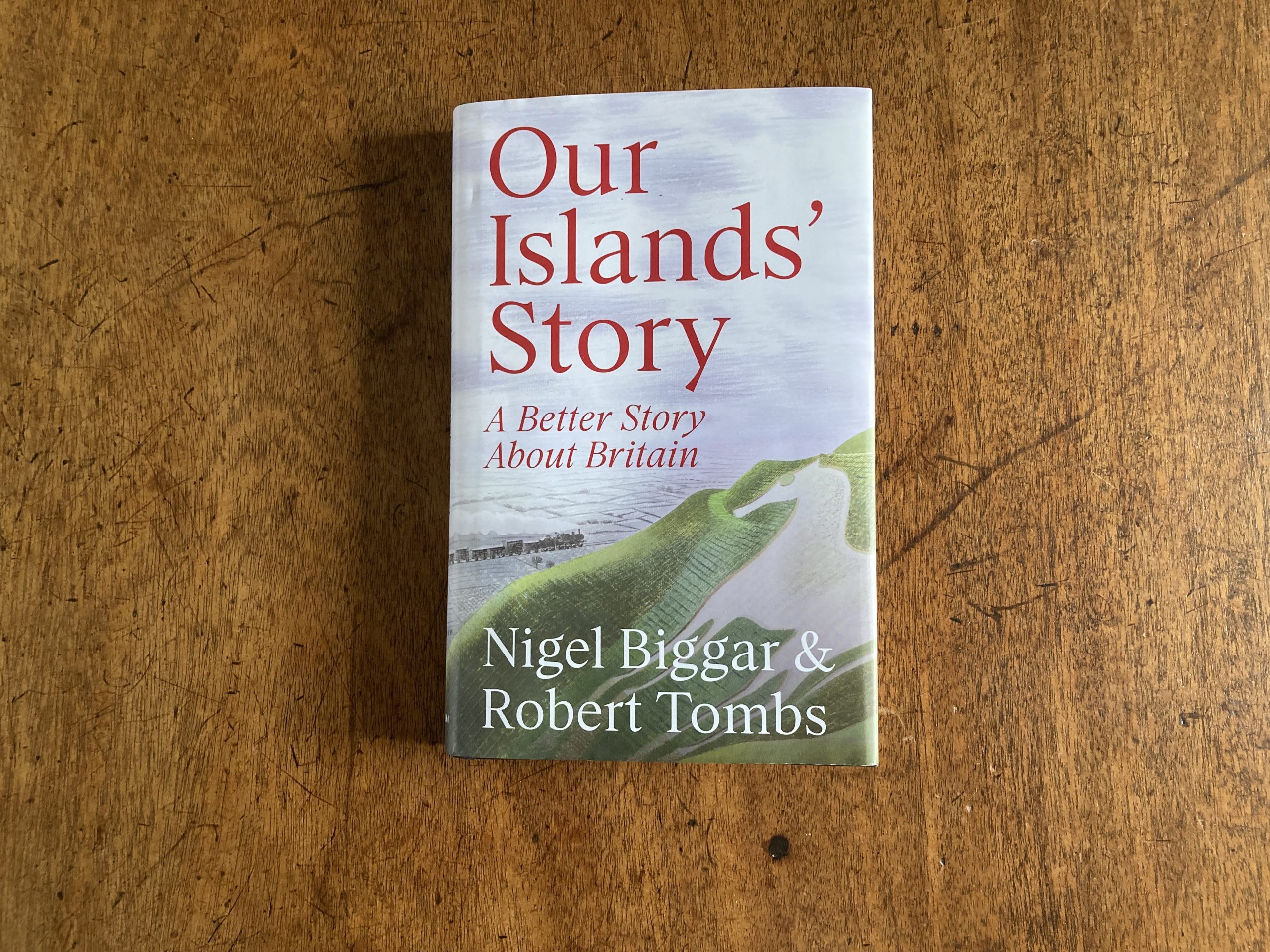
Our Islands’ Story: A Better Story About Britain by Nigel Biggar and Robert Tombs
Kemi Badenoch was “the original inspiration” for this book: in their acknowledgements, buried on page 223, the authors, Nigel Biggar and Robert Tombs, recall that four years ago Badenoch, then Minister for Equalities, invited them to a meeting at the Home Office “to discuss her long-standing concern about the racially divisive assault on Britain’s history and heritage, and how best to push back against it.”
It is to Badenoch’s credit that she called in the two scholars to ask them what could be done, and it is perhaps to the scholars’ credit that they answered her call.
But the resulting book cannot be considered entirely satisfactory. A polemic would be more readable.
So would a satire, if one or other author had the pen of Voltaire and held up to public ridicule the kind of charlatan who denounces the United Kingdom as the worst of all possible nations, and the British Empire as the worst of all possible empires.
Biggar, Emeritus Regius Professor of Moral Theology at Oxford, and Tombs, Emeritus Professor of French History at Cambridge, are not satirists, but sober, reputable scholars.
Biggar’s books include and , reviewed on ConHome here and here, and in 2020 he gave a thoughtful interview to this site in which he described his reaction to the Rhodes Must Fall campaign, and contended with Anglican moderation that human rights are not enough, and virtues such as charity and self-restraint matter too.
The two scholars set out in this book to demonstrate with the utmost scrupulousness that the history of Britain and her empire is far happier than various left-wing agitators would have us believe.
The authors are not writing propaganda: whenever disgraceful episodes occur these are described and discussed.
But we know where they are heading, which makes the journey less exciting than it might be, for neither scholar is a brilliant stylist, and put together they become rather clumsier than normal.
They have abbreviated the story in a remarkable way. A chapter called Homeland History compresses the history of the British Isles into 70 pages, after which the British Empire is outlined in just over 100 pages, divided into 20 different sections, with headings such as (six pages), Singapore and Hong Kong, 1819-1979 (three pages), (four pages), West and East Africa, 1808-1939 (three pages), (twelve pages), (five pages) and The Second World War, 1939-45 (four and a half pages).
This arrangement cannot be said to make for ease of reading, but perhaps as a brief introduction, or textbook, it works. The book contains many striking quotations, and the reader is told in the endnotes where these come from, so one can go back to the source to discover more. For example, in the account of (eleven pages) we read:
“According to Nirad Chaudhuri, in rescuing classical Sanskritic civilisation from oblivion, Hastings, Jones and other ‘Orientalists’ ‘rendered a service to Indian and Asiatic nationalism which no native could ever have given. At one stroke it put the Indian nationalist on a par with his English ruler.’ It gave him the material out of which to build ‘the historical myth’ of a Hindu civilisation that was superior to Europe’s.”
In the notes one finds this is taken from Chaudhuri’s The Autobiography of an Unknown Indian (1951), and his later book, (1987). In the earlier work he wrote (this passage is not found in the book under review):
“Very few people seem to realise that nations stand in need of leadership in order to perish or to rot away no less than to rise and achieve greatness. The exceptional men who play this evil role are mostly plebeians puissant in speech, who with plausible words anaesthetise their fellows to the agony of death or drive them like Gadarene swine over a precipice after conjuring up a screen of black magic to hide the trap of death from the wretched herd.”
Chaudhuri defied the spirit of the age with a brio seldom matched by later scholars.
Biggar and Tombs point out that in the American War of Independence, “indigenous peoples and escaped African slaves overwhelmingly supported Britain”, knowing their chances of life, liberty and the pursuit of happiness were better under rule from London.
From May 1940 to June 1941, the authors also remind us, came the British Empire’s finest hour, when along with Greece it “mounted the only military opposition to the expansion of the genocidally racist regime in Nazi Berlin”.
In late 1941, only a quarter of the Eighth Army in North Africa was British:
“the rest was imperial, drawn from Australia, India, New Zealand, South Africa, Southern Rhodesia, Basutoland, Bechuanaland, Ceylon, Cyprus, the Gambia, the Gold Coast, Kenya, Mauritius, Nigeria, Palestine, Rodrigues, Sierra Leone, the Seychelles, Tanganyika and Uganda.
“Meanwhile in the East, the Fourteenth Army was composed of Indians from every corner of the Raj, Nepalese, Gurkhas, Kenyans, Nigerians, Rhodesians and Somalis, as well as men from Kent and Cumberland. By 1945, Indians and Africans comprised 90 per cent of the troops. India alone recruited 2,581,726 men in the British imperial armed forces – whereas only 43,000 Indians fought for the Japanese and 3,000 for Hitler in 1945.”
In the American presidential campaign of 2007, when I happened to meet Barack Obama as he made a whistlestop tour from Philadelphia to Harrisburg, I said to him, knowing I might have the chance to say only one thing: “Your grandfather and my grandfather were both with the British Army in Burma during the Second World War.”
Obama smiled. He was being ushered towards his train, but gave the impression he had all the time in the world to talk to this strange Englishman.
“That’s pretty impressive,” he said, “coming from different angles” – and here he raised a hand and pointed his two index fingers diagonally at each other – “in the British Empire.”
“You’re partly British,” I said, knowing he would understand what I meant, and Obama did not deny the claim, for which his autobiography, Dreams from My Father, offers convincing evidence. It recounts Obama’s search in Kenya for his father, also called Barack, who spoke with a British accent and attempted even when visiting the United States to drive on the left-hand side of the road.
At a personal level, most of us have connections with one part of the British Empire or another. Biggar and Tombs quote Margery Perham, who said in her 1961 Reith Lectures, published as :
“No record can ever be made of all that was done, good, bad and indifferent, by Britain in her dozen or more African territories during the brief years of her tenure. The mosaic is too vast for its pattern to be seen at one time or from one viewpoint…”
What a craving for certainty we have, how cheaply we can seem to attain this by imposing a simplistic and anachronistic morality (it was all bad, it was all good), and how deluded we are if we suppose that blinded by self-righteousness, we are able to see, let alone understand, the vast mosaic that was the British Empire.