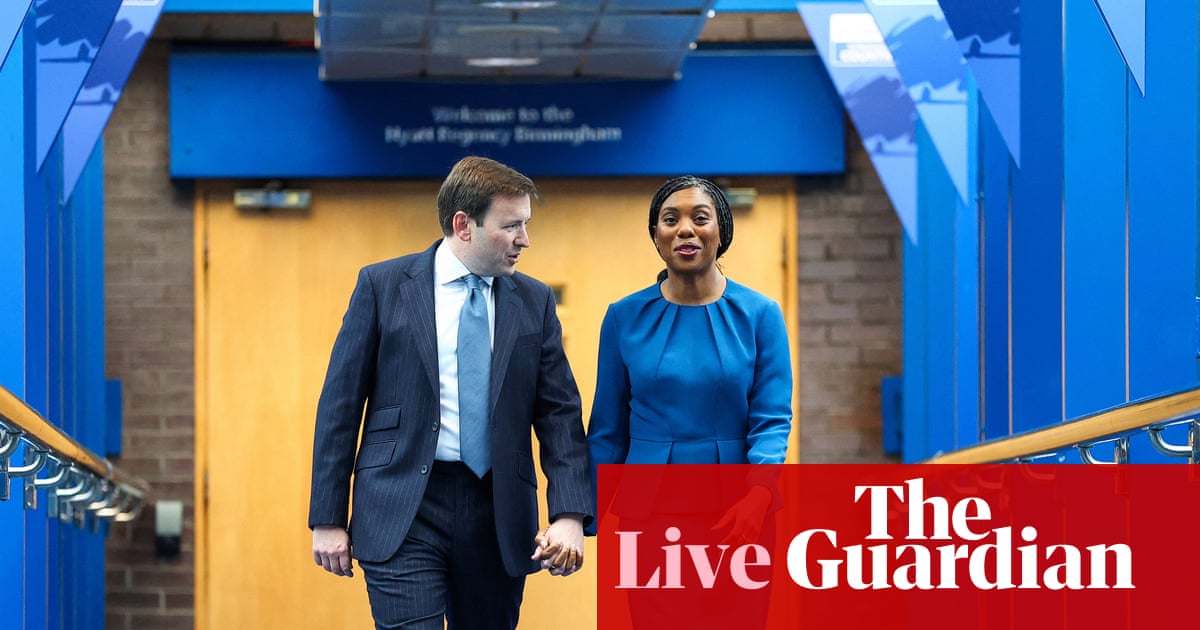
When Ed Davey, the Lib Dem leader, gave his conference speech two weeks ago, he was clearly making a pitch for the moderate Tories who either switched to his party two years ago, or who might cross over at the next election. Since 2024, on migration and Europe, Kemi Badenoch has been sounding increasingly like Nigel Farage. As a result, for one nation Conservatives, her party has been a turn-off.
Now that is changing. The story of this conference is that – belatedly, but significantly – Badenoch is trying to win them back.
That is best illustrated by looking at the headline policies either announced at this conference or in the run-up to it. They fall roughly into three categories.
Policies for everyone
These are proposals that don't benefit a particular demographic, but which arguably are good for the nation as a wh0le. They are, however, almost all ideas that would appeal to people with distinct, rightwing views.
1) "Tough love" welfare proposals that would stop many young people claiming universal credit.
2) Building 50,000 new prison places (funded by slashing aid spending to £1bn a year, although you had to read the small print to find this out).
3) Tightening the rules for people wanting to get a sick note so they don't have to work.
4) Excluding foreigners from the student loan system.
5) Spending £1bn a year on a "Britannia Shield" missile system.
The welfare proposal seems to penalise young people, although the Tories would claim that ultimately they will benefit from a system that does not consign them to a life on benefits. In fiscal terms, it is hard to gauge to what extent the young would lose out because the Tories have not provided clear costings.
Policies for the young
Badenoch is sensitive to the claim that her party only favours wealthy, older voters, and there have been two announcements that do seem designed to appeal to younger people.
6) Cutting regulations relating to building, as part of a series of measures that the Tories claim could cut the cost of building a new house by £50,000.
7) A £2.3bn cut in employer national insurance for young people.
Younger voters may be sceptical about whether these proposals will do a lot for inter-generational fairness. They are both announcements that primarily benefit businesses. Builders might sell homes more cheaply because red tape has been cut, but they might just pocket the gains. And it is employers who pay employer national insurance – although the move should help young people by boosting their employment prospects.
Policies for older, wealthier people
While the policies for younger people may seem relatively marginal, the Conservatives have announced two measures that will potentially have a huge impact on a smallish number of older, wealthy people.
8) Lifting the £100,000 earnings cap which means people on more than that amount do not qualify for free childcare. For some people, this will be worth as much as £20,000 per child.
9) Repealing the mansion tax. Andrew Griffith, the shadow chancellor, announced this in his speech on Monday. This is how the party explained it in a note it sent out later.
The Family Homes Tax, which Labour call a High Value Council Tax Surcharge, was announced by Rachel Reeves in her 2025 budget, and is due to start in April 2028. It will add between £2,500 and £7,500 a year to the council tax bill of every home in England affected. Even the lowest band costs more than the average Band D council tax bill in England, which stands at £2,392 this year, so the surcharge alone will cost more than a typical family pays for all its council services. However, there have been recent reports that the threshold could be lowered even further …
A Conservative government will abolish the Family Homes Tax outright, and if Labour legislates before the election a Conservative government will repeal it. The Family Homes Tax is an unfair tax raid on the homes people have worked hard for. It is a purely political and spiteful tax raid by Labour. The tax is expected to raise just £400 million a year compared to the over £50 billion a year raised by the council tax system. It adds huge complexity for very little gain in terms of overall revenue.
Interestingly, asked about the pensions triple lock yesterday, Badenoch said it would be difficult to reverse Labour legislation on this if it becomes law because that money would be spent elsewhere. But she is not applying that logic here.
10) A cut in inheritance tax? If that does happen in the speech later, that will clearly be a third, significant bung to older, wealthy people.
You don't need to be John Curtice to see what is going on here.
It's true that not a lot of people are hit by the £100k childcare thing, but the thing is, all of the people who are live in about 100 seats, 40 of which the Tories need to win from the Liberal Democrats, 20 of them they have to prevent the Liberal Democrats winning next time.
(The other 40 are Labour held seats where a lot of socially liberal high earners are locked in a loveless marriage with Labour to try and stop the Greens winning the seat.)
And he was backed up by the politics professor .
Seems the Tories have finally looked at an electoral map
This is stupid it only benefits rich couples with children"
(Points at map) - look at the blue bits. What do they have in common?
Yes Cons do best with pensioners who have paid off their mortgages but next group to target after that is high income families who feel, not without reason, that they are taxed more heavily than ever. They have noticed and aren't happy about it. That's a political opportunity!
In an interview yesterday, ITV's put it to Badenoch that she was obviously trying to win back older voters in the south of England who are leaning towards the Lib Dems or Labour. replied: "Robert, I'm very sad, very sad, that you're looking at this in crude electoral terms."
Viewers will have taken that as proof he was right.