Margaret Thatcher used to take immense pains over her party conference speeches. First drafts would be composed for her months in advance, by some of the finest wordsmiths in the land.
These drafts she would hack to pieces. Her advisers saw wonderful lines which had been fed into the process too early thrown away.
Ferdinand Mount, heavily involved in speech-writing during his spell as head of Thatcher’s Policy Unit, describes in his memoir, , the extreme misery of the late night sessions devoted to the speech as the deadline for its delivery drew near: the mounting exhaustion of all concerned, the desperate attempts to get the Prime Minister to put the stress on the right word in a joke, the delivery by car of a joke by Jeffrey Archer which proved unusable, the impossibility of getting her to speak with a semblance of sincerity as she promised the NHS was safe in her hands.
And yet from these ghastly sessions a formidable oration would at length emerge. She always took with the utmost seriousness the need to put fresh heart into her followers by explaining with force, clarity and wit what the Conservatives were striving to do.
She was a tremendous performer, seldom dull, and no one could doubt her seriousness of purpose, her burning desire to expound the Tory case, and her high sense of the ridiculousness and feebleness of her opponents: “You turn if you want to. The lady’s not for turning.”
Her great rival, Michael Heseltine, turned himself into a mighty conference orator, whose jokes at Labour’s expense induced helpless spasms of joy in the Tory faithful.
Here is a clip of him in 1976, pouring scorn on the recent Labour Conference in Blackpool, “a one-legged army, limping away from the storm they had created, left, left, left, left, left, left, left, left, left.”
It is just possible that excellent jokes at Labour’s expense are being told at the present Conservative Conference, but the chances of some new Thatcher or Heseltine delivering them on the main stage have been savagely curtailed.
Instead of speeches, we are fobbed off with panels on which line-ups of experts discuss health care or the economy or farming for 15 or 20 minutes.
These panels are as respectable and uninspiring as the Open University broadcasts of the 1970s. They offer no chance to laugh and cheer some new orator who can raise morale.
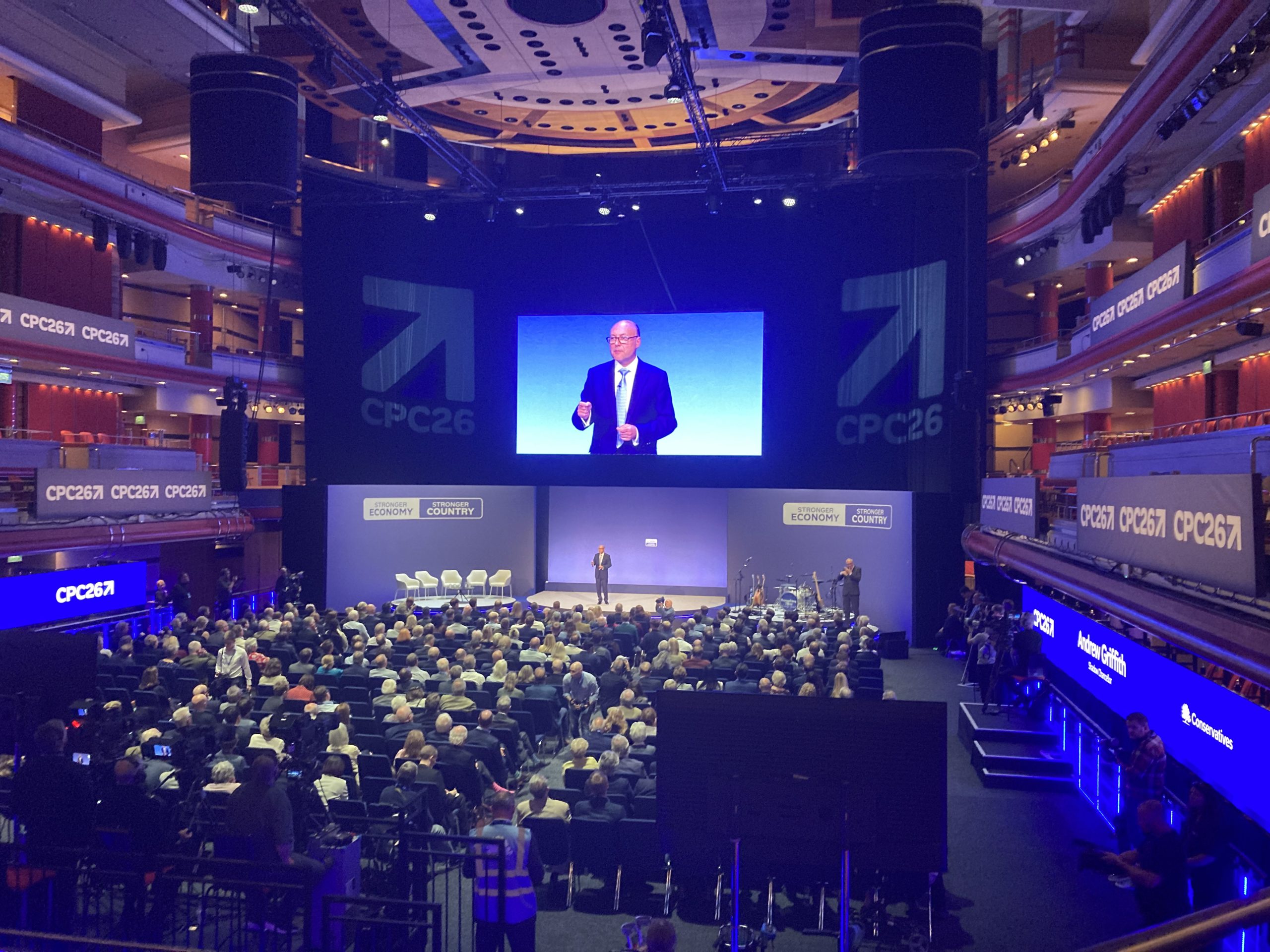
On Monday the main event was supposed to be a speech, heavily trailed in the press, by the Shadow Chancellor of the Exchequer, Andrew Griffith.
A glance at the programme indicated he would be on the Main Stage, Hall 5, at 12.15. Here we hastened, and secured with suspicious ease a place only four rows back from the lectern.
First we listened to a panel on the future of British healthcare, full of expertise, after which Damian Hinds, the Shadow Health Secretary, spoke for a few minutes in a lucid, modest, understated way.
Then came another panel, about how to get into work, with two employers, and two young people in search of jobs who described the obstacles Labour has put in their way.
After which we were treated to a second panel discussing much the same subject, with Griffith as one of its members, one of his highly polished black shoes jiggling under his chair: an indication, perhaps, that he too did not find the format satisfactory.
“I feel a bit short changed,” I remarked to my neighbour at the end of the session, as people drifted off to lunch.
“Yes, so do I,” she replied. “But there it is, nothing one can do about it. We all make an effort to get here. Then this damp squib.”
She was Clare Hopkinson, a former county councillor for Warwick West and High Sheriff of Warwickshire, and went on:
“Kemi’s inspired me. There’s nothing that comes out of her mouth that doesn’t make sense.
“We don’t want bullshit. We need absolutely accurate information straight from the heart.
“I’m here because I want to pass on my very little campaigning experience to the young in order that we win back all of the seats in Warwickshire that we lost at the last general election.
“It was a disaster. We now have only one of the six seats in Warwickshire.”
Hopkinson and I had been misled by the programme, in which no distinction is made between panels and speeches: Griffith was giving his actual speech during a two-hour session in the Symphony Hall on Monday afternoon, in which we were invited “to meet the team with a comprehensive plan to get Britain’s economy growing again”.
The team turned out to be quite numerous, and more panels were held, on one of which Jeremy Clarkson made a guest appearance.
Clarkson said: “A lot of people have come dressed as seats, I see.” There were indeed plenty of empty seats, for who wants to spend the day listening to a succession of panels where everyone, even Clarkson, is on their best behaviour?
He amused us by suggesting that because he enjoys using his digger, he dug some ponds on his farm about which he may not have informed the planning committee, who are notable for their “unbelievably low IQ”.
At last we came to Andrew Griffith’s speech. He stood alone on the stage, reading fluently from the autocue, and gesturing from the elbow, a practice against which Harold Macmillan advised.
But as Griffith himself told us, he spent 26 years in business, so he knows what business needs. He has only been in Parliament since 2019.
Griffith declared that like Nigel Lawson, he intends, once he is Chancellor, to abolish a tax in every Budget. That is a good intention, and one might add that Lawson also had a career before politics.
But Lawson learned how to write and deliver a speech, while Griffith has yet to do so.
That is not entirely his fault. The Conservative Conference is now run in such a way as to offer almost no practice in the arduous but essential art of giving a good platform speech.