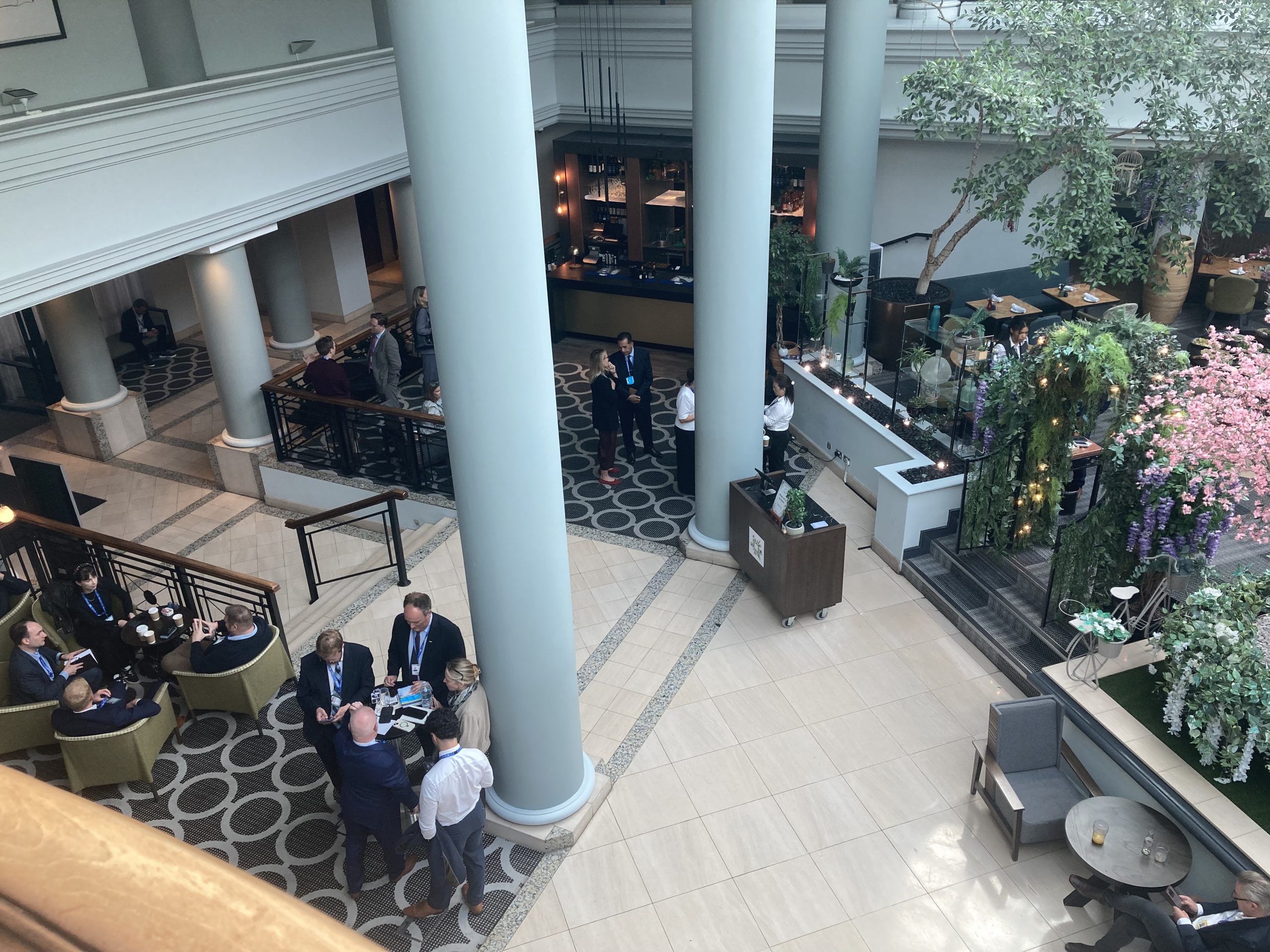
How peaceful this Tory conference feels. It has the charm of an out-of-season holiday resort: one is not trampled by the crowds, and can get a drink within moments of arrival at some place of refreshment.
What a pleasure it is to bump into old friends in the Hyatt, the conference hotel, which in years gone by would have been a moiling mob of politicians, journalists and lobbyists, but is now so quiet (see the photograph above this report) one can hold a civilised conversation.
“I think it’s going rather well,” an aged peer remarked. “Everyone’s relaxed. There’s no nastiness. Nobody is trying to get rid of Kemi.”
He remarked that we live in an increasingly presidential system, deprecated this development, but pointed out that the choice at the next election is likely to be between Andy Burnham, Nigel Farage and Kemi Badenoch.
The Conservatives think this is a competition they can win. Just as Jacob Rees-Mogg in recent days exposed the depraved populism of the clickbait-peddling Tucker Carlson, so Badenoch can vanquish Farage by being more reputable and truthful.
Burnham and the new Chancellor, John Healey, will demonstrate in the Budget on 28th October whether they are serious about getting a grip on the public finances, so the country can spend on defence rather than welfare.
If they defer that hard decision to another day, they will be vulnerable to the charge that they are not serious, and that Healey resigned his post as Defence Secretary in order to bring down Sir Keir Starmer, rather than as a principled protest against pitifully inadequate spending on our armed forces.
So Badenoch and her supporters can see a route to power.
But in almost the same breath they admit that they still have a mountain to climb. All they have done, they admit, is get to base camp without being destroyed on the way.
They think they can see a route to the top, but who can tell what storms may hit them during the ascent?
And how few they are in number compared to what they used to be. To be at 20 per cent in the polls is pitiful compared to almost any time since the party emerged in modern form in the 1830s.
Is anyone out there listening? Hard to tell once one has passed with no delay though the security cordon into the sprawling International Conference Centre, a place which seems to have been designed with the aim of disorientating the visitor.
One is cut off from the outside world, and begins to notice others who feel disorientated.
A distinguished figure leaves an evening event. He is a knight of the realm, and in days past counted for something. Now he has no engagements, for no one has invited him to dinner, or to the drinks receptions after dinner.
He consults his mobile phone, as if it might contain some urgent message. It is as blank as it has been for hours. Who does he think he deceives by this behaviour? Perhaps his greatest need is to deceive himself into supposing he still has some significance.
He leaves the secure zone through a clanking turnstile, puts his conference pass in his pocket, and strolls on a fine autumn evening past the wonderful Victorian buildings, and dreadful modern ones, in the centre of Birmingham.
This was once the city of a thousand trades. As he heads for his hotel, he sees plaques commemorating the mighty city fathers, including Joe Chamberlain, during whose mayoralty in 1873-76 “many great public works were notably advanced, and mainly by whose ability & devotion the Gas and Water Undertakings were acquired for the town to the great and lasting benefit of the inhabitants”.
David Willetts has recently explained for the benefit of ConHome readers how Chamberlain went on to broaden and enrich the Conservative Party by bringing the Liberal Unionists into alliance with it.
Do we still have figures who make the political weather as Chamberlain did? Probably we do. But that is a question more easily answered in retrospect than during the troubles of the present day.
We should not make the error of supposing the past to have consisted of a series of easy triumphs. The first Conservative Conference I attended was in Blackpool in 1983.
Margaret Thatcher had just led the party to the second of her three great general election victories, and had intended, after that triumph, to elevate one of her favoured assistants, Cecil Parkinson, the party Chairman, to the post of Foreign Secretary.
He advised her that because of difficulties in his private life – his former secretary, Sara Keays, was pregnant by him – this would be unwise, so instead she made him Trade and Industry Secretary.
The whole affair blew up during the party conference, and at first it seemed Parkinson would be all right, for he had the staunch support of the PM.
But one evening rumours began to sweep through the crowded lobby of the conference hotel, the Imperial, that Colonel Keays, father of Sara, had given an interview to which might well render Parkinson’s position untenable.
The first edition of the paper had appeared on the streets in London, reports of its contents were being telephoned to Blackpool, and minute by minute details of the unfolding story emerged in an atmosphere of hysterical excitement, with almost everyone one met able to contribute some new and fascinating detail.
I had just started working for the Conservative Research Department, which during the conference occupied a room next to a side door of the Imperial. For some reason I had popped for a moment into that room, and when I came out, there was Anne Parkinson, wife of Cecil, being led away in tears through the side door.
Michael Portillo, his special adviser, that night drove the Parkinsons to London. A story which was first-class entertainment to a heedless young man was for the people most closely involved in it a tragedy.
At the time of writing, nothing comparable has happened in Birmingham, which is one reason why the conference has felt rather flat.