Alison Griffiths is shadow Rail Minister and MP for Bognor Regis and Littlehampton.
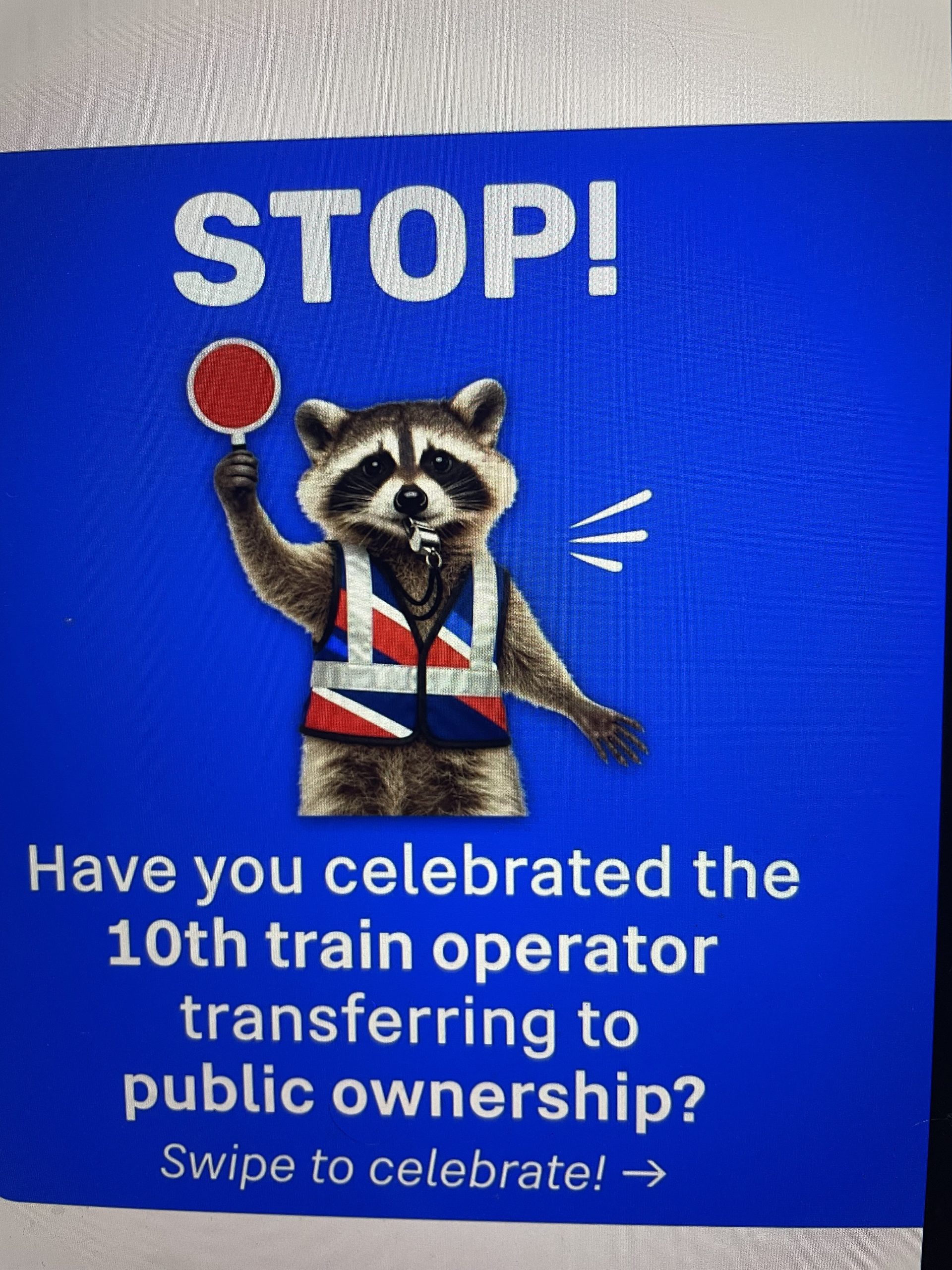
“Have you celebrated the 10th train operator transferring to public ownership?”
That was the question asked last weekend by the Department for Transport to rail passengers delivered by a cartoon Raccoon wearing a Great British Railways high-vis jacket, blowing a whistle and holding up a stop sign.
Those who swiped were wished a “”, complete with confetti.
I first encountered the raccoon when I was on a train which was running late – on a service run by a nationalised operator – and wasn’t inclined to take up his invitation.
As a former Chief Marketing Officer, I appreciate the value of a strong brand and engaging communications, even if I did briefly wonder why an animal that is not native to these isles had been chosen as Great British Railways’ mascot. But, as anyone who has ever worked in business will tell you, to create customers who truly want to celebrate with you, the brand promise must match both the substance and the service delivery. Again, and again, and again.
That is where Ministers should be concentrating their efforts.
Before the election, Labour promised a “reliable, affordable, efficient, quality, accessible and safe” railway.
Nationalisation was presented as the means to deliver those ends.
Yet the Government seems to have dropped the focus on reliability and affordability and increasingly appears to be celebrating the change of ownership as an achievement in itself. Indeed, last week, the Telegraph reported that £80,000 of taxpayers’ money was spent repainting a Chiltern Railways train in Great British Railways colours for the launch.
Ironically, even this train arrived late for its own party.
The package announced for Chiltern includes more services, additional seats, refurbished trains and better onboard facilities. Those improvements are welcome, but it contains no Chiltern-specific fare reduction, and the much-trumpeted fare freeze predates public ownership. Nor does it set a new target for punctuality or cancellations.
Much of the positive work began before the transfer into public ownership.
The previous operator began the £12 million refurbishment of the fleet, as well as the additional trains and updated timetable. In the official press release, Chiltern’s Managing Director credited the improvements to “years of planning, dedication and hard work” by its staff.
Ministers should understand that they cannot simply spray flashy new branding on improvements that are already under way and claim them as proof that nationalisation works.
I don’t buy it, and neither will passengers. Yet that is increasingly what is going on. Earlier this year, the Sun revealed more than £35,000 of taxpayer’s money was spent rebranding a train for Andy Burnham’s Bee Network launch while he was Greater Manchester Mayor.
That was despite officials admitting “we haven’t really got anything to say”.
Slick new ‘paint jobs’ may make trains look better for Minister’s photo opportunities, but they do not make the railways work better for passengers. Ministers should surely wait until passengers can see the benefits they were promised before reaching for the confetti.
Britain’s railways do need reform, but replacing several private operators with one enormous state monopoly will not itself fix poor services. Labour pledged to sort out the railways at the last election. Two years on they have got carried away with the ideological excitement of their nationalisation project, and seem to have lost sight of the end goal: delivering for passengers.
We all want a reliable train network that runs on time, puts passengers first, and is affordable. If they can deliver that, it would be a just cause for celebration. Although perhaps we can agree to leave the racoon out of it.